
The idea that individuals favor using either the right brain to produce creative results or left brain for logical thinking is a recent one. It originated with the work of physicians in the mid-1800s, so at least it’s recent compared to the span of human’s study of the brain. In earlier centuries, this dichotomy in thinking styles was attributed to functions of the stomach and heart, or a result of excessive black bile or blood. Ancient Egyptians understood something about the brain. They performed surgery on it as early as 3000 B.C. and some of the patients survived. One of the Egyptian’s theories was that the main purpose of the brain was to cause pain.
But, back to how modern humans decided that our brains have a creative and logical side. In 1865 a French physician, Pierre Paul Broca, pinpointed Broca’s area in the front left of the brain after studying patients suffering from aphasia (the inability to speak) due to physical brain injuries. This area provided a critical component in speech production. In 1874, Carl Wernicke uncovered another area on the back left side also responsible for language processing. Damage to Wernicke’s area resulted in people speaking phrases without meaning. They weren’t just parroting the latest catch phrases at random moments. Instead people with Wernicke’s type of aphasia used obviously incorrect words or spoke in an incoherent and jumbled manner.
The challenge was on. Surgeons were eager to map brain functions and get a section of the brain named after themselves. Language was considered a component of logic. Many areas of the brain that dealt with this ability were on the left side, and those supporting visualization were on the right side. But this wasn’t a rule in all cases. The resulting brain maps were too complex for the ordinary person to comprehend. So, early pop psychology entered the scene and produced simplified diagrams of both hemispheres of the brain with a border in the middle between imagination and logic.[1]
People were tagged as ‘right brains’ if they could draw and ‘left brains’ if they were analytical.
Carl Zimmer
According to current science writer Carl Zimmer, ”People were tagged as ‘right brains’ if they could draw and ‘left brains’ if they were analytical.”[2] However, more recent research questions that conclusion. A joint study performed by psychologists from the U.S. Army and the University of Melbourne found that gifted students did better than average students on tests that required the two hemispheres of the brain to cooperate. It didn’t matter if their ability was in math, art or music. The ability to use both sides of the brain, with their intricate interdependence, together for a single task is a hallmark of “giftedness.”[3]
If someone asks you to concentrate on “right brain” thinking when writing, remember that a whole brain is better than a half a brain, especially when it comes to creativity.
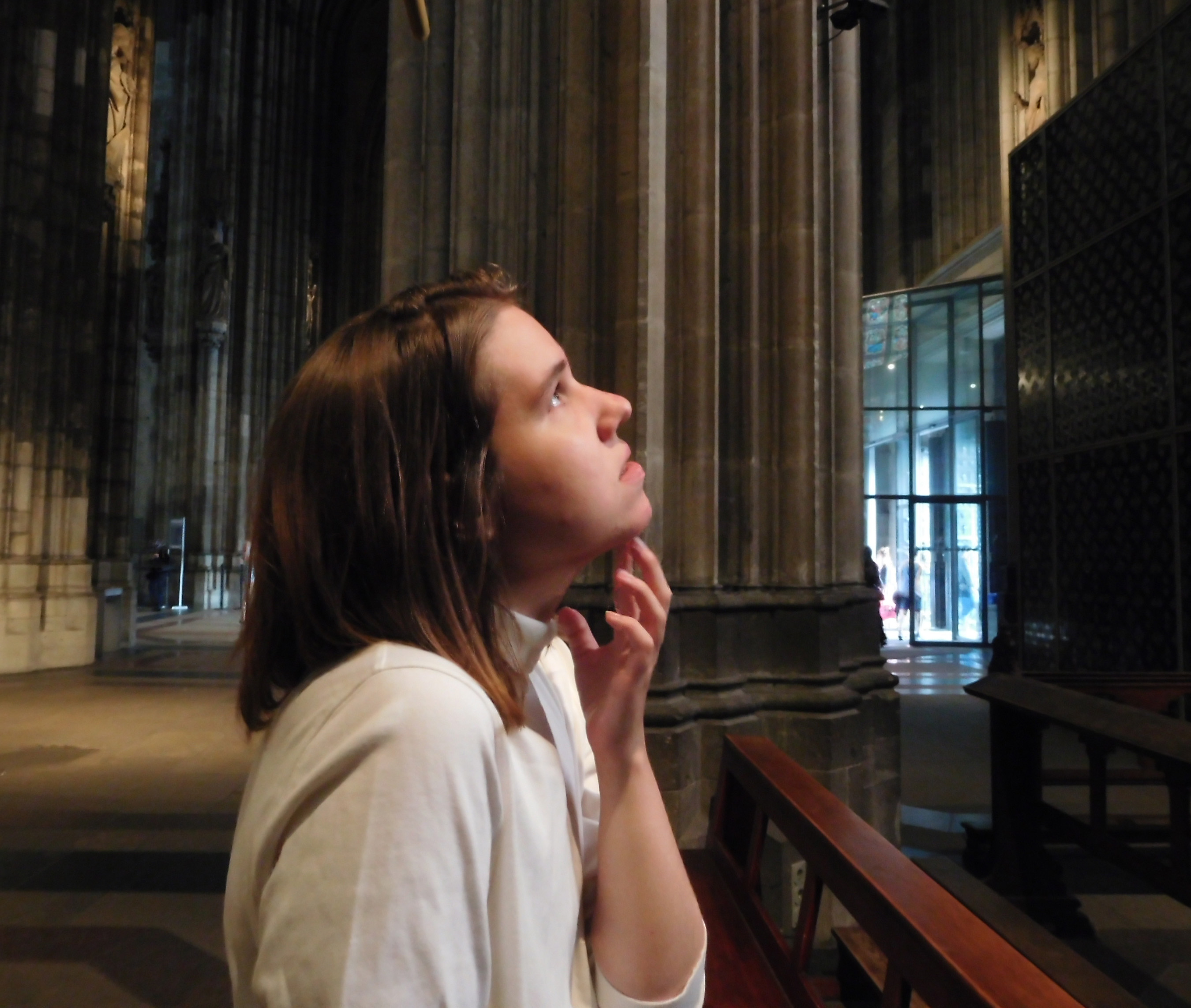
Photo of Koln Cathedral. Germany by K.N.Listman
[1] Wanjek, Christopher. Left Brain vs. Right: It’s a Myth, Research Finds (accessed Feb 17, 2014)
[2] Zimmer, Carl (2009) The Big Similarities & Quirky Differences Between Our Left and Right Brains. Discover Magazine (accessed Feb 17, 2014)
[3] Singh, Harnam, and O’Boyle, Michael W., Interhemispheric interaction during global-local processing in mathematically gifted adolescents, average-ability youth, and college students” Neuropsychology, Vol. 18, No. 2.


 Write about what?