
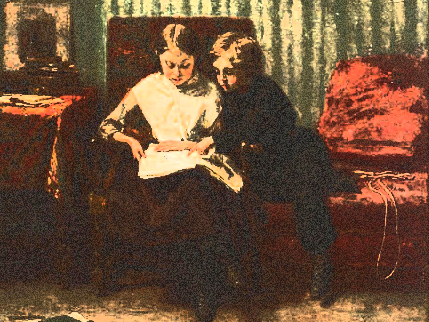
I find the “show don’t tell” adage for writers a curious contradiction. Unless you are writing a movie script that will be produced, everything that you record is actually told to the reader. Writing is very abstract, so providing this kind of instruction requires bringing the abstract to a more concrete level. When authors give examples of showing versus telling they often demonstrate a fifty/fifty approach and intersperse detailed descriptions and dialog with exposition that simply tells the reader what has occurred.
If you have ever read Marcel Proust’s À la Recherche du Temps Perdu (English title: Remembrance of Things Past or In Search of Lost Time) you find sounds, smells, and textures, along with the characters’ movements and dialog overflowing the narrative. There is a lengthy paragraph on the taste of a Madeleine cookie dipped in tea that starts the ball rolling for the author’s memories. His work is a prime example of showing. The first volume contains the popular self-contained story entitled Un Amour de Swann (Swann in Love), which I read in French class. Enthralled with Proust’s writing, I continued to consume the rest of Swann’s story, only in English translation. This classic finally became a movie in 1984.
I became so enthralled with Proust’s writing that I continued to consume the rest of Swann’s story. “Swann in Love” finally became a movie in 1984.
However, this style may not have been popular when Prost wrote in the early 1900’s. An editor for Nouvelle Revue Française (NRF) rejected his first volume. Reluctantly, Proust paid to have it published by another less well known company. Soon, the tables turned and Proust’s second volume won the Prix Goncourt, a French equivalent of the Pulitzer Prize. The editor at NRF could have kicked himself for rejecting his work and even sent Proust a letter of apology. But, the author decided to stay with his original publisher as he completed this eventual seven book series.
Unlike Proust, many writers who show more than tell struggle to convey subtlety in their work. A reader may not comprehend what is occurring when a character shuffles his feet or makes snorting noise. So, authors may feel the pressure be dramatic enough for all readers to pick up the meaning. For actions to be easily interpreted they must be exaggerated to ensure that the reader detects happiness, anger, or fear on the face of the character. Proust was able to display subtle emotions—boredom and restlessness—but this required interweaving the telling with the showing.
Most readers want an author to tell them what is happening but include enough description of a scene so that they feel they are present. Exclusive showing when writing is best reserved for key scenes. However, when a scene seems to drag on and become boring, this may be a sign to truncate this descriptive style and simply tell the reader what is occurring. Telling takes far fewer words than showing. The trick is to balance between explaining what is happening and displaying events through description of sensory details. When unsure, I write the scene in both manners—one that shows the action, and one that tells what is happening—and choose the one that works best.
Illustration by J. S. Duverger – Wikimedia commons


 Write about what?