
How many times have you read posts in which people argue about the merits of fictional characters? I’ve read enough of these to assume many readers prefer imaginary people to real ones. Fictional characters are often created to be braver, more beautiful, more talented and often more ingenious than real people. They can solve desperate problems within a few chapters. But the real advantage is that created characters don’t talk back. I realize that some authors follow the trend of claiming their characters are so real that they refuse to behave. Instead they ignore the author’s plan and even argue about what they are going to do in the story. I don’t see these authors shaking in their boots in fear. They are still in control of their characters. Asserting that they are not just makes an interesting tale.
My characters live in my head for an amount of time, often experiencing a very ordinary life until a possible conflict arises. Then, I quickly take them down that path to see where it will lead me. The difficult part is capturing the life of these characters in words. But this is the only way to get them out of my head and into those of readers.
What is the best way for me to help readers become acquainted with my characters? The easy way is to tell them that the main character is tall, muscular, drives a BMW with reckless abandon, is frequently impatient, speaks four different languages, has a preference for champaign, and a severe allergy to peanuts. Then, there is the better way, which is to write the narrative in a manner so the reader can observe this character. They follow his reckless drives, see how he reacts when he serves into a ditch to avoid hitting bison. The reader can hear what he says about others, listen to his thoughts to reveal his true feelings. They can even feel his pain when a sumptuous almond cake also contains peanut oil and the burning sensation in his throat begins.
But other less important characters also get their time on the page, because I’m not writing a new version of Robinson Caruso. I will not create them all with the same detailed development reserved for the main character because I don’t want to drive readers up a wall. Each minor character who is seen repeatedly will have a bit of individuality, like a quirk in behavior or a physical trait to make them distinguishable from the others.
So here are some usable shortcuts to creating characters:
Archetypes are the embodiment of a collective set of characteristics. They include the mentor–a wise old man or woman willing to share their wisdom with the hero, or the trickster–a lively character whose loyalty is always suspect. Archetypes must be fleshed out with details to make them unique and different.
The foil is pretty much the opposite of the protagonist or another important character. For example, a short, weak man with boundless patience who hates driving cars would make my protagonist more dramatic by comparison.
The doppleganger is a character who has striking similarities to the main character. Often the most noticeable one is appearance. This “twin” can be an empathetic companion or a cunning advisory. Their traits don’t have the boundaries of other archetypes.
Semi-Round characters are partially developed with a specific combination of traits to keep them from being flat, such as an actor with stage fright.
Creating complex characters for the protagonist, the sidekicks and the antagonist(s) is both more difficult and more satisfying for the writer and the reader. Flat characters who follow basic tropes are predictable and do not require as much thought when writing. It is appealing to use formulaic characters to make writing easier. But, you have to decide who you are writing for and if you can live with your decision.
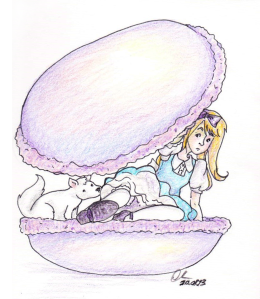
Illustration by J.W. Listman


 Write about what?