The foundation of world building

earth 045As a child, the stories that fascinated me the most were set in other lands. As an adult, reading passages that describe an unknown world still intrigues me. Simply throwing me into a story without a describing the setting leaves me floating in a void without stimuli, similar to floating in an isolation tank. At first this may be enjoyable experience but soon I become disoriented. I prefer the sights, sounds, smells and feel of a concrete world around me.

Basing the alternate world loosely on some existing culture or mythology transported to another time and space, does not do away with the need to flesh out the environment. That is the foundational step in world building.

In The Lord of the Rings, J.R.R, Tolkien gave personalities of regions within Middle Earth– the humble, homey Shire, the menacing Misty Mountains, the eerily unnerving Dead Marshes and delicately balanced Isengard, trying to flourish on the border of a wasteland.

Before embarking on creating your own world, you need to decide exactly what are the differences between the real world and your imaginary one. Of particular importance is the limitations imposed on it. If your world has alternate laws of physics that allow your characters to escape a sticky problem, introduce them in advance because  revealing solutions just-in-time is the mark of an amateur.

What kind of things need to be considered for your new world? How about a brief human geography lesson:

Population: Who lives there? Are they like earth-like people, animals and plants, or something else? If they are something else, limit the number of  species drastically to prevent writing an alternate biology book.

Settlements: What kind of places do they live in? Metropolis, cities, nomadic camps, villages built in tree tops, attached boats floating on the sea, or massive underground hives?

Culture: How do language, religion, and education differ between groups in the society?What kind of political state predominates and how is it organized? Even in a small group such as a family there has to be structures of leadership and division of labor.

Economics: How do the inhabitants gain sustenance, protect themselves from the elements, produce goods and trade with others? Denizens of imaginary worlds must do some kind of work to survive. What is the standard of living and quality of life in your world? Is it changing…. for better or for worse?

Medicine and Health: The medical rules depend on the species inhabiting your world and their level of development. Characters will have to deal with the challenges of illness and death.

History: This is an area that I like to spend a lot of time on which prevents me from actually writing. Most readers don’t want lengthy back stories, so it often works best just to give hints about the history as needed,  unless it is a very intriguing history.

The final challenge is informing your audience about your world without writing an alternate history at the beginning of the novel.  The rules of your world should be introduced in small doses before they are actually needed for the plot. Remember, the alternate worlds in Science Fiction and Fantasy works share more with the “real world” than they differ from it. Otherwise the world you have built would simply would not make sense to the readers.

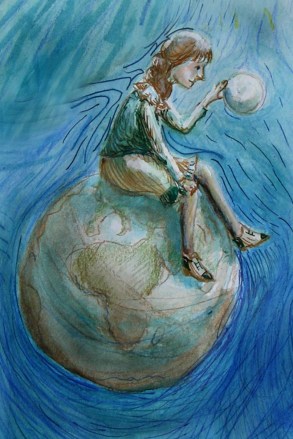
Artwork by S.L. Listman
Posted in Literary devices, Literature, Story structure, Writer's resource | 1 Comment

The art of world building

planet saturn CI wanted to vacation on the banks of the San Antonio River as it meandered through the center of town. The river that had once created messy floods was now encased by sidewalk with a sprinkling of shaggy bald cypress trees encircled with iron grates on the banks. It was now scenic and safe. I choose a strategically placed hotel, which amazingly was built in little over 200 days. The concrete cast room units, already decorated, were stacked in place. The rooms were still very nice, just identical.
Sometimes, science fiction/fantasy authors would like to have the same kind of pre-fab world built. A world, ready for them to plug in characters and start the action. But, instead of being intriguing and complex, these worlds tend to be scenic and safe, full of places  already familiar to us. The act of world building is not easy. It means balancing the need of the readers to understand the imaginary environment with their need for action. They prefer not to read page after page of descriptions before any action occurs.

As I discussed one of my favorite fictional worlds, Middle Earth, with an avid Star Wars fan, I discovered it was easy for her to watch movies portraying other planets. But, she confessed that she just couldn’t make it as she attempted to read through the first book of Lord of the Rings.

This series was so popular when I read it that I couldn’t get a copy of the first book from the library. So, I started with the second one and was dropped right into the action. Betrayal had just split up the party carrying the infamous ring, which I knew nothing about. I had to follow the paths of the fragmented groups. However, I kept reading with the assumption that the author would tell me enough background that I could decipher what had happened. J.R.R. Tolkien did exactly that.

One of the secrets of world building is to create your world—regions, society, languages, cultures and economy—as a handy reference for yourself when writing. Then, you can start your story and slowly weave in the details. If this is too daunting a task, consider borrowing someone else’s imaginary world. J.R.R. Tolkien wrote based much of his made-up world on mythology, Germanic, Norse and Finnish. But, that did not mean that he got away without completing the tedious process of world building, and constructing the physical characteristics, flaws, and temperament of the world and its societies. A fictional world can be flat and predictable or round and well-developed, just like a character.

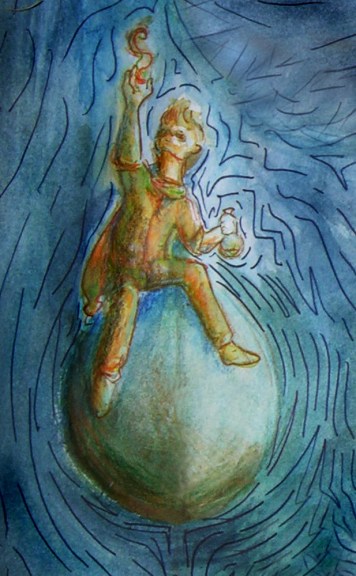
Art by S.L.Listman

Posted in Literary devices, Literature, Story structure, Writer's resource | 1 Comment

Superhuman weakness

knlistman's avatarWrite about what?

A-fest12 004cAt one time there was a “story” circulating about a famous producer of modern supernatural fiction movies, and an unknown screen writer.
The famous producer says “I have a new idea for a movie.”

“What’s the plot?” asks the writer.

“There’s this boy, and he’s really a robot.” the producer answers.

“That’s a plot device, not a plot.” the writer responds.

The American public has an on going love affair with superheros and a lot of writers want to cash in on this. Yet, we keep on recycling the classic superheros. Why? When you give a character a supernatural powers, you can easily become preoccupied with the special ability. Every crisis that arrives is another chance to showcase the special power. Although the crowd of spectators may be astonished, the hero finds solving the problem as natural as breathing. So having a superpower does not guarantee an interesting plot, anymore than…

View original post 311 more words

Posted in Uncategorized | Leave a comment

Let students read what they want?

knlistman's avatarWrite about what?

04242012semana_de_la_cultura086Reading literature in education may be on the way out. It is one of the many previous foundational skills that have been thrown aside to find a place for all the additional science, math and technology that a “competitive” county needs in this world’s economy. In a recent discussion with English teachers I found many who thought there was no problem with exposing secondary students to works written only in the last fifty years or less. Some preferred an even more recent time frame and choose nonfiction or new popular novels to give students books that they found easier to read. They were willing to give students assignments that didn’t require analysis because the author basically told the story.

What do we have to lose when we no longer require students to read works that are not easily read but have withstood the test of time? Perhaps we will be…

View original post 537 more words

Posted in Uncategorized | Leave a comment

Pointed view

knlistman's avatarWrite about what?

point Oct sun 060Almost everyone knows about first person and third person narratives in writing. Basically as humans we all see from the familiar, limited first person point of view that allows us only to know what goes on in our presence.  Much traditional literature is written in the third person omniscient view point.  Omniscient in this case is not really all-knowing, but refers to multiple limited viewpoints. The author follows various characters as they interact in the story and informs us not only what is going on around them, but what they are thinking and feeling, too.

So what happened to the second person narrative? The one written from the “you” viewpoint? Although we frequently use this construction in informally, it almost sounds insulting in other forms of writing. Imagine reading:

 You walked slowly towards the front of the school, clutching your backpack  in your hand. You scan…

View original post 316 more words

Posted in Uncategorized | Leave a comment

The character who saw too much

knlistman's avatarWrite about what?

reading2Writing from the first person point of view routinely goes through periods of popularity only to be followed by a flood of amateurish first person novels. Then, writing “gurus” will advice the beginning writer never to write in first person. However, it is really a matter of whether it fits the story you are telling.

First person is the viewpoint that we as humans are stuck with in real life. Sticking strictly with one person, revealing only what they see,  hear and feel actually simplifies the story telling process. This viewpoint works with a strong plot that is driven by character development. Bouncing back and forth between characters tends to increase excitement, but it also increases a the number of plot holes.  It is easy to forget that characters possess different bodies of knowledge. 

Recently I was reading a mystery movie that began in an interesting manner. There were the…

View original post 243 more words

Posted in Uncategorized | Leave a comment

Writing the right-hand man (or woman)

17oklahoma07 053Most protagonists are not complete loners. Interactions with a sidekick, best buddy or groups of friends typically make up a good portion of the story. Creating the peers of the main character may actually take more thought than creating the main character. Many authors rely on their own experiences to flesh out the major person in the story. However, they have to guess what is inside the head of the companions and must stretch themselves beyond the comfortable realm of “write about what you know.”

However, observation of real life helps when creating an interesting interplay between the main character and friends.  A peek inside of what helps real groups to solve problems may be the key to creating the cohort that complements the unforgettable protagonist. The current emphasis on collaboration  would lead people to assume assembling a large enough group could solve almost any problem. You really don’t believe this do you?

Create a group of more than five people in fiction and readers have difficulty remembering who’s who. This is not much different from real life. In large groups people stop contributing and start a tactic known as social loafing. Research has shown that somewhere from 4 to 6 is the magic number for a truly collaborative group [1]. Any size beyond that and people will follow the loudest voice that supports the status quo [2]. Maintaining status quo not only limits creativity; it also makes a boring plot line.

Unless you are writing the epic novel of your era, too large a number of well-drawn auxiliary characters dilutes the attention that your reader will invest in the struggles and triumphs of the main character. I used to keep lists of characters when reading epic novels, but then I enjoyed studying literature. I am not your typically reader.

In real situations, diverse groups are smarter and better at problem solving [3]. So add someone of the opposite gender as a friend. Put in a best buddy from another city, country, continent or even another world.  Different ethnicity makes different viewpoints more acceptable because, oddly enough, people become more upset when a view that conflicts with theirs is proposed by someone that looks and acts like them, rather than someone who is obviously different.[2]

This kind of attitude occurs in the fictional world also. Consider the difference between a foil and a doppelganger. Cervantes’ Don Quixote is tall, thin, and an impractical idealist, while his sidekick Sancho Panza, is short, fat and a realist. These differences in temperaments and appearance not only play the main character off of his side kick, but provide a range of resources so that they can assist in helping each other get out of trouble.

However, the when the main character has a twin, a person who appears the same physically but is on the other side of the behavioral spectrum, the outcome is virtually bound to be tragic. It doesn’t matter whether the twin is an actual human, as in the Charles Dickens’s Tale of Two Cities, a mythical doppelganger, as in Edgar Allen Poe’s William Wilson, or simply an illusion as in Fyodor Dostoevsky’s The Double. One (or sometimes both) of the identical appearing people are almost always doomed. There is an occasional exception. In Joseph Conrad’s The Secret Sharer the young captain benefits from saving the life of his criminal look alike.

When it comes to creating the friends of the protagonist, you may not be able to always write what you know, but look at what others have written, both in fiction and real life research.

[1] Useem, Jerry.  “How to Build a Great Team” Fortune  Magazine, June 1, 2006 
[2] “Is Your Team Too Big? Too Small? What’s the Right Number?”Knowledge@Wharton. Jun 14, 2006
[3] Woolley, Anita. and Malone, Thomas. Defend Your Research: What Makes a Team Smarter? More Women, Harvard Business Review Magazine June, 2011.


Posted in Literary devices, Writer's resource | Leave a comment

When characters collide

knlistman's avatarWrite about what?


Face_Off copy
Consider the possible basic conflicts in fiction:  man against environment, man against man, man against society, and man against self.  In most plots the conflicts are between people.  Even in Robinson Caruso and Castaway, tales of man surviving in isolation, other people are part of the conflict. The fact that the protagonist  learned to survive  on his own didn’t bring either story to an end. When people arrived on Robinson’s Caruso’s island, they weren’t friendly. The enemy had to be defeated. In Castaway the  biggest conflict occurred when the main character returned to civilization only to realize that the love of his life had married someone else. Contact with people only brought new conflicts.

What causes the conflict between fictional characters is often over simplified. Typically character A and character B want the same thing, but they don’t want to share. This love triangle plot is played over and over…

View original post 289 more words

Posted in Uncategorized | Leave a comment

What makes a classic, a classic?

knlistman's avatarWrite about what?

AIC copyWhen a person refers to classic art, you automatically assume it is the style derived from classic Greek art. This style is associated with city-states on a small Greek peninsula beginning about 500 B.C. and ending 323 B.C., at the death of Alexander the Great. There are other civilizations with other classic periods, blooms in culture led to the height of artistic expression. Why do we assume that the culture is automatically Greek when it is not identified?  One clue is the ending date, the death of the Alexander the Great. Alexander was actually a Macedonian, but military empires often do not come up with their own “culture.” Rather he adopted one of a conquered region and spread it where ever his armies traveled. Having a similar language and culture makes it much easier to rule a huge empire. When the Romans took over they were too busy building roads and outposts to…

View original post 326 more words

Posted in Uncategorized | Leave a comment

What makes poetry, poetry?

knlistman's avatarWrite about what?

Barbara_Fritchie_House 2As a young child I assumed poetry must rhyme.  Meter was beyond my comprehension. It was only that constant repetition of ending sounds that mattered. In fifth grade, the teacher encouraged us all to enter a poetry recitation contest.  The selection had to be memorized.  In a conscious attempt to be an over achiever, I choose a poem longer than any other student, a ballad by John Greenleaf Whittier called Barbara Fritchie.

In what seemed to be a monumental task, I spent the next week committing to memory the story of an old Quaker woman confronting Stonewall Jackson as he marched into Frederick, Maryland.  I didn’t care much about the history behind the poem, but I loved chanting the neat rhyming couplets. Each ended on a single syllable accented word so I could really punch out those rhymes.

However, I did have a bit of a quandary what to do…

View original post 561 more words

Posted in Literature, Writer's resource | Tagged | Leave a comment