A Stuck Character

The character that I’ve imagined is stuck. Literally. He’s in solitary confinement, or in a dungeon, or abandoned on an island, and I know how he’s going to escape. But, for now he’s stuck. Should I just jump ahead to the completed tunnel or the finished raft as my protagonist prepares to leave so I don’t bore my readers? Or, should I take them through this daunting isolated period in my main character’s life?

Perhaps you are familiar with movies such as Castaway in which the protagonist spends over half of the time on an island by himself. Or older films, such as Papillon and Midnight Express in which the major character is in prison for the majority of the film. These prisoners may not spend most of their time in isolation but they still seem stuck in one place without much to do except focus on escaping.

You may also be familiar with some famous books. The Count of Monte Cristo is not about a real count, but a wrongly imprisoned French sailor named Edmond Dantés. He spends much time in the first part of this historical novel in prison and in isolation. Of course, there is the famous novel Robinson Crusoe, with the eponymous main character who spends 28 years on a tropical island.

How do I make a solitary life interesting? First, there is the matter of survival. The main character must figure out how to continue to live. Most readers assume this person will survive until the end of the book, but this often requires finding sustenance and evading dangers. It becomes a game of wits. Making survival seem difficult but plausible is the challenge I take on to keep the reader’s interest.

Most authors do not leave this person in complete isolation. Dantés digs a tunnel that ends up in cell of another prisoner, Faria. Caruso helps a man, whom he calls Friday, escape from cannibals. However, living in isolation can mess with one’s mind. Finding just one other companion is a major accomplishment.

Making isolation interesting may be challenging, but it’s also an opportunity to bring maturity to the main character. While stuck in the dungeon or on the island, there will be lessons the protagonist needs to learn or goals that he needs to achieve. Most of these we would not have considered unless we had gone through these same experiences.

Finally, the main character doesn’t need to be male. The Island of the Blue Dolphins is an excellent story of a woman who survived in isolation for many years. So, the solution to having a character who is stuck is often not to jump ahead to the escape. The most exciting part of the story may be taking your reader through the challenging experience of surviving in isolation.

Photo by K.N. Listman

Posted in Characters, Drama and movies, Ideas for writing, Literary devices, Literature, Novels, Story structure, Teaching writing skills, Trends in books | Tagged , , , , | 2 Comments

My Boring Little Life

What dark secrets can I dredge up to reveal that occured during hours of deliberating about the plot? If I promised to tell the audience the deepest secrets of my life and lived up to my promise, they would be bored. Many well-known writers lead notoriously uninteresting lives. 

Where do they get their ideas from?

Noticeably more introverts indulge in writing books, as it is a solitary occupation requiring hours alone with some way to convey ideas in their heads as words on paper. Some make the major conflict in a novel reflect their own fears about asserting themselves in public. They recall the time another student took credit for an elaborate diorama they created for a school science project. But, the stakes are higher in their story.  The little diorama is morphed into a top-selling book, or a patent for a completely silent engine. 

They may base fictional stories on the most interesting part of their lives but must add thrills and dangers greater than their fibbing partner in the school project. This requires research to fill in the blanks. Authors must read to inform themselves as well as write. They become versed in the stories of others, too.

Many conflicts in books are borrowed from other people. Character personalities come from a similar source. Authors may fulfil their own wish to be in the limelight through a glamorous and charming character or draw from their own strengths to create an independent and self-sufficient one. But, usually there must be more than one or two characters in a story. Observing people around them, and watching how they deal with struggles provides an inventory of ideas to develop multiple fictional characters. 

People with lots of friends avoid solitude. They fear being alone and will seek out the company of other people even when these are nuisances. People with few friends seek solitude and actually find comfort in being by themselves. Sometimes this leads to avoiding social situations unnecessarily.

Authors can collect dramatic conflicts from the works of previous writers, confessions other people tell them, and their own fearful imagination. Some friends like to talk and have stories to tell. If you are around them very long you’ll discover that you’ve heard them more than once. That’s when authors use imagination to embellish these stories.

As a wrap, you have your own life, your own dreams, those of your friends, and those of people you know who aren’t friends to draw from. In addition there are ideas recorded in books that you can blend with your own life. No longer do you have to worry about boring your reading audience with your own little secrets.

Photos by K.N. Listman

Posted in Uncategorized | Tagged , , , , , , , , , | 1 Comment

The Terrifying Part of Horror

The terrifying part of horror is often the nature of the threat. Perhaps only one lucky survivor remains alive through a traumatic adventure out of sheer luck. The terrifying part of reading horror is realizing how much of it is based on gory scenes producing adrenaline in the reader rather than a comprehension of a complex overarching threat.

My son, who enjoyed reading Edgar Allen Poe and Ray Bradbury, showed me a short story written by Bradbury concerning people trapped in a mansion similar to Poe’s House of Usher. Ironically, they could have escaped if they had been familiar with Poe’s work, but they were not.

It’s not a complete coincidence that Bradbury used this idea of willing illiteracy more than once.

Edgar Allen Poe wrote stories above a sixth grade level (often at 8th grade level or higher). Bradbury repeated the theme of willing illiteracy by a public who simply wanted to be entertained. The lack of desire by the population to read challenging works is the reason that book burning began in Bradbury’s most famous novel, Fahrenheit 451.

Much of a generation not used to reading this more difficult literature doesn’t have the patience to dig through Poe’s work. The average adolescent reader hasn’t gained the vocabulary necessary to understand what was said in The House of Usher. I know that is not true of all adolescents. My son is not a one-of-a-kind person.

Because of the preference for simple direct language by many publishers, well known authors create obvious action scenes in horror stories rather than complex psychological problems. On the other hand, Poe provided subtle clues to the horror behind his stories. This deeper interest in human nature leads some readers to prefer writers that delve into human psyche, even if it requires a more complex understanding.

Here’s another article if you wish to read more:

https://today.yougov.com/entertainment/articles/44107-no-film-genre-divides-americans-like-horror-does

Photos by K.N. Listman

Posted in Uncategorized | Tagged , , , , , , | Leave a comment

Do You Know What Polyandry Means?

If you are familiar with Clint Eastwood’s first movie, a musical called Paint Your Wagon you’d realize that a woman having more than one husband is not a recent idea. If you recognize “polyandry” as an ancient Greek term for the woman’s version of polygamy, you’d know that this concept is far older than most current romance authors claim.

Therefore, It surprised me when I saw an author on Facebook bemoaning remarks from a reviewer that hadn’t detected that the plot would revolve around this often castigated behavior of polyandry at the beginning of her fantasy novel. When I read the author’s description I understood why. The author indicated that the heroine has no resources to deal with the stress of deciding between multiple suitors. That would indicate a problem or conflict. As the conflict is a key component of the plot, it becomes disappointing when the problem simply becomes “no problem.” The men are all fine with being part of her “harem.” This leaves the reader with no real resolution.

This brings up the question: what exactly comprises a romance novel?

I could see why a reader might criticize a book that does not have the complete plot arc for a romance. A conflict that turns into no problem is usually only an acceptable conclusion in children’s books and literary works. And, the book in question was obviously not either one of these. This brings up the question: what exactly comprises a romance novel? If the struggle is not finding the right person, even among multiple possible lovers, and ultimately overcoming the problems to get together with the right one, should the book be classified as a romance?

Dr. Zhivago is the story of a man torn by his love for two women, at least in the movie (there’s a third one in the book). What genre is this famous novel by Boris Pasternak? You should not consider it a romance, but a historical literary novel. Pasternak received the Nobel Prize for Literature after he smuggled this novel out of the Soviet Union. The fictional doctor’s romantic liaisons are woven in between a detailed record of pain and suffering caused by the Communist Revolution.

It doesn’t really seem to matter if the novel concerning a woman struggling over which man (or men) to choose is written by a male or a female. Both Madame Bovary by Gustave Flaubert and The Awakening by Kate Chopin end up as tragedies. It doesn’t always have to be that way, as Paint Your Wagon is a musical and a comedy. But, are any of these really considered romances? 

So what should be the genre of a book dealing with polyandry or polygamy?

Photo: “Мечты Стеллы Марис” by Stella Maris – https://500px.com/photo/86751947/in-dreams-by-stella-maris. Licensed under CC BY-SA 3.0 via Wikimedia Commons

Posted in Drama and movies, Novels, romance, Story structure | Tagged , , , , , , , , , , , , | Leave a comment

The Happiness Requirement

“And they lived happily ever after” is not just a matter of fairy tales. A Happily Ever After (HEA) ending remains a favorite of many readers and has likely been one ever since stories were first told. In this age of growing social unrest, HEA as a required satisfying resolution has morphed into the defining factor for an enjoyable read for many audiences. A romantic novel is often not considered as belonging to the romance genre unless the lovers end up in this situation.

Novels are a temporary distraction rather than a recipe for fulfillment. Readers of the initial book in a series may want other similar ones to a point. They probably will not tolerate the major couple splitting up and getting back again more than once. So, HEA may not be the ideal ending for a novel in a series. D.H. Lawrence’s main character in his first semi-auto biographical novel, Sons and Lovers, indicated that happiness was not his goal.

So long as life’s full, it doesn’t matter whether it’s happy or not. I’m afraid your happiness would bore me.

D.H. Lawrence

Penny Locaso, author of Hacking Happiness, views happiness as a state of being that requires constant improvement. Her assumption that no state of mind is permanent came from climbing the economic ladder without finding satisfaction. That’s not a great shock to me. As I grow older I increasingly notice people, who gained everything they wished to have when younger, and yet are still frustrated or fearful. Locaso also noted that fear caused by unfamiliarity with others can cause unhappiness. People who acknowledge both negative and positive emotions tend to be happier.

But, novels are fiction, so I read to find out how an overwhelmed protagonist deals with a problem that I hope to never encounter. What leads to a momentary happiness may be enough to end a book in a satisfactory manner. Let’s return to Hacking Happiness and research findings by the author, Penny Locaso. Happiness may result from helping others. Often characters in romance novels seem self-centered, living in a world revolving around their own desires. Knowing that one character truly made a difference in the life of another could be a happy ending.

For a character to be interesting they should have serious problems. Perhaps, a suitable ending is learning to adapt to problems rather than getting rid of them. So, what if blissful happiness is not the final destination of your characters? They can make the courageous decision to let go of a mindset requiring their own happiness and create a better world for others, or help others overcome their own depression. Either outcome can be considered a successful ending that rivals the traditional “and they lived happily ever after.”

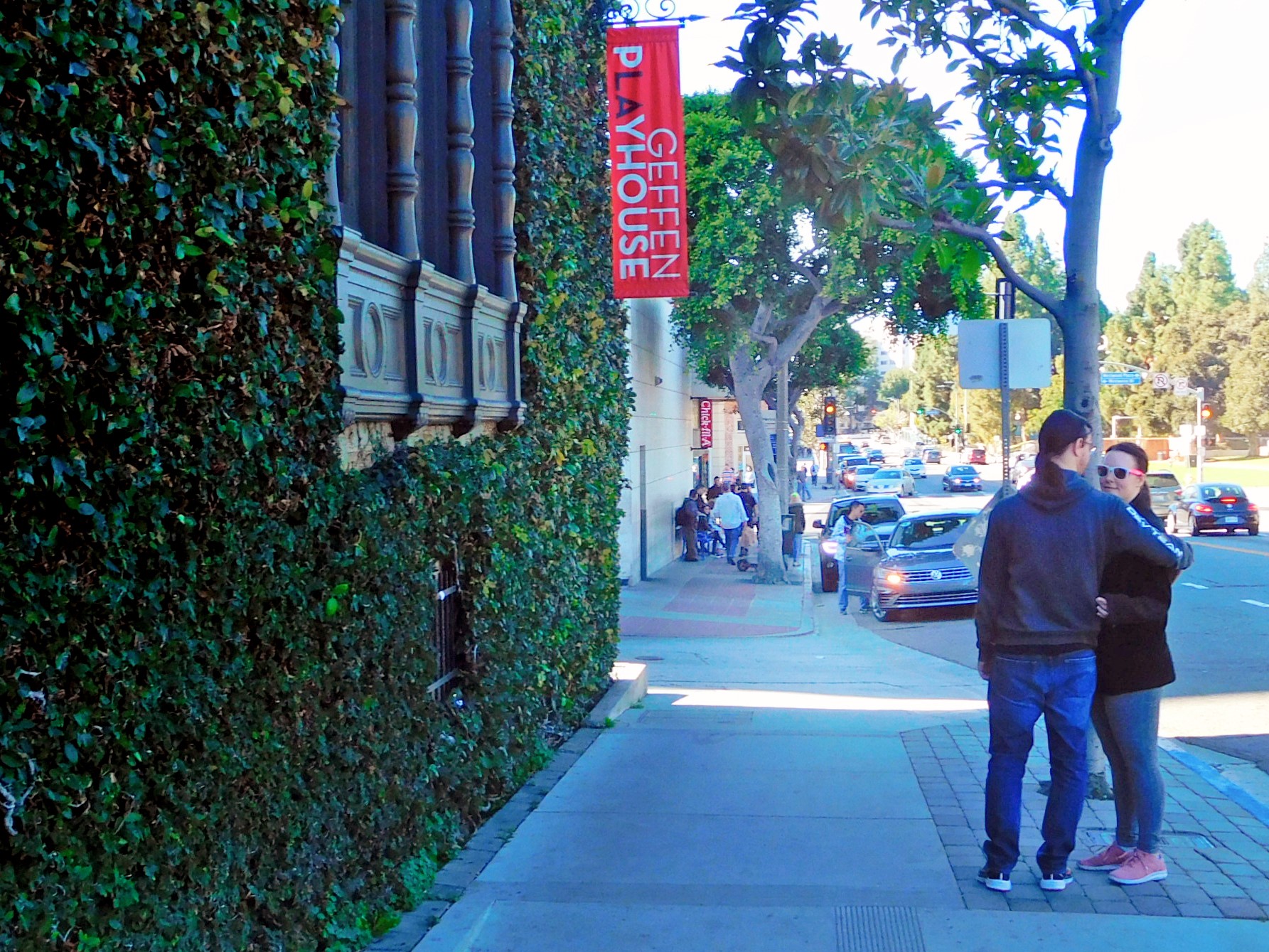
Photo of Geffen Playhouse, Los Angeles, CA by K.N. Listman

Posted in Characters, Ideas for writing, Literary devices, Literature, Mental health, Novels, Psychology, romance, Teaching writing skills, Trends in books | Tagged | Leave a comment

The Language of Empires

Have you ever wondered why we have two words–who and whom–both meaning the same thing. What is the difference? These two words are different cases of the same [pronoun, which are forms which provide clarity. Even people who don’t know how to define “case” notice the incorrect sound when a young child screams, “Me do it!” By school age most of us figure out that “I” is used for the subject of a verb, and “me” for the object. Cases are forms of nouns and pronouns, which clarify meaning.

Who and whom are similar; “who” is the subject and “whom” is the object. But, in American English we forget that. We tend to use who for both: Examples: “Who is there?” and “You hit who?” We relegate “whom” to indirect objects, such as, “To whom this applies.”

This leads to other questions: “Who added cases to our language?” You could blame it on empires. Greek and Latin are the languages of ancient empires and they both used various cases frequently. 

A sixth grade student approached me during a class silent reading period to ask a question. I allowed students to do this when stumped on the meaning of a word. Often they knew the word and just wanted to stretch their legs. However, one student’s question intrigued me. He asked if I could explain the genitive case to him. A basic class in Koine Greek allowed me to respond without thinking.

“It’s the possessive form of a word,” I explained. “If the book you’re reading belongs to Bill, it is Bill’s book. If it belongs to me, it is my book. ‘Bill’s’ and ‘my’ are the genitive case.”

He nodded with a look of comprehension, before the shock hit me. The boy was trying to stump me.

“Who taught you about language cases?” I asked with some suspicion.

“My dad’s teaching me Latin.” He grinned.

Koine Greek was the business form of the poetic literary Greek used by Homer. It spread through the conquests of Alexander the Great. Like the Greeks, the Romans had numerous cases in the language. The widespread use of the Roman alphabet indicates some of the reach of this huge empire. Fluency in Latin was the mark of higher education long after the time period and far beyond the geographic reach of the Roman Empire. 

Although Greece and Rome have left their mark on English, our language is Germanic at its roots.

Although Greece and Rome have left their mark on English, our language is Germanic at its roots. There was no written record of any Germanic languages before the Romans met the Goths. (That’s what happens no one speaking the language reads or writes.) So, understanding the development of the Germanic languages is based on the deductive linguistic work of the Brothers Grimm. Jacob and Wilhelm Grimm did more than collect fairy tales. 

Many current languages have far more cases than English. The romance languages of French and Spanish use them to indicate if words are subjects, objects, masculine, feminine, etc. When cases no longer serve a purpose we tend to drop them. But, until that time we will also not sound quite as civilized when other people still know the difference between who and whom.

Illustration: First encounter of Hernan Cortes with la Malinche at Duran Codex. National Library, Spain (Dreamstime.com)

Posted in Literature, Style and voice | Tagged , , , , , , , , , | Leave a comment

The Imitation Game

You haven’t heard of Herlock Sholmes? Let me tell you a bit about him.

Maurice Leblanc created Arsene Lupin, a well intentioned gentleman thief who aided the bumbling police in finding perpetrators of more vicious crimes. In France, Lupin was as well known as Sherlock Holmes was in England. As a competing author of mysteries, Leblanc wrote a collection of these stories in which Lupin outwits another character named Sherlock Holmes to take pot shots at Arthur Conan Doyle. His intention was clearly mockery. Doyle protested, so these series of mysteries were published with the revised name. In Leblanc’s collection, Arsene Lupin faces off against Herlock Sholmes.

A century later Shu Takumi admired the fictional British sleuth, but was unable to gain copyright for usage outside of Japan. He recreated Herlock Sholmes as a video game character. The character dresses and acts like Conan Doyle’s creation. However this is a video game and Herlock Sholmes needs help. Players must correct the deductive errors of this otherwise brilliant detective. The Leblanc estate made no fuss over this use of character’s name.

The same problem occurred with Leblanc’s most famous character, the gentleman thief.

The same problem occurred with Leblanc’s most famous character, the gentleman thief named Arsene Lupin. He became a favorite character in Japan in the second half of the twentieth century. Hayao Miyazaki (of Studio Ghibli fame) came to public notice as a screenwriter in 1979 with his first full-length movie featuring Lupin the Third, a grandson of Maurice Leblanc’s character. Of course, Lupin the Third, was a polite and skilled cat burglar. The Leblanc estate called foul play at the debut of this character, so the Japanese studio renamed him Wolf, (which is what Lupin means in English), but, he’s still a gentleman thief willing to risk his life to help those in need for a small payment.

Many authors want a ready made character with name recognition. An author who is fond of such a character but has trouble obtaining copyright permission from the family or an author who is mocking the character can morph some one like Sherlock Holmes into a still recognizable name. Both admiration and disdain will produce an imitation. But, adding enough twists and variation from the original can make it our own. That is true even when using a well-known legend, such as King Arthur or Hercules, whose name we can keep for the hero of a story. The more that our ideas shape our variation, the more chance the character has to make a life of his own.

We may have a hearty dislike for people who mock our creation, or who take our ideas to create new forms of income for themselves. But remember, imitation is also a form of flattery.

Photo by K.N. Listman

Posted in allusions, Characters, Ideas for writing | Tagged , , , , | Leave a comment

Fiction from my Family Tree

One of the reasons that there is “nothing new under the sun” is because human creativity depends on our experience. But, I have only lived one life. Rather than writing an autobiographical series about a rather sedate existence, I would choose to record a fictionalized history of my ancestors.

In my family tree exists a woman, who is a daughter of a Separatist from Nottinghamshire, England. She moved to Amsterdam and married a local Dutchman. I would have to create a story to show how they got together, most likely in spite of parental protests. I also wanted to know why they ended up in New Amsterdam (currently New York) rather than in Massachusetts with the rest of her kin.

Research was in order. After watching a special about William Bradford. I discovered the Separatists, first headed to Amsterdam. They didn’t like the free-wheeling culture, or the poor wages. This group, whom we now call Pilgrims, returned to England seeking passage to the New World. First, they hired the Speedwell, which did not speed well and was not even a seaworthy ship in the rough oceans. They returned and left again with only the Mayflower. After suffering severe weather during the crossing, the pilgrims were blown off course as they neared their original destination of New Amsterdam. But, the captain did not want to risk going against the violent storms to reach Manhattan. That might sink the Mayflower as well. So, he chose Massachusetts, the closest place to land.

In historical fiction, when the facts are few, the door is open to be creative.

Another family reached New York in the seventeenth century by a roundabout way. The man was Sephardic Jew, who left Seville in the late 1500s when the Spanish Inquisition put him in danger. He traveled east to the country that had been Persia and married a woman from that region. Then, he headed west again, all the way to the Caribbean isles, employed by the British to find the source of the gold in these islands. Of course he never found these non-existent goldmines. The British who wasted their money were unhappy. He fled to another island. His son eventually made his way to New Amsterdam.

That’s two stories, the joining of these two adventurous families is a third. But, evidently their descendants’ lives were sedate like mine. I have found nothing more than a list of marriages and births. I would have to recreate the bulk of a fictional account on my own. There is a large market for historical fiction. It does require time for research. But, when the facts are few, the door is open to be creative. 

Personal photo belonging the Neree H.Wood. Photographer unknown

Posted in Literary devices, Literature, Trends in books, Writer's resource | Tagged , , , , , , , , , , | Leave a comment

What’s the Big Deal about Readability?

Today, writers rarely use semicolons, which provide a level of pause between a comma and a period. Authors have declared war on adverbs, forms of the verb to be, or filter words that identify a character’s thoughts. Others want to rid writing of dialog spelled as it sounds. These changes are touted as increasing readability. I suppose the goal is to create text so easy the reader forgets that they are reading.

Despite my experience with a number of classic books written by authors from the British Isles, I don’t recall an overuse of semicolons. But, American author Herman Melville was quite fond of them. I lived through reading his massive tome, Moby-Dick for American Literature class. Despite its 10th grade reading level i and meandering text, this deadly duel between a captain and a white whale captured the attention of America. Moby-Dick remains his most popular work, at least in abridged versions rewritten at a lower reading level.

If you’ re familiar with Adventures of Huckleberry Finn by Mark Twain (reading level 8th grade), you may grasp the difficulty of understanding regional dialects written as they sound. However, the prize for most incomprehensible regional dialect belongs to Emily Brontë. In Wuthering Heights, the servant Joseph’s words in Yorkshire dialect are unintelligible to at least 95 percent of English speakers today. Ah suppose eur mooar fowk could understan’ it i’ ‘a tahhm. (Yorkshire for “I suppose more people could understand it in her time.”) I read Wuthering Heights with footnotes translating this brogue into English received pronunciation. Later editions (reading level 6th grade) revised this servant’s dialogue within the body of the novel.

In the United States today, far more people can read than during the lives of these three authors. However, adult literacy is in decline.

In the United States today, far more people can read than during the lives of these three authors. However, adult literacy started its decline around 2005 ii before the COVID virus. Prior rates fell below the Program for the International Assessment of Adult Competencies (PIAAC) international average. iii Still, the recommended readability level when writing for the general public in the U.S. is seventh to eighth grade.

Evidently, the New York Times best-selling authors are not writing for the general public. Ben Blatt has researched statistics on each New York Times bestseller from 1960 to 2014. The eighth grade was the median reading level for these best sellers in 1960. Today that level is sixth grade. The largest number of bestsellers fall into either the thriller or romance category. Since the 2000s increasing numbers of novels in these two genres are written at sixth grade level or below. iv

Writers might have more to worry about than semicolons, passive tense, and adverbs.

Photo by K.N. Listman


Posted in Fiction in education, Novels, romance, Writing trends | Tagged , , , , , , , , , , , , | 1 Comment

How Creative Do You Want to Be?

What can creativity do? Provide me with insight into yet to be imagined stories, allow me to develop amusing ways to express unpopular opinions, fill up my time when I am bored, or fritter away my precious time when I have work I must get done that I simply don’t want to do. 

People are often classified as creative according to their occupation, with writers, artists and composers getting top billing. Not everyone in these professions is imaginative. Although some people may be more inherently creative than others, I would not classify them according to their occupation. How inventive a person is depends on how much they esteem originality. However, at some point, their ideas need to actually work. Creativity in literature can be unnerving to readers shy away from techniques like stream of consciousness or story told completely as dialog. Extreme experimentation means extreme confusion for some readers, while a few still enjoy works that push the envelope.

The ability to create and innovate appears in all fields.

      The ability to create and innovate appears in all fields. As an electrical engineer my father developed new household appliances/products. One of those I tested was the portable vacuum designed to replace the clunking roll-around canister type. It hung from my shoulder by a strap as I walked through the house poking the long hose like an elephant nose into dusty crevices. His inventions required a knowledge of both engineering and creativity. He probably assumed what was manageable for me as a ten-year-old would work as a new design. However, it also required the approval of the marketing department, and that never occurred. 

      My father wanted me to be an engineer, too. However, I gave into the lure of a typical creative field and majored in art in college. Then, I spent several years working both as a graphic designer and a photographer. Fortunately, I had some positions where my artistic projects required imagination, and I was not just cranking out ads all day long. However, this field changed and new computer technology could do the work that used to require many graphic artists. My company at the time tried to place most of us no longer needed artists in new positions. But, I also had a degree in English, I ended up writing lesson delivered via computer.

      As a graphic designer and photographer, I wrote and publish poetry and flash fiction on the side. However, when my new profession required eight hours at a desk writing, I found myself drawn to watercolor painting and nature photography outdoors. No matter the reputation that my profession had as far as creativity, I preferred exploring the arts in a manner that wasn’t currently paying the bills. Making a living producing new and unusual written work is not a form of play. It takes as much discipline as it does imagination. But if the thoughts inside must find their way out as words on a page, you are stuck with being creative.

Photo of artwork by Colleen McCubbin Stepanic by J.W. Listman

Posted in Ideas for writing, Literature | Tagged , , , , , , | Leave a comment