Why create art?

Picture 014 w

Recently I took a hiatus from an almost daily habit of spending an hour or so writing poetry or fiction. It wasn’t really intentional. Mistakenly, I saw the two weeks work shut down at the end of the year as an gleaming opportunity for writing; especially with my husband’s looming project preventing him from taking the same holidays. I could laze until nine in the morning; leisurely dig through items for winter cleaning in my annual ritual of dividing the necessary from the no longer needed. At noon I could call on friends who I had been ignoring, take the dog on extra long walks  photographing whatever caught my eye, and even have a leisurely conversation with my children during the break between semesters.

One of my tasks during this time was gathering new data on creativity, reviewing what I had collected for over a decade after completing my research on creative talent development.  I recalled the professors in the school of education as hailing the development of creativity among gifted students as our best chance to correct the ills of society. A fairly tall order to expect of students I had thought. How could we expect student to become so creative and that they could come up with the solutions to problems we had perpetuated?

But no matter how impossible the task, building creativity for the result of benefiting humankind is more palatable than the current reason for doing it. Companies wan innovative workers to make money for them. Creative has not become the key to growing the economy, and to keep company profits pouring in during uncertain times. [1] I find an increasing embrace of creative destruction, the idea that technological innovation that will disrupt economic structure from within in the attempt to find a new ways to make money. [2]  I am disquieted at creativity being used to promote unsustainable capitalistic expansion. Much more disturbed than I was as an idealistic art student in the seventies worried about being able to make a living with my ability.

However,  I figured that with a couple of weeks break from work, there would be plenty of time for expressing my own originality. But without a tight schedule that required I actually set aside the hour or two, I failed to do creative writing. After a week of this existence I started sensing a kind of bland, bloated feeling that was hard to shake. Somehow I missed the daily exercise of taking my ordinary prose and recreating it as I played with insights, images, and alliteration.

Really, I do not understand all the reasons that I have this insatiable drive to create works of art. It doesn’t seem to be for the fame or solving the latest crisis for humanity or amassing wealth. My daughter says all art in essentially unnecessary, or it would not be art. However, she is constantly sketching, painting, and writing. She is currently majoring in fine arts; hooked on creativity, too. Ultimately I realize that creating makes my life more bearable, and hopefully I add a bit of joy to others by sharing what I have made.

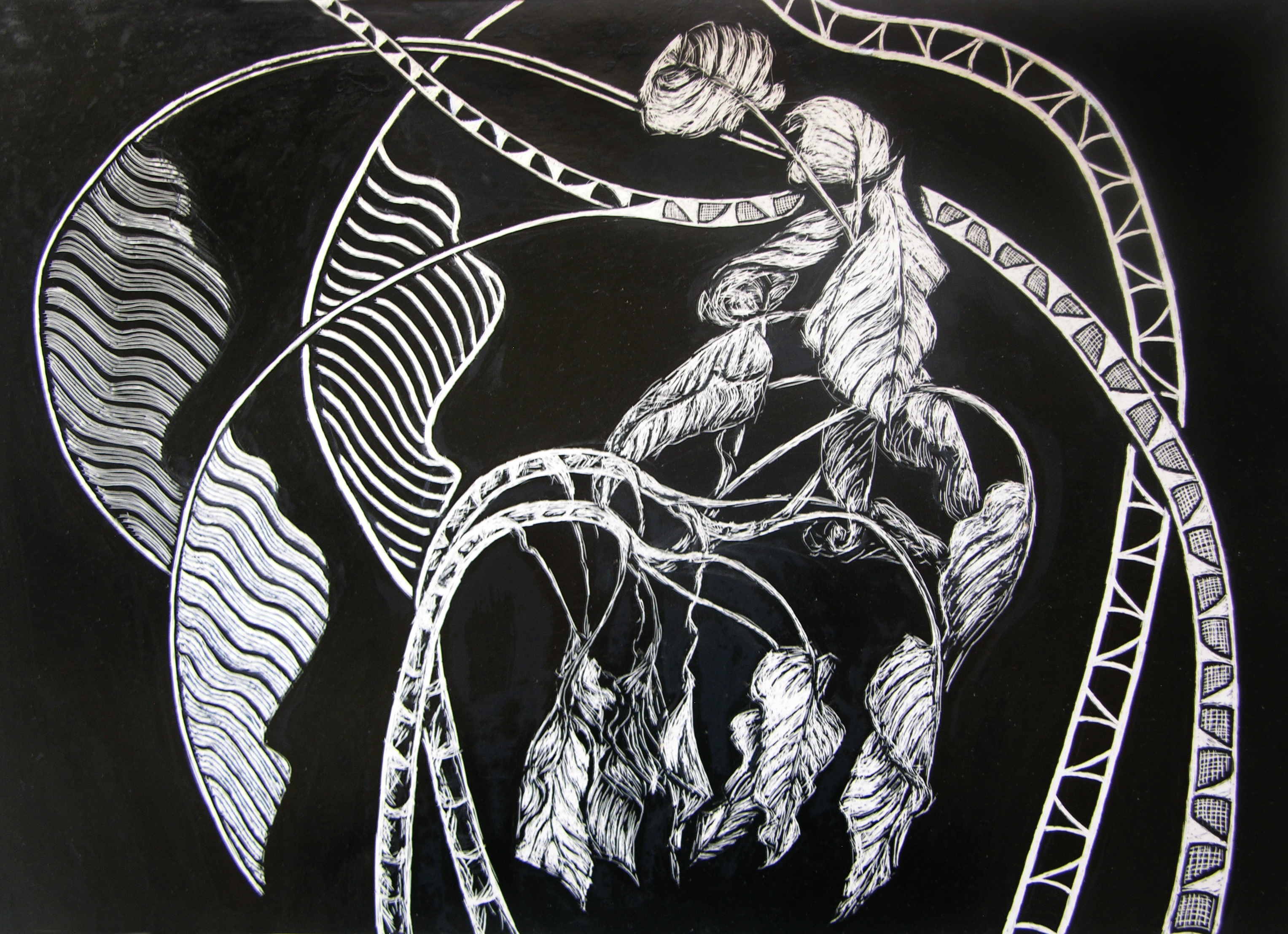
Art by K.N. Listman


[1] Florida, Richard, The Real Reason Creative Workers Are Good for the Economy, Sept. 13, 2013
[2] Schumpeter, Joseph A. (1994) [1942]. Capitalism, Socialism and Democracy. London: Routledge. pp. 82–83. ISBN 978-0-415-10762-4.
Posted in Creativity | Tagged , , , , | Leave a comment

Pointed view

point Oct sun 060Almost everyone knows about first person and third person narratives in writing. Basically as humans we all see from the familiar, limited first person point of view that allows us only to know what goes on in our presence.  Much traditional literature is written in the third person omniscient view point.  Omniscient in this case is not really all-knowing, but refers to multiple limited viewpoints. The author follows various characters as they interact in the story and informs us not only what is going on around them, but what they are thinking and feeling, too.

So what happened to the second person narrative? The one written from the “you” viewpoint? Although we frequently use this construction in informally, it almost sounds insulting in other forms of writing. Imagine reading:

 You walked slowly towards the front of the school, clutching your backpack  in your hand. You scan the entry way for any sign of Derrick and his gang and notice one of his minions loitering around the trash cans. So you sidle around the side of the building to the cafeteria doors just to be safe. You start knocking on the cold glass door, hoping one of the few lingering students would let you in. In your gut you know you are a coward, and wonder how long you can keep avoiding him.

We tend to take the second person “you” personally.  In which case reading about a fearful  character from that viewpoint might not click, because  you would not behave in that way.

However, it has been done, both in poetry, short fiction and novel form.  The most notable novel is Bright Lights, Big City by the American Jay McInerney which appeared in 1984. The unnamed main character (referred to as you) is tired of entanglement in the New York City rat race of the 1980s and is trying to escape the hectic pace of life in the fast lane.  Maybe there was a lot of people with that same dilemma.

Another attempt to break the mold of tradition point of view narratives is the “absent” third person narrator, who sees and relates all details, but reveals no interior thoughts.  In the novel La Jalousie by French author Alain Robbe-Grillet, the reader sees and hears all events from the position of an unnamed narrator watching the interactions of a woman with her neighbor, Franck. However, as these minutely described events continue the reader becomes aware that every element is from the observation of the jealous husband, who seems like a mere shadow, spying on his wife.  The situations he sees appear concrete and objective but may be his suspicions rather than observations – one cannot tell.

So what new spin on point of view will you dream up?

Photo by S.L. Listman

← Back

Thank you for your response. ✨

Posted in Literature, Teaching writing skills, Writer's resource | Tagged , , , , , | 2 Comments

Simply unreliable

The_Great_Gatsby_Fashion_(10032906573)Characters who have psychological profiles, also have their own viewpoint – opinions, judgments and prejudices – concerning the world around them. The first person narrator that is a viewpoint character – such as Nick Carraway in The Great Gatsby – freely gives his interpretation of other peoples thoughts and actions. F. Scott Fitzgerald provides a wealth of descriptive detail that wrap the reader in the senses of the narrator. Sometimes readers get sucked in to viewing the story from the lens of the viewpoint character and fail to see that not all is as it seems to be. I recalled a relatively bright student who normally comprehended literature that complained “I just don’t get The Great Gatsby.”

“What you’ve got to understand is that the characters are often lying to each other,” I explained.  “As you read try to pick up on who is lying to whom. The narrator, Nick Carraway, is still something of an outsider among the wealthy easterners. You cannot necessarily trust what he thinks he sees.”

Nick is a lovely example of an unreliable first person narrator. He’s a sympathetic character and the reader would never accuse him of intentionally lying. Instead he seems to factually report what he sees and hears, colored by his own views. Nick, is also becoming aware of the fabric of deceit woven into the lives of the uber-wealthy. He even voices his vague suspicions about the illusions of the society around him. What was it that made him a tad uneasy around Jordan, that delectable young woman who seems attracted to him? … He heard rumors that she cheated at golf.

Why does an author create a narrator whose words cannot be trusted? Because uncovering deceit is part of the plot. This occurs not only in traditional mysteries but in a wide range of fiction. The whole point of Joseph Conrad’s Heart of Darkness, is not an adventure story about surviving the interior of Africa, but discovering that the legendary Kurtz is not what he appears to be. The veneer drops away to expose a man of former power, quaking in fear, but the narrator cannot reveal the truth about him to others.

There are many ways to create an unreliable narrator that readers will still find likable, a child, an outsider, a person returning home after a long absence, are all good candidates.  The characters who rationalize cruel acts and then lie to protect themselves, such as Vladimir Nabokov’s narrator in Lolita, rarely get any sympathy from the reader. However, the most difficult to write unreliable narrator is the one who is mentally ill.

There is always a hard decision to make: should the schizophrenia (or other mental illness) be revealed in the beginning? Should the story start with a dribble of clues that soon become a flood about the use psychotic nature or the person telling the tale. Or should one wait until the end to reveal that not everything was as it appeared, similar to but not quite the same as “it was all a dream.” This last is probably the most difficult to get away with. Readers may feel cheated by a ploy if the narrator fails to reveal questionable the break in sanity soon enough.  Be careful trying too hard to polish the narrator who doesn’t tell the truth because they are hearing voices and seeing things that don’t exist. You just might drive yourself crazy.

Photo By Eva Rinaldi – Flickr, CC BY-SA 2.0, https://commons.wikimedia.org/w/index.php?curid=36940224

← Back

Thank you for your response. ✨

Posted in Literature, Teaching writing skills, Writer's resource | Tagged , , , , , , , , | 1 Comment

Out of character

char1012_imagery“It fits the  perpetrator’s M.O.” … you’ve heard M.O. mentioned in so many police shows, detective novels, any kind of work related to law enforcement. What is it? A profile of a killer who has struck again collection constructed from every detail  of a crime. The victims’ age, gender, race, style of dress; when it occurred: morning,  weekends, undercover of dark, where it took place: country road, back alley and data on type and make of weapon such as ballistic details, and so forth…

What does M.O. really stand for? Modis operandi, a Latin phrase translated as mode of operation. These psychological profiles do not simple belong to criminals. Companies also have a modis operandi, or preferred way to doing business (which should not fall into the domain of criminal activity). And we all have one, although most of our customary behaviors to get what we want remain unwritten, but are well recognized by our friends and acquaintances.

Characters in books need to have an M.O. also. This goes beyond describing external actions, such as ways of moving and talking. The M.O. is set behavior aimed at a goal. For example, a person hoards money – Silas Marner is a good fictional example –  an old man spending all his days working, and stockpiling his earnings. Does Silas really just want to have a lot of gold in a bag around because it is shiny? He is trying to achieve something else by sitting on wealth. In Silas’ case it is to replace the family that he thought he should have had before he was framed for theft and his fiancée married someone else. He craves acceptance and belonging.

As in Silas’s case the true goal is often intangible: love, inclusion, security, importance, fame, control or power. Those kinds of attainments that one can keep chasing after and never obtain. But the exterior method a person has chosen seems promising in delivering these results. Often we create characters that are simply brave, glamorous, brooding or hot-headed, but if we do not consider why they are that way, and what their goals actually are, we risk having our characters act out of character.

Art by S.L. Listman

← Back

Thank you for your response. ✨

Posted in Literature, Teaching writing skills, Writer's resource | Tagged , , , | Leave a comment

The character who saw too much

reading2Writing from the first person point of view routinely goes through periods of popularity only to be followed by a flood of amateurish first person novels. Then, writing “gurus” will advice the beginning writer never to write in first person. However, it is really a matter of whether it fits the story you are telling.

First person is the viewpoint that we as humans are stuck with in real life. Sticking strictly with one person, revealing only what they see, hear and feel actually simplifies the story telling process. This viewpoint works with a strong plot that is driven by character development. Bouncing back and forth between characters tends to increase excitement, but it also increases the number of plot holes.  It is easy to forget that characters possess different bodies of knowledge. 

Recently I was reading a mystery that began in an interesting manner. There were the spooky chase scenes in the fog with shadowy people disappearing around the corner, However, people also disappeared when surrounded by crowds and nobody seemed to notice. 

The villain had to keep feeding the protagonist with clues in an artificial manner to keep the plot going.  To add to the emotion wringer, the hero agonized about not catching the nasty guy rather than buckling down and actually following the clues he had been given. These were clues that even an extremely narcissistic villain wouldn’t have been spreading around so carelessly. 

However the major problem was the characters, who were obviously human and not omnipotent, manage to learn everything that was revealed to the reader.  Of course, this villain’s willingness to give himself away was blamed on the “insane” genius. But the writer was no genius, and seemed to have forgotten which glimpses of the villain were seen only by the readers because the protagonist  became clairvoyant, magically deducing whatever was revealed to us.

Unfortunately, I have read too many similar stories. So I long for the narrow, confined discipline of the first person narrative. I yearn for plots in which the main characters gleans secrets based on their own wit, explaining to the reader how they came to their conclusion. Perhaps imposing the limitations of the first person point of view is a healthy discipline for writers. At least it is a skill they should master before moving on to the more complex view points.


← Back

Thank you for your response. ✨

Posted in Story structure, Teaching writing skills, Writer's resource | Tagged , , | 2 Comments

Physiological writing

blush de roses et de roches aWhat exactly are physiological reactions?

Imagine you are a young teenage girl. You are waiting in the math hall, and that handsome senior with an air of indifferent confidence strolls past you on the way to calculus. Normally you are watching unseen, but today he looks you in the eye and says “Hi, how’s your day going?” Your heartbeat increases, you breath faster, you start to feel warm, and your face begins to turn red – otherwise known as blushing  – these are the physiological effects of surprise, even a pleasant surprise.

Now, imagine you are a soldier sent to scope out the number of men guarding an enemy compound. After stealthily scaling the chain link fence, you slide between the fence and building, treading softly, trying to conform to the shadows.  You can hear unintelligible conversation. Then, there is sudden silence followed by the click of a semi-automatic weapon. Your heart races, your breathing becomes rapid, you start to sweat, your face begins to turn red – but it is far beyond blushing.

The physiological changes to in your body are similar for excitement and  fear, the difference is in the intensity.  The amount of a change, such as heart rate, are often used to measure emotions in experiments. These innate responses occur before people have a conscious realization of their emotional state. Some scientist have even proposed that the racing heart beat and clammy skin is a cue that lets a person realize he is feeling strong anxiety, fear and so on.

Recognizing how to describe physiological reactions in writing is the first step to putting the reader into the character at the moment that the unexpected happens.  Simply describing the scene puts the reader in the place of the voyeur, watching other’s lives as we often do, seated safe at home or in the theater in front of the big screen. Knowing what the characters feels inside puts us into their heads. This is something more easily captured in writing than it is by seeing a camera shot from the characters viewpoint, which often leaves the audience dizzy and not too sure of the details.

Cathartic writing, to rid oneself of obsession, stress and anger, has often been prescribed by psychologists. What I think about is not how it works to relieve the pent up emotions of the writer, as much as what it captures within the words.  Are the ardor, zeal and fury still there? I wonder when I write, tears streaming down my face,  or trembling in rage, how  much of it remains to be released when someone else reads it.


← Back

Thank you for your response. ✨

Posted in Literary devices, Teaching writing skills, Writer's resource | Tagged , , , , | 1 Comment

Unknown, unnerving

sky storm (6)While watching a military movie, that was unexpectedly full of death in gory detail (i.e. multiple flying body parts) my mind decided I had seen enough gruesomeness I started laughing. Unable to squelch the giggles, I told my husband that I had to use the toilet and left long enough for me to regain composure, and for the film to move onto something less horrifying. Months later I was describing this slightly embarrassing moment at work, giving it as a rational for not having seen but a handful of scary movies. One of my co-workers, a former helicopter pilot in Vietnam, told me that my reaction was normal in real war. He had seen some overwhelmed soldiers start laughing in the midst of the most terrifying situations.

Writers often wonder how they can achieve the heart-pounding, hair raising effects that the sounds and sights of cinema are able to produce. One of the ways to do this is by lightening up. Provide space to breath, so that the impact of horror is more horrible. Passages can continue the move the plot (yes, plot is still a necessity in horror)  that resonate with everyday  concerns and even provide brief humorous moments. The change in intensity is what heightens  the feeling of it. Shakespeare employed this technique of comic relief in his tragedies, carrying on the plot through the humorous conversation of unimportant palace guards, minor officials and grave diggers. And so did Hitchcock, from 39 Steps to Rear Window, he places his hero’s in somewhat embarrassing situations when it comes to the opposite sex that adds humor in between suspense. 

The images and nuances of sound in movies play on the viewers emotions.  But viewers become used to these effects and  their impact is lessened each time they see them again. So the search for the next special effect is never-ending. Watching a 1940’s noir film I sometimes felt like I was trying to peer through a rain of ink wash.  But I was intrigued how the use of the unknown, something lingering just beyond the edge of the grain film, kept my pulse high.  The unknown plays on one’s imagination and is probably as frightening as any concrete scene that a writer, or filmmaker, can conjure up. The difficulty with using the unknown is the inevitable need to provide some sort of the explanation (rational or not) for events. Otherwise the reader/audience tend to be fairly unsatisfied with the work.  But whoever said this kind of writing was easy to do, and still do it well?

← Back

Thank you for your response. ✨

Posted in Literary devices, Teaching writing skills, Writer's resource | Tagged , , , , , , | Leave a comment

Creating pungent memories

Vanilla1webcThe sense of smell is such a powerful memory enhancer that at one time people in the training business tried to capture its potential.  However, the difficulty with using smell to help people retain what they had learned is that very few smells are considered neutral. Most smells carry an association, either with something pleasant, or unpleasant. And people do not always agree on feelings evoked  by particular smells.

For example many people enjoy the pungent smell of vanilla, especially combined with sweet overtones such as in vanilla cookies. However, long ago when I was in college, I was approached by a shuffling, old man in a grocery store as I pondered which fresh fruit would best supplement the rather insipid, college cafeteria food. There was a familiar pungent smell exuding from him as he kept pestering me.  Then, I realized what it was when the stock boy shooed him away.  “Just ignore him,”  the boy told me. “He’s a vanilla drunk.” Now, imagine having that old man in your family and vanilla would might begin to smell revolting.

On the other hand, manure is not considered an enjoyable substance to smell. But I recall many enjoyable afternoons climbing up the wooden planks placed on the still warm, pile of manure behind my grandfather’s barn. My cousins and I would pretend that we were climbing a mountain; Indeed at the top I could see far into the other farms.  We would utter  threats to push each other into the pile with good nature laughs, but never carried these out. Even today, the whiff of fragrant manure as I drive past a cattle farm brings back images of those congenial times.

People begin to compile feelings connected to specific smells from the day they are born. By the time they reach adulthood they have subconsciously cataloged a huge number of smells according to responses based on the situations in which they encountered the smell. This can make the scent of roses luscious or unnerving , depending on your experience. When you use the powerful descriptor of smell in writing, how do you deal with the wide range of connections your audience may already have for the potent, scent of coffee or hot sweat? You must show how your character reads the smell. What’s in your mind must go down on paper, so the reader can also enjoy the acrid, but earthy, scent of warm manure on a lazy, summer day.

Photo of vanilla orchid by National Park Service (public domain)

← Back

Thank you for your response. ✨

Posted in Teaching writing skills, Writer's resource | Tagged , , , , | 1 Comment

The forgotten sense

stollen c

For an recent practice in sensory description, emerging writers chose a photo from their childhood–playing on a snow drenched hill, seeking warmth in the flicker of a fireplace, or splashing in a plastic pool to escape the summer heat.  For many  the photo showed them posed in starched clothes in front of a birthday cake. As part of the exercise, they were required to use descriptors for all their senses. Well, not quiet all senses but the five major ones. However, one did include the sense of balance in the dizzying sled ride down the snow drenched hill.

When it came to illustrating the required sense of taste, almost every nascent author choose to describe something that tasted sweet. Granted humans are only suppose to be able to differentiate between five tastes: sweet, sour, bitter, salty and the newly discovered one that we have been attracted to all along, the savory flavor found in meat. But it’s not that simple. In our experience, these tastes are combined in various percentages and mixed with the potent sense of smell. The results are almost infinite  variations in taste.

Descriptions of taste, like that of smell, have the power to invoke strong emotions, and bring memories lingering beneath the conscience to the surface. That is what Marcel Proust claimed. He said as an adult he remembered almost nothing of his childhood in Combray, except for a brief visit from a certain Charles Swann that interfered with his normal bedtime routine. At least this occurred until a bite of a madeleine sponge cake dipped in tea triggered a nostalgic episode of involuntary memory. Then, childhood memories began to trickle back, such as eating this same madeleine snack with his invalid aunt. Each memory lead to another, until they became a flood resulting in seven volumes about his neighbors in Combray entitled À la Recherche du Temps Perdu.  This masterpiece is commonly called Remembrance of Things Past in English, and includes the well-known classic about the doomed love affair of Charles Swann.

What is so powerful about taste? Our perception of how delicious food depends not just on the taste of the food itself, but also the color, the temperature, the smell, and most importantly, the people around us when we are eating. An adept description of taste actually affects all of our senses. But it takes a bit of skill to fully encompass taste with words; the English language doesn’t seem to be heavy with taste descriptors.

Finally, why did most of the writers tend to capture the memory of sweet tasting things? Memories of good times are more easily recalled than those of disappointing or stressful times. Good tastes are more memorable than bad ones. And, most of us have a sweet tooth.


← Back

Thank you for your response. ✨

Posted in Teaching writing skills, Writer's resource | Tagged , , , , | 1 Comment

Visualizing conversation

converse Ave Ledru-RollinImagine you are creating an everyday conversation of a fairly happy couple lunching at an outdoor café. The idea is to make it sound ordinary but still drop in some clues about the problems looming just beyond the horizon. However, you tire of using the ubiquitous  “said” after every sentence of dialog.

“How was your day?” she intones.

“The new president has made some unusual requests,”  he articulates.

“They cannot be as strange as what Mr. Rossi asked for today,” she utters.

“How would  you know?” he rejoins.

This couple already has deep problems beyond bizarre requests from the new president and Mr. Rossi.  The intellectual verbs used to replace “said” trend to drip with boredom. So, let’s try to add a little more feeling to the conversation and use words that are stronger.

“How was your day?” she demanded.

“The new president has made some unusual requests!”  he exclaims.

“They cannot be as strange as what Mr. Rossi asked for today,” she counters.

“How would  you know?” he retorts.

Now the couple seems aggressive and combative. However, that wasn’t really the idea. They are supposed to be a devoted couple, facing the challenges that the world throws at them as a united front. What could you do to add a little more empathy?

“How was your day?” she cajoles.

“The new president has made some unusual requests,”  he murmurs.

“They cannot be as strange as what Mr. Rossi asked for today,” she croons.

“How would  you know?” he implores.

The romantic way of speaking doesn’t exactly fit either. There are many times when those everyday words—said, asked, replied—are the best choice.  If it is necessary to capture an undertone of meaning that is not evident in the actual dialog, you can throw in an adverb such as “sympathetically,” or an adverbial phrase like “with concern.” You may have heard “Don’t use adverbs with dialog!” Ignore this advice, at least partially. The trick is not to cut them out completely, but use them sparingly to get across the mood of the speaker when necessary.

Another way of adding emotional impact to conversation is to describe the action of the speaker along with the words. What does sympathy look like in a face? The forehead wrinkles, the eyebrows slope down on the outside, the eyes peer ahead and then look down for a few seconds, and the mouth is shut with pursed lips. Describing a face takes a lot longer than to write “He said with concern.” This means you also have to be sparing with showing everything. Some emotions simply have to be told to keep the story going.

You should choose one aspect of a sympathetic face to insert as a cue to emotions in your dialog. “His brow wrinkled,” or “her eyes shifted to the floor.” You might still  have to tack on “with worry” to a facial expression because many readers do not catch on to descriptions of subtle emotions.

The following are descriptions of the seven universal emotions (according to psychologists Paul Ekman  and Wallace V. Friesen ):

  • Surprise – eyes open wide, eyebrows raised, mouth open slightly
  • Anger – eyebrows pulled down, lips tightened
  • Fear – eyebrows raised, mouth stretched open
  • Sadness – out edge of eyebrows and corner of lips both slanting downward
  • Disgust – eyes squinting, nose wrinkled, top lip pulled up
  • Contempt – the lips are raised only on one side, also known as the sneer
  • Happiness – portrayed by eyes crinkled at the corners, and mouth turned up.  If a person smiles using only the lips it appears fake—better known as the evil smile.

Many readers won’t necessarily be aware of the facial composition of the sinister smile when they read about it. However, they can quickly pinpoint a “fake smile” when they see one. Sometimes you just have to label things what they are rather than describing details for the reader visualize. Describing a face takes a lot longer than to write, “He lied.” Therefore, you have to use this technique just as sparingly as adding adverbs to dialog. The best technique may simply to have your characters say what they mean.

← Back

Thank you for your response. ✨

Posted in Teaching writing skills, Writer's resource | Tagged , , , | 1 Comment