Comments About Commas

Among literary devices, one of my favorites is polysyndeton. Despite its fancy name this is a plain device and easy to use. Simply repeat “and” after every word in a list. Polysyndeton provides quick and simple emphasis.

“While driving through a wildlife preserve in Oklahoma I spied llamas and zebras and ostriches and emus and water buffalo. However, I saw no wildlife native to the state.” 

Isn’t it pretentious to use a lengthy Latin term for a literary device that imitates the way a child speaks? Not at all. No commas were used in my list. But, the repetition of “and” made the meaning clear. Such clarity cannot be attributed to the Oxford comma. This punctuation mark, which I prefer to call the serial comma, gained its infamy in a legal case. The lack of a comma between the last items in a list dealing with overtime payments for delivery drivers cost a dairy in Maine five million dollars. 1

Some writers believe such vast sums of money to be of the utmost importance. They don’t want anyone to challenge the sanctity of the Oxford comma. But, using the serial comma doesn’t always work. I found that out when I asked for feedback on a story. The main character, a recent college graduate, reflected on his three day visit to the immense city of Paris in which he meets three women. He never caught the name of the first one, but he knew her intended career, to sing in the opera. By the second day he was a bit wiser and learned more about the second and third young ladies when conversing with them. So, the sentence states, “He compared the stunning opera singer, Brigitte, and Tova.” 

Some readers assumed Brigitte was synonymous with the want-to-be opera singer. The commas around her name indicated an appositive. Using the serial comma to separate the last two items in the list didn’t make the meaning clear but muddled it. If I leave out the comma after Brigitte, it becomes obvious that the young man is weighing the attributes of three different people. The ardent Oxford comma aficionado would say, “You must reword your list so that the comma works.” I could have used “and” between each woman he considered because polysyndeton works where the Oxford comma fails. “He compared the stunning opera singer and Brigitte and Tova.” No comma is needed.

Why is preference for the Oxford comma so proudly proclaimed? Evidently it reveals a certain kind of personality. Claiming affinity for the Oxford comma has been noted on dating sites as a way to show erudite sophistication (especially on Tinder).2 On the other hand, people on Reddit find championing a comma a bit pretentious. I find people who use a specific type of comma as a way to judge other people’s value as a way to turn a useful punctuation mark into a ridiculous obsession. 

What would others think about me if I boldly described myself as polysyndeton proponent?

1 https://www.nytimes.com/2018/02/09/us/oxford-comma-maine.html

2 https://www.gq.com/story/oxford-comma-enthusiasts-unites

Posted in Ideas for writing, Literary devices, Literature | Tagged , | Leave a comment

The Challenge of Writing Humor

I struggle with writing humor. What I find funny is often too close to real life for others to comfortably laugh at it. What others find amusing may irritate rather than entertain me. Once I heard a bit of advice spoken by one adolescent boy to another. “Do you want to know if a girl likes you? Tell a really stupid joke, the stupider the better. If she laughs, she likes you.” It has been obvious for eons that laughter has a sexual side. I am not referring to sex as the subject of humor, but the differences in the way people perceive what is funny.   

So when topics mystify me, I do research to try to wrap my mind around the concept. Allan Reiss of Stanford University studied the response of male and female brains when reading comics. To a large degree they used similar parts of the brain–the part that makes sense of semantics and juxtaposition of ideas. The difference is brain function between genders existed but barely. It was not possible to tell who was male or female by viewing the response results. The part of the brain that deals with executive processing was activated more in the women’s brains than the men’s. The reward center in the female brain was also more active when they found a comic funny.  But, again this difference was minimal.

If am adolescent boy told a stupid joke, a female laughing in response would indicate approval. His male peers would be more likely to respond with a kind of laughter known as scoffing.

Let’s return to our first example. If an adolescent boy told a stupid joke, a female laughing in response would indicate of approval. His male peers would be more likely to respond with a kind of laughter known as scoffing, to show him how stupid the joke really was. Boys, and even men, commonly use humor as a kind of competitive social tactic. We ignore the way males poke fun at other males. However, when adolescent girls laugh at other girls in a ridiculing manner, they are considered “mean girls,” the kind of cliquish queen bees who use cruel humor to maintain their superiority over others.

Women’s humor is expected to be socially supportive, whether they are laughing at a man’s not so funny joke, or laughing with their female friends about a common situation. Don Nilsen, a linguistics professor at Arizona State University, discovered that women who employ the aggressive or competitive male sense of humor will find both men and women not laughing at her. Humor is not affected as much by the way genders perceive what is funny, because their brain functions have very minute differences according to the Stanford study. The difference in how they show amusement over a humorous piece is determined by the role that they assume men and women play in society. 

So what is occurring when men laugh in the way that society prescribes for women. They may chuckle softly in an appeasing manner to show support.  According to Don Nilsen, that is the way that men laugh in front of their bosses. I find myself writing male characters that do this from time to time. However, unlike society, I do not view them as weak. So exactly what are we seeing as differences in the response to humor between people? A funny action for a person in charge is not the same as one for a lackey. People often laugh at humor based on what their society sees fit and let other people shape their idea of what is funny.

A. Reiss, MD, the Howard C. Robbins Professor of Psychiatry and Behavioral Sciences and director of the Center for Interdisciplinary Brain Sciences Research. Dean Mobbs, Nov. 7 online issue of the Proceedings of the National Academy of Sciences.
W. Lawson, “Humor’s Sexual Side” Psychology Today, article 200508, published on September 1, 2005 – last reviewed on December 20, 2012

Posted in Creativity, Laughter and humor, Writing trends | Tagged , | Leave a comment

Name Dropping

Hamlet is often portrayed as a man dressed in medieval finery with a skull cradled in his hand. Many people assume that Hamlet recited his fateful soliloquy “To be or not to be…” as he stared at the skull. That’s not true. He said “Alas poor Yorick, I knew him well.” Yorick had been the king’s jester, and a bit of comic relief. He served the same purpose as the protocol droid, C-3PO, in George Lucas’ film The Empire Strikes Back. During that film Chewbacca holds the head of the dismembered C-3PO in the same manner that Hamlet is often shown holding Yorick’s skull. If the audience does not catch this visual allusion, they can still understand the gist of The Empire Strikes Back. However, Chewbacca’s struggle with the nature of life and death does make the Wookie seem more human.

If you find yourself dangling too close to the edge of sanity trying to come up with the perfect words to describe your character, you can lean on what past writers have done. Allusions are the literary equivalent of name-dropping. Once, I heard an acquaintance refer to another person as an “Adonis.” Despite knowing over fifty people in common, I immediately knew who she was discussing. There was only one man in our circle handsome and charming enough to fit that comparison, and he just happened to be Greek. Alluding to a well-known character, fictional or real, is a shortcut that hands an already developed concept to the readers.

How do you determine which characters or which works should be the basis of an allusion? Use your friendly internet to supply lists of the most famous people, both real and fictional that share the same problem as your character. Then, cross out anyone who wasn’t walking the earth or in through a fictional book more than one hundred years ago. (If that’s too hard, delete any real or fictional person that did not exist before your birth.) Not only have you shortened your list dramatically, you have selected people to use for allusions with staying power.

Is it necessary for readers to read the same books as you have for this kind of name dropping to work? Not always. Any list of the classics used for allusions include the Bible and Shakespeare’s tragedies. People who have never read either one still know that “Judas” is an epithet for a traitor, and “Romeo” describes a male with romantic intentions.

“Alas poor Yorick, I knew him well.” William Shakespeare

When you allude to a character from Shakespeare’s works, you aren’t claiming personal friendship with the playwright. But, people may assume that you know his works well. Yet, you may not have read any of them (just like most of your readers). That is where the difficulty lies. Comparing a character to Romeo because he is old and lecherous is not the kind of romantic male that Shakespeare had in mind. Unless you call him “Romeo” in a sarcastic manner, readers who have actually read the play may start making fun of your work.

It helps to be well-read if you like using allusions. Romeo in the play is not the same person as the brooding Leo de Caprio is in the movie. So, beware of drawing allusions from movies that pale in comparison to the work that inspired them. The criteria that the character has been well-known for more than your lifetime means reading something other than modern works. Drawing on already developed descriptions of classic characters will add depth to your writing. However, if allusions are used incorrectly, you simply sound pretentious.

Posted in allusions, Characters, Drama and movies, Ideas for writing, Literary devices, Nonfiction, Novels, Trends in books | Tagged , , | Leave a comment

Allusions

The man awoke in an unrecognized ancient building. He attempts to leave, only to find doors lock and windows barred. Then, he discovers other people inside as bewildered as he is. They are all being held as prisoners. The only clue is a list of dates on the wall followed by their names. Eventually they are informed that this is to be the date of their trials. However, none have any clue to what crime they have committed.

This was the intriguing start of a book, which a high school student and aspiring author divulged to me. She decided to call this first attempt at a novel The Trials. When I responded, “How Kafkaesque,” her blank stare immediately told me that she was not ripping off the plot from Franz Kafka’s famous work. She didn’t comprehend my allusion. That is the difficulty with using this particular technique. The purpose of an allusion is to reference a name so loaded with meaning that it quickly paints a mood for the reader. How can you be sure that readers will comprehend it?

One person, in a critique group from years ago, wished to allude to the protagonist in Interview with a Vampire simply as a character from an Anne Rice novel. There’s high familiarity with her this novel as it was made into a movie. But, it is not the only well known book Anne Rice wrote. A much larger percent of the world is familiar with Dracula as a daylight avoiding vampire, and Dracula is not the only book by Bram Stoker, either. But, most of his other novels remain obscure. Referring to a depressed woman who shunned daylight as resembling Dracula gets the point across to more readers than comparing her to an unspecified character in a novel by Anne Rice.

A currently popular trend, which has existed from the beginning of novel writing, is to include allusions to famous books with the hopes that the reader will reflect on the book they are reading in the same manner as the more famous one. However, recently I’ve noted YA books that give the character’s opinions of current novels rather than alluding to these works. One of these concerned two college students still holding on to their fondness for Harry Potter books and movies. On the surface, they appeared as cool students and not ones who maintained an immature taste in literature. The other reference was a high school student who preferred early black and white horror flicks to the slick Harry Potter films.

However, neither of these are allusions. Rather they are cultural references. The reader unfamiliar with this fictional teenage wizard may not comprehend the clues they provide about the characters’ personalities. But, clues were not important–rather they served as an excuse to mention a famous series to try to connect to young readers. Even the fans of Harry Potter learn very little about the characters from these references.

If an author wanted to make an illusion to Harry Potter that author might write a sentence like this: “The boy marched straight into the woods at night imagining a little war paint was comparable to Harry Potter’s lightning scar.” The reader would have to realize that the scar gave the boy wizard an enormous amount of protection to understand the foolishness of this other character heading into the dangerous woods after dark. Allusions refer to events and themes found in past literature as they relate to those in the story being told.

When the aspiring teenage author gave me a brief description of her novel in progress, I alluded to Franz Kafka’s work, but it would require her familiarity with it to sense the fearful capriciousness of being sentenced for an unknown crime. It’s important to choose an allusion from the well-known source that has existed in the public memory for the longest time. Although  Franz Kafka may not be as well-known as J. K. Rowling among current high school students, that could change. Since the time I was in high school decades ago, students have been assigned to read some of Kafka’s work. That is not true of J.K Rowling after her books were published. These two authors’ notoriety may switch at some point in the future. At least the high school student who discussed her book ideas with me wanted to know how to spell Franz Kafka. She planned to check the library for any books by him that same day.  

Posted in allusions, Characters, Drama and movies, Education trends, Fiction in education, Novels, Story structure | Tagged , , | Leave a comment

Imagery

Imagery is one of the harder concepts to pinpoint in writing. What exactly is the difference between describing something in detail and creating imagery? This is not easy to explain. Imagery is often a figurative or symbolic description that goes beyond the literal five senses. Imagery is comprised of words on paper (or a screen) and creates a feeling that permeates our imagination.

However, even with this knowledge I still struggled to define imagery in writing. I looked at what some experts in the fields of communication had to say about it. Marshall McLuhan, was known for his communication and media theories, and particularly the application of his theories. His most famous quote is “the medium is the message.”  He wrote extensively on how marketing and advertisement appeals to people. However, occasionally he commented on the realm of politics.

Politics will eventually be replaced by imagery. The politician will be only too happy to abdicate in favor of his image, because the image will be much more powerful than he could ever be.[1]

Noam Chomsky, a linguist and cognitive scientist, who is known for his political involvement has examined McLuhan’s area of expertise, how the public perceives advertisements. According to Chomsky:

Everyone knows that when you look at a television ad, you do not expect to get information. You expect to see delusion and imagery.[2]

There is a similar theme running through both of these quotes, the idea that imagery provides more than actually exists in the object or person being described.  The literary device of imagery can be defined as using words to create a mental picture. However, the mental picture is not simply what exists, but more than what exists. It is an amped up description that provides a greater intensity.

When Marcel Proust used imagery a simple cookie dipped in tea took on a taste, texture and color that made it magically memorable, a song played on a piano echoed in lyric fascination, and an ordinary machine became a frightening monstrosity. In a way imagery is description on steroids.

Some of the techniques that move imagery to this level are comparisons known as similes and metaphors. Similes typically deal with more superficial characteristics. For example, “the sky was filled with clouds, dark gray as slate.” Metaphors typically deal with deeper structural similarities as in “the sky is a vast turbulent ocean of air.” This similarity can be stretched into complex extended metaphors, known as allegories. However in each case the writer is adding nuances to the description that are beyond simply what is observed. Imagery adds connotations which builds another level of perception and results in something being more appealing or distasteful than it actually is.

In the end what reader desires is not simply to feel like they are present with the author but to be able to see the intangibles: the feelings, desires and very beliefs that drive the words on the written page. Remember the imagery in commercials: the man standing stalwart in front of flapping flag sells stability not the candidate, and the car rushing down the open road sells freedom, rather than a brand of automobile. People do  not want what to read books to show them reality, but something beyond it.

[1] http://www.brainyquote.com/quotes/quotes/m/marshallmc135596.html
[2] http://www.brainyquote.com/quotes/quotes/n/noamchomsk635602.html

Art work by J.W Listman

Posted in Creativity, Literary devices, Style and voice, Writer's resource, Writing trends | Tagged , , , , | Leave a comment

Traveling Swan Roads in Books

While reading Beowulf in a modern translation I encountered a person called a breaker of rings. In my mind I could see a burly man hacking gold rings apart, possibly a thief destroying the identity of his latest heist. As it turned out, a breaker of rings is a leader, or a chieftain, who more probably obtained his wealth through trading rather than snatching it like a thief. Beowulf also refers to another leader as a giver of rings. I suppose the more successful chieftain could give his loyal followers entire rings rather than breaking them apart in order to have enough gold to reward them all.

Reading ancient literature in translation is difficult because we don’t know how to interpret such figures of speech. These kennings, or idioms, would help the listener see the images of people and actions based on their own lives. It was a form of showing versus telling. We might assume the word ‘bigwig’ describes a person who is a boss. But, imagine the difficulties that someone from the year 1000 would have understanding it. They might imagine a person collecting a mass of hair to pile on their head without seeing it as a sign of power.  

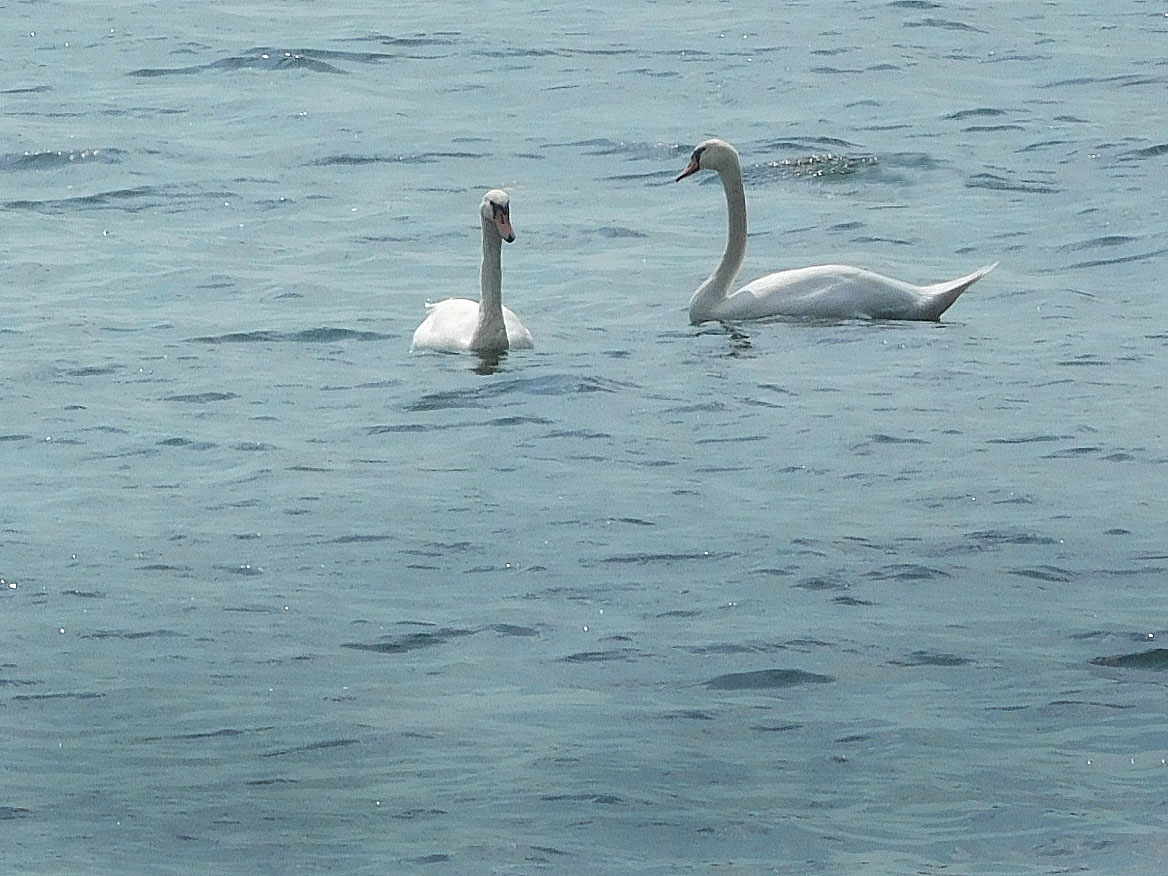
If an early text, such as Beowulf, was translated into completely modern English, we would still stumble over kennings, such as whale road, sail road and swan road. All of these phrases describe the sea. Huge whales and sailing ships travel the ocean, but I’ve never seen swans there. I suppose they may be found in estuaries that border the sea. Even old English authors realized using the same word repetitively was boring and sought out alternatives, some of which didn’t work as well. Are our highways, freeways, and interstates any less confusing than whale roads, sail roads and swan roads? These are distinct types of roads that conjure up distinct images for us, but in reality they overlap. 

Decades ago I was reading an email from my daughter in response to one I sent about how to cut mats with multiple openings to display photos of an art fair. I concluded by asking if the pictures had to be in the “same direction.” In her response she said there could be no mixing of portraits and landscapes. That threw me for a second because I knew some of the pictures were of people at the art fair, and others of the trees in the park where it took place. Then, I realized she was referring to the orientation of the pictures. Rectangular pictures have been aligned either horizontally or vertically for eons. Now we have a kenning, a way of describing orientation based on print options.

Figures of speech fill our conversation and our books with words pertinent to our time and our location. We see those common phrases as being ordinary and easy to understand. Seeing outside of our own existence can be a struggle. Learning to understand figures of speech from another time and place is one of the steps to understanding diversity.

Posted in allusions, Creativity, Literature, Poetry, Showing versus telling, Style and voice, Trends in books | Leave a comment

Leaders within the Writing Community

Writing is often a solitary endeavor. Authors spend hours alone working words and ideas into something alive within their own minds. New writers, unused to such dedicated isolation, often seek inspiration for their creativity–new sources for intriguing characters and unique plots which will win the reader’s approval. They look to experienced writers with hope for help. The experienced author usually desires to be seen as a representative of their craft and a leader within their genre. Despite the loneliness of their career, they crave followers that share their sentiments and are not above accepting adulation. 

If a writer wishes to be a pathfinder and out in front of the crowd, some of the literary crowd will not perceive them to be as appealing. Egos will be bruised and feuds will result. A number of well-known authors have the reputation of stepping on the toes (or worse) or other writers. Ernest Hemingway was regarded as a charismatic person by many in his day. He lived an exciting life, wrote exciting tales and fought with other writers, including a fist fight with the poet Wallace Stevens who was twenty years older than Hemingway. 

F. Scott Fitzgerald became Hemingway’s friends, helped his career, and introduced him to an influential editor. Despite all of this, the younger Hemingway soon began mocking Fitzgerald. He claimed that Fitzgerald’s life was wasted talent, and that the consumption of alcohol which helped him write, was an overpowering poison for the older Fitzgerald. Evidently, this famous author’s flaw was helping Hemingway, who wanted the credit for making his own way in the writing world. 

Later in Hemingway’s career he found he had switched places. Now he attempted to advise a younger William Faulkner in his career. However, Faulkner did not respond with the reverence Hemingway desired, and even mocked his use of an elementary level vocabulary. What crushed Hemingway the most was that Faulkner won the Nobel prize for literature years before he did first.

The more emotional the appeal of the leader in the writing community, the more influential  that leader is likely to become. Also, the more likely that followers will act harshly against this author due to any perceived problems. One of the difficulties with a charismatic leader is they may make an appeal to fight against the common enemies as a way to rise to fame. This often creates an “us against them” culture with people who are not that much different.

Posted in author feuds, Leadership, Literature, Teaching writing skills, Writing trends | 1 Comment

Skip the Formula

At one point in time, 10 years ago to be more precise, I decided to write a romance. According to my critique group a romance is a genre that readers can’t get enough of and therefore an easy to market novel. Most people publish their own because it is an addictive kind of read, that people want to experience over and over again. Romantic leads traipse through the book following a formula. The beloved other person has a magical aura that is unmistakable. Guy sees a girl and just can’t keep his eyes off her (or vice versa). If that doesn’t happen the pair can run into each other, physically bumping into the soon to become significant other person while walking down the street. 

Of course, there is not one attention grabbing technique that will work for every single person. I didn’t want to copy what others wrote. I created a leading male who was attracted to the woman’s voice before he saw her. This is not the correct order in the steps to romance and can sometimes cause a blunder. I recall the seductive sound of the woman announcing the Blue Light Specials at the K-mart. A guy who frequently checked out at the pet department where I worked, commented on her beautiful voice. So, one time I pointed out the disheveled fifty-year-old owner of the sultry voice. He never mentioned her again.

In my romance novel, the young woman was as lovely as her voice. The timid guy who didn’t have the guts to approach her fell in her lap when the plane encountered turbulence as he headed back to his seat from the restroom. But, my story didn’t turn out to be a traditional romance. The romantic hero wasn’t exactly a “prize.” He had a degree, but no job, was shorter than average and suffered from a heart murmur. But, love is a thing that should be able to overcome such deficits. Right?

Grabbing attention at the beginning will not keep the reader engaged all the way through a book. Keeping a reader’s attention requires more work. I needed scenes to increase tension that let off slightly, and then started to build up again. I needed to throw in problems to keep the two apart. The singer was definitely into her career in opera more than she was into the guy. So, the young man becomes friends with two other women, one is a bit weird and artsy, and the other one is gorgeous and refined–definitely the prize he seeks–and also a source of trouble. 

There was no need to have the romantic couple have problems and spats. The guy had to do a bit of soul searching to uncover who the right young woman was for him. The first one he met could easily be the wrong one. A romance is not a romance if it breaks any of the narrow rules: idyllic characters, love at first sight in the first chapter, neither couple looks at anyone else despite spats over trivial problems, and finally the required happily ever after ending. 

Typical romance novels can also make you feel like your own romantic life is pale and boring in comparison. My characters are not strong or beautiful, but a mixture of strengths and weaknesses that results in an average person. They are sometimes charming, or clueless, or arrogant, but they develop throughout the story. The Bronte sisters and Jane Austin became famous writing romances in which the characters grew up over time. It wasn’t always clear who would be the couple that found true love. Good romances break the rules.

Posted in Characters, Novels, romance, Story structure, Writing trends | Leave a comment

The Superpower of Speaking Other Languages

I found a list helpful for writers wanting to avoid the dreaded Mary Sue/Marty Stu character.  If a protagonist had three or more of the traits that character had failed the test. One item that caught my attention was “Speaks five or more languages fluently.” There are a few rare individuals that can do this. They’re just not incredibly attractive and able to run the mile in under four minutes. I want to make reading stories which involve other languages easy for the readers to comprehend, but if it is too easy, the illusion is broken.

Creating a character whose strength is foreign languages does present some challenges. In one of my earliest novels, I followed a twenty-something Texan adult traveling around Paris who speaks French with a few intentional errors. However, this Texan’s language ability was not superb but enough to impress some Parisians. He receives more positive attention than his strikingly handsome and strictly monolingual friend. As my character was not completely fluent in French, I had him think about what he was going to say in English before he spoke in French. Then, he translated the other person’s response in his head. This prevented the need for inserting translation notes during conversations.

What if inability to comprehend the other person’s language is the core problems in a story? For example, characters in an historical fiction novel concerning the Island city of Tenochtitlan. As ancient Aztec nobles they speak Nahuatl (but and I do not). That should not present a challenge if I do my research. Classical Nahuatl translators exist online. However, my readers will not want to resort to that. To give a richer sense of the nature of this Mesoamerican society. I use authentic names for people and places and insert a few common Nahuatl terms such as avocado, chayote, chipotle, and chocolatle.

The difficulty occurs both for the inhabitants of this city (and for me as a writer) when the Spanish conquistadors march over the horizon. In scenes where characters from both groups appear, each group will be confused as to what the other one is saying. There should be a translator, a native who has been with the Spanish explorers long enough to pick up some of their language. But, this translator will not be fluent in Spanish, and their dialog will change depending on who he (or she) is speaking to.

The translator may use a stilted speech towards the Aztec nobility and casual speech to a peer. When speaking Spanish to the soldiers, it might be at the level of a five-year-old. However, when I researched the communication between Cortés and the Aztec nobility, I discovered this required two different translators. Aguilar, who spoke Spanish and Mayan, did not know the Nahuatl language. An enslaved bilingual Nahua woman named la Malinche translated his Mayan into Nahuatl the speech of the Aztec nobility. She has become famous (or infamous) in her own way as a woman who help bring down the empire who had originally enslaved her.

In each instance you want to give the reader an authentic feeling of how this point of view character senses the dialogue. If the reader only comprehends as much as they do, this avoids breaking the illusion of the difficulty in communicating. This takes skill and some effort to write in this manner so that the book can be written almost completely in one language. It is important to adequately portray the superpower of knowing multiple languages.

Illustration of Hernán Cortés and La Malinche, 1576 Durán Codex

Posted in languages, Literary devices, Novels, Translations, Writer's resource, Writing trends | Tagged , , , , | Leave a comment

What is Not Lost in Translation

One of the old Star Trek episodes that intrigued me had a simple plot with a complex Idea. Captain Kirk and his landing party were forced to land on a planet only to discovered that their universal language translators didn’t work. They heard the inhabitant’s words translated into English but the phrases didn’t make sense. Finally, Spock discovered that the people spoke a language based heavily on allusions and imagery. It was an advanced literary language for such a simple-appearing society. Imagine calling a beautiful woman Aphrodite, or referring to a task requiring strength as Herculean, or one with no end as Sisyphean. A few people do this. However, the person needs a comprehension of mythical Greek literature to understand such conversations. Allusions make translating a challenge in any world.

What if we ignored descriptions referring to legendary characters. Consider those that we use based on ordinary animals. Does it make sense to refer to an attractive woman as a female fox, or vixen, and an irritable one as a female dog, or bitch. The behavior of the two species is very similar, so why does this difference exist?  Explain why calling a person a dog means that they are physically ugly or undeserving while referring to someone as a fox indicates cunning? Face it, universal translators wouldn’t even work on Earth.

Such problems cause some people to reject reading any work in translation. How are they going to understand the content of any book that differs so much from what they are used to reading? Translators need to be skillful in both the original language and the one into which they are translating. Matching the meaning precisely is not always possible. Therefore, I don’t mind translation notes attached to the text. Learning why the same word in English carries a completely different connotation from the original is enlightening. Sometimes the reader of a translation will not get the full meaning that a native speaker would. However, refusing to read based on that limitation restricts us to reading only about our own culture. Closing ourselves off and associating with similar people is not the right path to understanding other societies.  

Therefore, I strongly recommend reading works in translation.The difficulty of translating a book creates an advantage for the reader. People do not go to this trouble for ordinary or trite written work. The translated works are often the most notable ones. I did not think about this when choosing novels such as War with the Newts (Válka s Mloky), One Day in the Life of Ivan Denisovich (Odin den’ Ivana Denisovicha) and The True Deceiver (Den ärliga bedragaren). These stories fascinated me with visions of other places. 

Another bonus to reading works in translation is that they are most often translated into the modern version of English, which does not require as much reading skill. Through the hard work of a translator I could read the 17th century French novel La Princesse de Cleves and comprehend it better than if I were reading one of Shakespeare’s plays written in his original words.

We now have the benefit of artificial intelligence (AI) translators, and I try to contribute to the machine learning of AI by adding clearer alternative translations to phrases in articles when there is one that doesn’t make sense. However, I hope we never turn over the invaluable task of translating literature to a machine. AI does not take into account our ignorance about Aphrodite, Heracles and Sisyphus, or my lack of understanding why comparison to a dog is an unfavorable one but comparison to a fox is not.

Posted in allusions, languages, Literary devices, mythology, Translations, Writing trends | Tagged , | Leave a comment