Grasping at Ideas

Books exist that relate the basics of writing stories: how to create plots that follow specific beats and pacing, how to develop characters and throw continual problems at them, how to use settings to enhance your story. But, all this does not tell you how to do the complex part—create a concrete story from abstract creative ideas. When the creative thoughts first come to me, the words to express these thoughts are a little hard to grasp. They slip through my mind like trying to grab a fish swimming in the creek. 

I close my eyes and imagine a visual in my mind, something I can describe. This same technique often shows up at writing workshops to help participants grasp their creativity. Show the eager writers a few intriguing images. For some that is enough to launch them into penning (or typing)  a few interesting paragraphs that will lead to more words and hopefully a creative breakthrough.

However, after the first few hundred words or so, I reach a block and it’s hard to push on. I’ve learned to use prompts to produce more by considering my personal experiences with the pictured item, an incident that will fit into a current works in progress, and the opposite of what the reader might expect. For example, the prompt is a knife with a drop of blood on the tip. 

I’ve learned to use prompts to produce more by considering my personal experience, my current work in progress and opposite of the expected.

“Her father handed her the stranger’s cloak. She pulled it around her and the fabric clung with warmth. But, something hard and unyielding hid inside the cloak. She reached through the outside pockets—nothing there. She felt the inside lining until her hand breached a slit in a seam. Under the lining she found an inside pocket, which she searched until her fingers touched leather—a long slender case. She gazed around to assure herself that no one was watching and pulled out the leather case. The stamped design of a floral vine coiled around it. She slid out a slender blade that gleamed with a reflection of the dying fire. She slid her finger along the blade, until it reached the edge and a drop of blood oozed out. A finer weapon she had never seen. Her father didn’t need to know about it. She hid the knife and case beneath her blanket and called to him. “The air is cold. The man will need this cloak to stay warm. I have my blanket, so give it back to him.”

I do not consider what danger the knife can bring, but what is the unexpected opposite. The knife becomes an item of prestige, secretly discovered in the confiscated possessions of a strange man who had stumbled into their tiny village. Appreciation of this weapon leads the young woman to kindness—the opposite of what I would have written if I had not refused to follow the typical impact of a knife dripping blood. 

Photo by J.W. Listman

Posted in Creativity, Ideas for writing, Story structure, Teaching writing skills, Trends in books | Tagged , , , | Leave a comment

Writing with a Divided Mind

In the 1930’s, an Oberlin College English major named Roger W. Sperry worked at a campus cafe and provided transportation for a physically disabled psychology professor. Sitting in on luncheons and meetings among eminent psychologists introduced him to a new world of how our brain affects the way we learn. Years, later he reached his goal of becoming a psychology professor and researcher.

Those cat lovers who are squeamish may not want to know that Sperry’s early research included dividing cats’ brains by splitting their corpus callosum. This white matter region of the brain contains nerves connecting gray matter on either side. This operation did not kill a cat but affected how visual information was transmitted to its brain. Recognition of items learned by viewing only with the left eye were forgotten when the patch was switched so the cat could only view with the right eye. Still, trying to track differences in the sides of a human brain is difficult. At least when studying normal people. 

Sperry invited a handful of epileptic patients who previously had surgery to split the corpus callosum as his next set of “guinea pigs.” Of course, Sperry was not a brain surgeon, but he knew about this experimental surgery which seemed successful in lessening seizures affecting the patient’s ability to function. However, with the corpus callosum cut the cognitive abilities of these people changed slightly. These patients that had their left and right brain hemispheres disconnected were unable to name objects when viewed with only the right eye.

Most areas controlling speech may be on the left side for a right-handed person while they are split more evenly between the hemispheres of a left-handed individual.

Sperry received the 1981 Nobel Prize for split brain research, known as lateralization. An obvious but incorrect conclusion would be that language was processed on the left side of the brain. However, some further research shows that some functions such as understanding intonation and producing poetry, depend on areas in the right side of the brain. Evidently gray matter controlling speech exists in a scattered pattern all over our brains. The pattern is not uniform. Most areas controlling speech may be on the left side for a right-handed person while they are split more evenly between the hemispheres of a left-handed individual. [1]

Research on creativity has refuted the theory that our brains have a creative and logical side even though this idea has circulated since scientists discovered specific brain areas that controlled functions. As most the most critical areas for language production are on the left side, people assumed that half to be the seat of logic. However, the use of language can be creative as well. Innovative ideas exist in whatever part of the brain is used for a particular skill, be it language, math, or visuals. The main difference between the sides is the left hemisphere prefers processing visual “parts,” while the right hemisphere has an edge on analyzing visual “wholes.” [2]

How does this affect the craft of writing? Authors also alternate between concise text and that with a descriptive and poetic bent to it. Even the dialog shifts based on emotional tenor. Authors must alternate between the specifics of a scene and the entire plot. The brain hemispheres are not divided predominantly between emotion and logic. Engaging both halves is still required for quality writing.

Photo of Texas A&M Academic Building by K.N.Listman

[1] http://en.wikipedia.org/wiki/Roger_Wolcott_Sperry (accessed Feb 17, 2014)
[2] Zimmer, Carl (2009) The Big Similarities & Quirky Differences Between Our Left and Right Brains. Discover Magazine (accessed Feb 17

Posted in Creativity, Psychology, Style and voice, Teaching writing skills | Tagged , , , , , , | Leave a comment

Writing What You Don’t Know

Writing what I know makes the presupposition that I possess an intimate knowledge of events surrounding my own life. However, this knowledge is so specific to me that it may not reflect what others knew or thought at that same time. If read by a public who grew up and lived in the same manner as me and time as me, they may not see themselves reflected in my work. As a teenager common fashions in the stores were brightly flowered A-lined shifts, embroidered caftans, and bell bottom jeans. Many people my age hummed the same tunes and knew the all words to the latest song by Grateful Dead, Jefferson Airplane and the Doors. Actually I didn’t follow this path because I wasn’t comfortable with that kind of conformity. I came dressed in one of my few fashionable 1960’s outfits and a friend pointed out to me that it was the same outfit that a popular girl was wearing. I never wore it again.

In 1967 my parents decided it was time to take a grand tour of the country. For three weeks we traveled west of the Mississippi, camping most of the way, hopping from national park to national park (Thank you Teddy Roosevelt, the parks were and still are an excellent idea.).  Halfway through the trip we ended up in San Francisco. Dad wanted to see Golden Gate Bridge, Mom wanted to see Fisherman’s Wharf, and I wanted to ride the cable cars up and down the thrillingly steep streets. My older brother wanted to visit Haight-Ashbury.

I wanted to ride the cable cars up and down the thrillingly steep streets. My older brother wanted to visit Haight-Ashbury.

So one evening our family, parents with four children nicely dressed for our visit to the big city, walked through this quiet bohemian neighborhood with rows of old apartments crammed against the sidewalk. We stopped in a small store filled with a strange assortment of items; the walls were papered in posters with brilliantly colored surreal patterns. It was the type of establishment that would later be called a head shop. There my older brother got his prized underground newspaper. I found the posters an interesting style, and learned what “psychedelic” meant, but I am sure we weren’t the typical clientele in this birthplace of the hippie movement.

We had taken the grand tour of the country early in the “summer of love.” We arrived at San Francisco when over 100,000 teenagers and college students were about to descend on this same neighborhood to celebrate a counterculture of yet to be illegal drugs and free love. If it hadn’t been a chilly night, when most of the early arrivals were indoors, I am sure my parents would have vetoed my brother’s request. But instead, I had the privilege of sight-seeing in Haight-Ashbury at the cusp of it becoming overwhelmingly famous as a hippie haven, not realizing that my brother knew things ahead of his peers.

As I look back on my life, I realize writing about what I didn’t know can be crucial to my work. Even describing my ignorance, such as being at the heart of the “Summer of Love” and not recognizing it, can be more interesting than writing about my world as I knew it.

Photo of university student in Mexico City, Wikimedia commons

Posted in Generational differences, Ideas for writing, Writing trends | Tagged , | Leave a comment

Which Side of the Brain Do Writer’s Favor?

The idea that individuals favor using either the right brain to produce creative results or left brain for logical thinking is a recent one. It originated with the work of physicians in the mid-1800s, so at least it’s recent compared to the span of human’s study of the brain. In earlier centuries, this dichotomy in thinking styles was attributed to functions of the stomach and heart, or a result of excessive black bile or blood. Ancient Egyptians understood something about the brain. They performed surgery on it as early as 3000 B.C. and some of the patients survived. One of the Egyptian’s theories was that the main purpose of the brain was to cause pain.

But, back to how modern humans decided that our brains have a creative and logical side. In 1865 a French physician, Pierre Paul Broca, pinpointed Broca’s area in the front left of the brain  after studying patients suffering from aphasia (the inability to speak) due to physical  brain injuries. This area provided a critical component in speech production. In 1874, Carl Wernicke uncovered another area on the back left side also responsible for language processing. Damage to Wernicke’s area resulted in people speaking phrases without meaning. They weren’t just parroting the latest catch phrases at random moments. Instead people with Wernicke’s type of aphasia used obviously incorrect words or spoke in an incoherent and jumbled manner. 

The challenge was on. Surgeons were eager to map brain functions and get a section of the brain named after themselves. Language was considered a component of logic. Many areas of the brain that dealt with this ability were on the left side, and those supporting visualization were on the right side. But this wasn’t a rule in all cases. The resulting brain maps were too complex for the ordinary person to comprehend. So, early pop psychology entered the scene and produced simplified diagrams of both hemispheres of the brain with a border in the middle between imagination and logic.[1]

People were tagged as ‘right brains’ if they could draw and ‘left brains’ if they were analytical.

Carl Zimmer

According to current science writer Carl Zimmer, ”People were tagged as ‘right brains’ if they could draw and ‘left brains’ if they were analytical.”[2]  However, more recent research questions that conclusion. A joint study performed  by psychologists from the U.S. Army and the University of Melbourne found that gifted students did better than average students on tests that required the two hemispheres of the brain to cooperate. It didn’t matter if their ability was in math, art or music.  The ability to use both sides of the brain, with their intricate interdependence, together for a single task is a hallmark of “giftedness.”[3]

If someone asks you to concentrate on “right brain” thinking when writing, remember that a whole brain is better than a half a brain, especially when it comes to creativity.

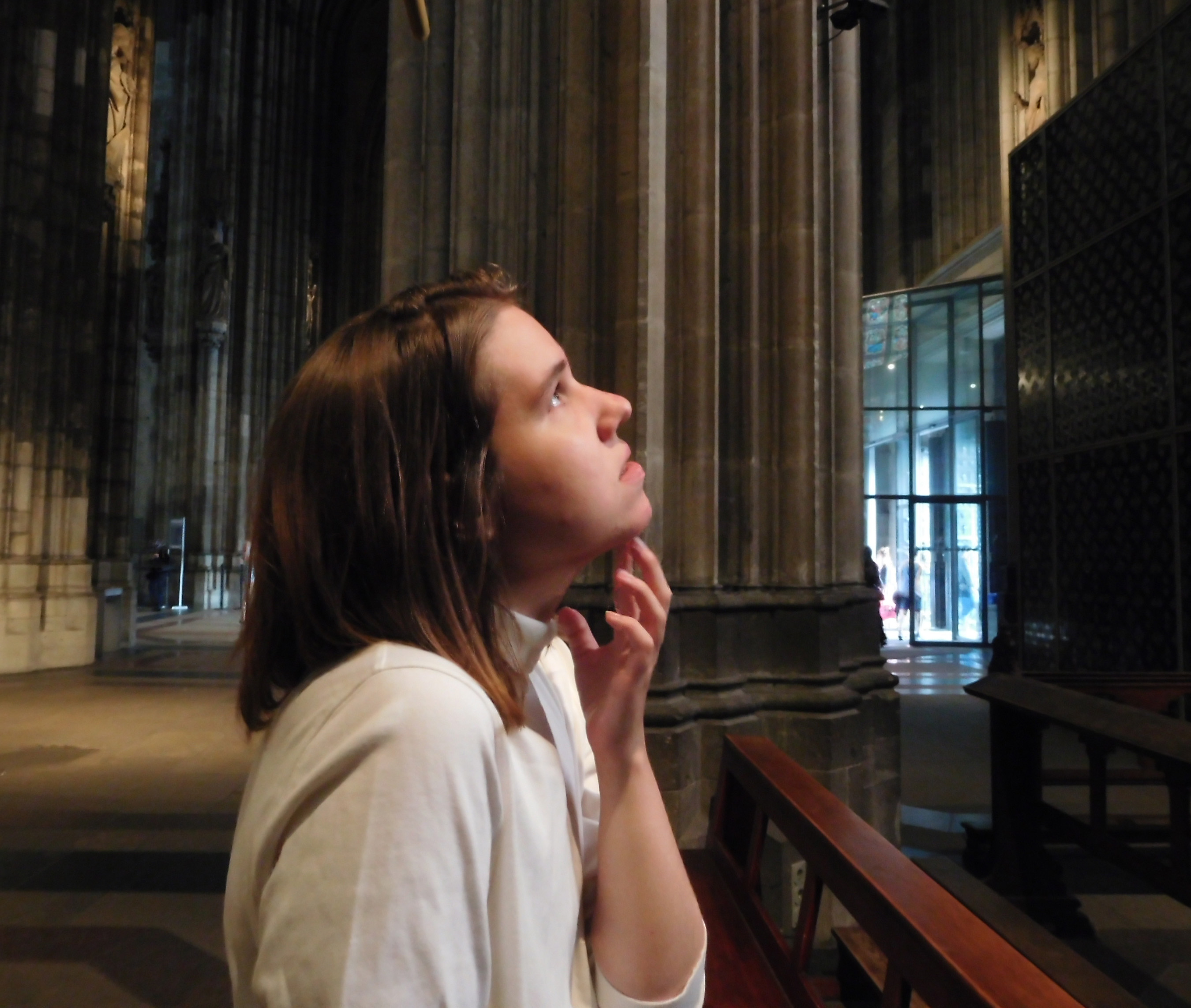
Photo of Koln Cathedral. Germany by K.N.Listman

[1] Wanjek, Christopher. Left Brain vs. Right: It’s a Myth, Research Finds (accessed Feb 17, 2014)

[2] Zimmer, Carl (2009) The Big Similarities & Quirky Differences Between Our Left and Right Brains. Discover Magazine (accessed Feb 17, 2014)

[3] Singh, Harnam, and  O’Boyle, Michael W., Interhemispheric interaction during global-local processing in mathematically gifted adolescents, average-ability youth, and college students” Neuropsychology, Vol. 18, No. 2.

Posted in Creativity, intelligence, Psychology | Tagged , , , , , | Leave a comment

Fear of Criticism

Ask an educator “How do you encourage creativity?” They will tell you students need an environment full of stimuli. They describe the ideal classroom as having an open, accepting atmosphere, free from criticism to build up self-esteem. Ask authors, poets and other people noted for work in creative fields this same question. They will agree with the need for a stimulating environment, but not with the lack of criticism. 

One of my research projects was interviewing college level art and education majors. The surveys that I developed requested two different types of data: factors that lead to creativity, and factors that hinder creativity. Both the education and art majors placed willingness to take risks high on their lists of items that bolstered creativity. However, the art majors said being around creative people was the most important factor. While the education majors gave high self-esteem first place. But, self-esteem wasn’t even mentioned by the art majors. Instead they ranked honest critiques of their work as the second highest factor leading to creative production. 

Educators often fail to understand highly creative students for the same reason corporate workers find creative colleagues difficult. People who come up with original ideas tend to level criticism at others more frequently. [1] However, highly creative people typically are not hurt as much by criticism, either. According to research on both innovative students and employees, these people take the anxiety resulting from a negative evaluation and convert it into a drive to be even more unique. [2]

Alex Osborn is known for founding the Creative Problem-Solving Institute which set up a structure for group creative brainstorming. One rule to free people from creative inhibitions is to forbid all criticism during initial brainstorming. [3] There is no need to guess why. People tend to champion their own ideas at the expense of better ideas. It only takes a small minority set on “defending their turf” to have a detrimental effect. 

According to Charlan Nemeth “Brainstorming techniques have specifically admonished people ‘not to criticize’ their own and others’ ideas, a tenet that has gone unexamined.” However, research in both the United States and France, challenged this preconceived notion about the result of brainstorming. In each case some groups were told not to criticize while coming up with new ideas, while the other groups were encouraged to debate. The second set of groups generally came up with superior ideas. The key was to encourage debate and even criticism, without allowing anyone to monopolize the session. [4]  

“Brainstorming techniques have specifically admonished people ‘not to criticize’ their own and others’ ideas, a tenet that has gone unexamined.”

Incorporating criticism into the creative process can be ego threatening. This may lower some writer’s self-esteem. But, the findings that surprised me in my survey concerning factors of creativity were echoed by other larger and more extensive studies. Honest critiques are not only helpful when it comes to writing and other artistic endeavors. Creative people actually seek out this experience. If you don’t like criticism you may not enjoy being creative.

[1] Torrance, E. Paul. ‎(1963) The Creative Personality And The Ideal Pupil. Teachers College Record, 65, 220-226
[2] Johns Hopkins University news release, August 21, 2012, Don’t Get Mad, Get Creative: Social Rejection Can Fuel Imagination, JHU Carey Researcher Finds
[3] Osborn, Alex. F. (1953) Applied imagination: Principles and procedures of creative thinking
[4] Nemeth, Charlan J. Personnaz, Bernard. Personnaz, Marie. Goncalo, Jack A. (2004) The liberating role of conflict in group creativity: A study in two countries. European Journal of Social Psychology,Volume 34, Issue 4, pages 365–374,

Posted in Creativity, Education trends, Group psychology | Tagged , , , , , | Leave a comment

The Crazy Writer

Writers, like other creatives, tend to exhibit pathological symptoms from time to time. So, psychologists have studied the life of writers, researching their unconventional behavior like they examine the pathology of a disease. Writers can appear contradictory because the strongest drive in creative people is to not be like other people, even other creatives.

During the 1950s, when creativity research was first acknowledged as a legitimate scientific subject, Psychologist Frank Barron tested and conducted in-depth interviews with writers, architects, research scientists, and mathematicians  at University of California in Berkeley. According to Barron the highly creative person is “both more primitive and more cultivated, more destructive, a lot madder and a lot saner than the average person.” Creative people could appear and actually be conventional in many ways. However, “they tend to rebel against conformity as they accompany their own private visions down lonely, untrod paths.”

The highly creative person… is a lot madder and a lot saner than the average person.

Frank Barron

Writers could appear highly neurotic on personality tests while having an ego strength that could deal with stress  and pain of creating products from their imagination. According to Frank Barron the psychology of imagination finds the need for both order and disorder. In his research the creative writer espoused originality, complexity, independence of judgment, and aesthetics sensitivity. Those that he studied often took extremely complex elements to produce a final product that was elegant and deceptively simple.

Creative people can hold two opposite views at the same time and yet see no contraction, because they are prone to “integration of dichotomies.” They can be both naive and knowledgeable, emotional and logical, disciplined and free spirited. Think about it—an either or view does not necessarily make life easier. It is a refusal to deal with ambiguity that naturally abounds. The highly creative person’s tolerance for ambiguity and messiness is balanced by a strong desire to bring order. “It was a powerful motive to create meaning and to leave a testament of the meaning which that individual found in the world, and in himself in relation to the world.”

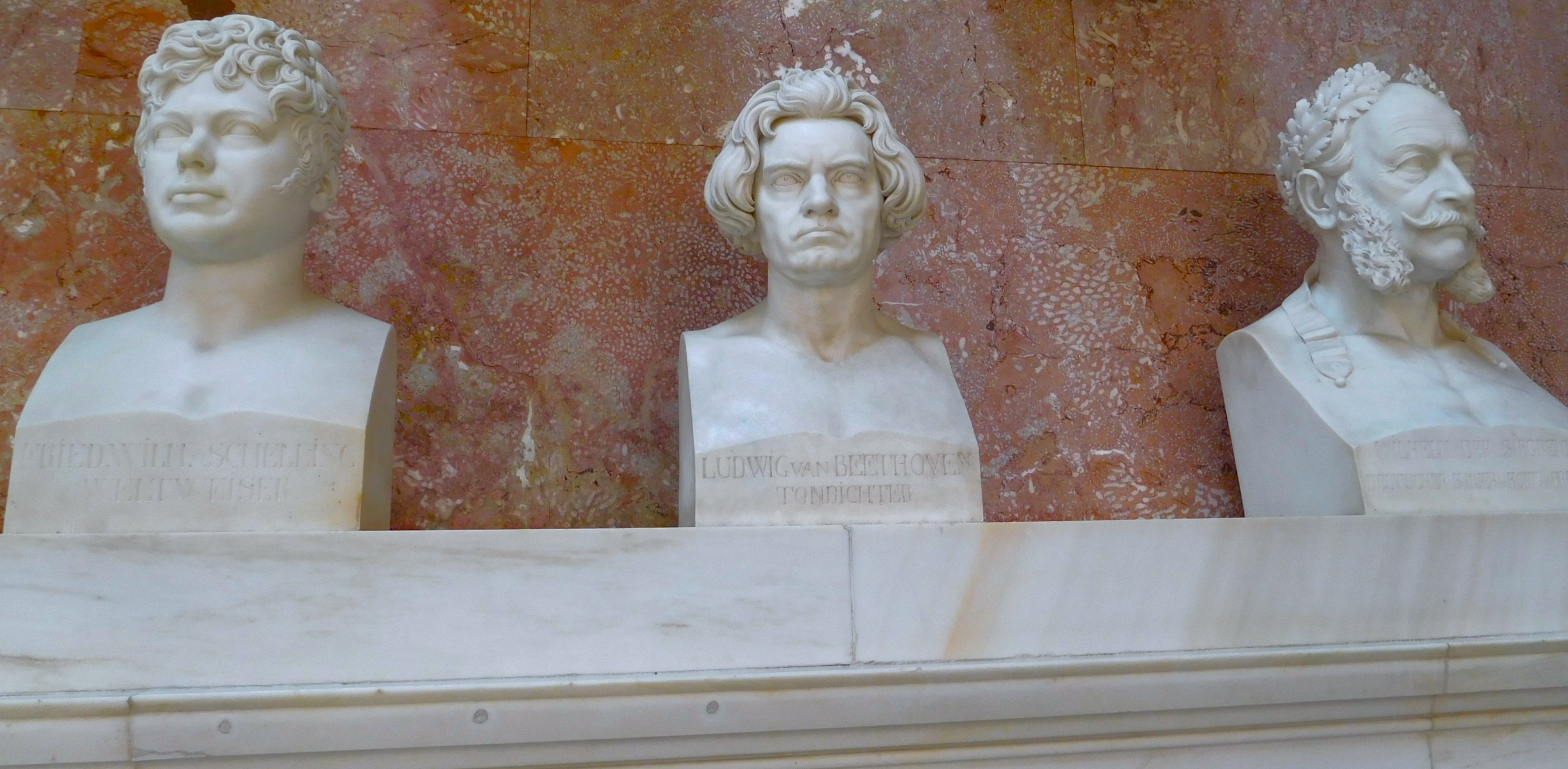
Photo of busts in Wahalla Memorial, Germany by K. N. Listman

Barron, Frank and Harrington, David M., Creativity, Intelligence, and Personality by Frank Barron. Annual Review of Psychology, 32 (1981): 439–476.

Posted in Creativity, Group psychology, Literature, Mental health | Tagged , , | Leave a comment

Writing and Age

As writers get older and improve at their skill, they sometimes bemoan the lost years of youth—time when they had more energy and yet were not writing. There are excuses that we give ourselves. Getting an education, working to pay for rent and groceries, time spent raising children all subtract from the time required to produce quality novels. Literary masterpieces don’t come from adolescents, but they are not as frequently produced by elderly people either.

Susan Eloise Hinton (better known as S.E. Hinton) of Tulsa, Oklahoma, began writing her first novel, The Outsiders, in 1965 at the age of 17. She had it published in 1967 and is one of the youngest writers to gain fame for her works. She continued to write young adult novels and children’s books, but time in between books increased to decades. Frank McCourt, of New York City, did not publish his first novel until he was 66. His autobiography, Angela’s Ashes, won the Pulitzers Prize. Then, he wrote two more memoirs and a few shorter pieces before he died in 2009. 

Most writers produced their greatest work by age 45, but poets tended to peak as early as their thirties.

So writers can start at any age, right? However, these two authors are outliers. H. C. Lehman who studied creativity and age found creative achievement in the arts was a bell curve with a single-peak as a function of age. Most writers produced their greatest work by age 45, but poets tended to peak as early as their thirties.[2] 

A cursory study of literature reveals a number of poets—Robert Burns, Percy Shelly, Alexander Pushkin, George Gordon (also known as Lord Byron) and Edgar Allan Poe—didn’t make it into their forties. There are exceptions to this trend. Robert Frost wrote his most well-known works in his late forties and fifties. However, poets with a longer life often stopped producing as much work.

D. K. Simonton also studied the lives of creative geniuses and concluded that poets tend to peak the earliest of the artistic disciplines. Yet, no matter at what age each poet started to produce renown work, their creative production rose fairly rapidly and then declined until their death. The good news? His research showed that novelists seem to peak later and decline more slowly. This may result from the complexity of novels and a greater ambiguity in this field of writing.[2]

Just as there is no single factor contributing to the creativity of individuals, there are no hard and fast rules when it comes to age and creativity. There are just trends that may not always hold true, because as all creative people know, rules are meant to be broken.

Photo of San Angelo, TX by K.N. Listman 

[1] Lehman, H. C. (1962). More about age and achievement. Gerontologist, 2, 141-148.

[2] Lehrer, J. ” Old Writers,” The Frontal Cortex, Posted on June 15, 2010

Posted in Creativity, Generational differences, Literature, Novels, Poetry | Tagged , , , , | Leave a comment

Who Are the Grammar Police?

As I perused research about grammar police, I found one study with a conclusion that I had already deduced myself. No matter how much of a thought provoking story or essay that I create, the people who notice every misspelling and usage error in my writing may still assume that I am ignorant based on these errors. However, when a person does this, they have given me a clue to their personality. A larger percent of these grammar judges are  disagreeable–certifiably disagreeable as diagnosed using the Five Factor Personality Analysis (often called the Big Five).

One of the traits measured in this assessment is level of Agreeableness. Subsets of agreeableness include trusting, high moral standards, altruism, cooperative, modest and sympathetic. People that score low in two of or more of these characteristics are considered to be closer to the disagreeable end of this trait spectrum

Now, for the research. Subjects were sent emails to read, both with and without spelling and grammar errors. Those that downgraded their estimation of the person who had written the email based on the number of errors that they found also scored low on Agreeableness in the Five Factor Personality Analysis. Of course, that is no big deal. Like me, you probably expected that result.

One of the other factors measured in this analysis is degree of Extroversion. Overall introverts were not as generous with their estimation of the unknown people writing these emails as the extroverts. Introverts who indicated that good grammar was important to them were more sensitive to these errors and could detect more of them. So, they downgraded the likability of the email’s author more severely than introverts who didn’t care about grammar. A definite correlation existed for the introverts between how much (or how little) they cared about grammar and how much they expected to like these unknown email correspondents.

Results for extroverts were a little perplexing because some extroverts said grammar mattered, but behaved as if it did not. “Surprisingly, extroverts who reported grammar as more important were less sensitive to typos than extroverts who felt good grammar was less important.”[1] 

Some extroverts said grammar mattered, but behaved as if it did not.

Why were they not noticing the typos? Did they overestimate their ability at spelling and grammar? Or was this lack of self-awareness intentional? This research may have provided a serendipitous insight into self-awareness and why it is rising on the list of desired traits of leaders. Past researchers have found that executives are predominantly extroverts. 

Self-aware people are introspective and tend to be introverted. These are common characteristics of writers. They think about their own values and motives compared to their actions. But as hard as they try, they soon realize they are incapable of behaving consistently according to their own values. There are different ways to respond to this realization: change values to match actions,  intently focus on every error and spiral into depression or give up being self-aware because nobody is perfect. Evidently extroverts use this last option. Simply avoiding reflecting on the effects of their actions is their preferred way of dealing with internal conflict. 

This lower self-awareness has some negative side effects when leaders fail to accurately estimate their own skill or understand their own motivation. High self awareness among writers can cause excruciating self-doubt. We have yet to see whether self-awareness can be adjusted one way or the other by external instruction. This may be as difficult as teaching  extroverts and introverts to behave like someone at the opposite end of that spectrum.

Photo by K.N. Listman

[1] Boland JE, Queen R (2016) If You’re House Is Still Available, Send Me an Email: Personality Influences Reactions to Written Errors in Email Messages. PLoS ONE 11(3): e0149885. doi:10.1371/journal.pone.0149885
Posted in Style and voice, Teaching writing skills, Writer's resource, Writing trends | Tagged , , , , , | Leave a comment

Is Creativity Fair?

Creative people often feel driven to be different, to strive for the original idea and take it as far as possible despite the deprivation and pain that results. They fear that inspiration may abandon them and leave them stranded, or the world may decide that the masterpiece into which they have poured blood, sweat and tears is useless and ugly. They may not see their ability as being  a fortunate circumstance. In fact, most of the evidence for innate creativity is based on the negatives associated with this trait.

One negative is the similarity of creative thinking to schizophrenic thinking. Researchers find increasing evidence for the genetic basis for schizophrenia, as they search through family trees of schizophrenics.  There appears to be a larger than average number of people in creative fields in these family trees. In the same manner, examining the families of famous creative people reveal more members exhibiting types of psychopathology than found in an average population.  Abnormal thinking includes:

  • Delusional thinking, which is similar to using divergent associations
  • Over inclusive thinking, or paying attention to seemingly irrelevant details
  • Uncontrolled flexibility, evidenced by jumping from idea to idea [1]

Do those sound a lot like creative traits? The difference is that the creative person has a stronger ability to make judgments to determine when this kind of behavior will be acceptable, a characteristic controlled by the prefrontal cortex. [2]

The second evidence for innate creativity is associated with a problem that many writer’s bemoan–the unpredictability of inspiration. For those most known for creative output, the peak often tends to come near the beginning of their career. Then, creativity tends to fluctuate, going up and down, but only occasionally reaching the earlier height. If creativity were a learned behavior it should improve more frequently. However, the ability to come up with a creative product seems to be “a chaotic sequence of hits and misses.” [3]

No one seems to be able to explain why some people keep after their creative pursuit when it is heavily discouraged. 

Finally, no one seems to be able to explain why some people keep after their pursuit of creativity when it is heavily discouraged. Reams of articles come out on how to encourage creativity in education and the workplace, but it appears some manage to keep a unique perspective without encouragement. Businesses have an increasing desire for creative products. But this desire for these products is in opposition to their treatment of most creative people. Those that produce creative ideas are generally disliked.[4] Why would a creative person continue coming up with the kind of ideas that cause social rejection if it was only something they learned to do–not something they did intuitively? Apparently social rejection increases imaginative thinking–at least  in those that are already nonconforming types. According to a study from Johns Hopkins:

“Rejection confirms for independent people what they already feel about themselves, that they’re not like others. For such people, that distinction is a positive one leading them to greater creativity.”[5]

It just isn’t fair. One person gets to be born with an enviable imagination, the ability to come up with new, innovative ideas, or create artistic masterpieces and the next person does not. Many cringe at the idea that creativity could be an innate and inheritable trait …. including those that have this trait.

Photo from Wikimedia Commons

[1] Kuszewski, A. (2009) The Genetics of Creativity: A Serendipitous Assemblage of Madness, http://www.grupometodo.org
[2] Jung-Beeman, M., Bowden, E., Haberman, J., Frymiare, J., Arambel-Liu, S., Greenblatt, R., Reber, P., Kounios, J. (2004). Neural activity when people solve problems with insight. PLoS Biol 2(4): e97
[3] Feist, G.J. (1998) A meta-analysis of personality in scientific and artistic creativity, Personality and Social Psychology Review, 2, 290-309
[4] Olien,J (2013) Inside the Box, People Don’t Actually Like Creativity.
[5] Johns Hopkins University news release, August 21, 2012, Don’t Get Mad, Get Creative: Social Rejection Can Fuel Imagination, JHU Carey Researcher Finds
Posted in Creativity, exclusion, Mental health, Self-awareness | Tagged , | Leave a comment

Surviving Creativity

When I was much younger I studied Abraham Maslow’s Hierarchy of Needs. Despite his theory that fulfillment of physical and psychological needs leads to self-actualization and creativity, I found many creative people driven by something else–something that often causes them to ignore basic needs.

About twelve years ago I first caught sight of the “Artist’s Hierarchy of Needs,” an upside down version of Maslow’s triangle. It balances on the tiny point of self-actualization. This hierarchy applies to more than visual arts and includes writers and others who often find creating more important than eating or sleeping. So it’s time to give others their fair shake and look at some competing ideas about what constitutes creativity.

Sigmund Freud, the father of modern psychotherapy, saw creativity as a socially acceptable defense mechanism for expressing socially unacceptable urges. In other words being creative was the way to sublimate that pesky sex drive. He felt the creative process was driven by the unhappy suffering of unfulfilled fantasies. For him being creative was akin to being neurotic.[1]

Sarnoff Mednick is most famous for his research that associates psychosocial disorders–such as acting like a criminal–with genes that you inherit from your parents. He also came up with the associative theory of creativity, the idea that a person comes up with original ideas as a response to stimulus–sort of like drooling when you smell fresh hot cinnamon rolls. When a stimulus hits the senses, a creative individual’s response would be to think of an extremely remote and barely related idea. Mednick created a test using words based on the theory that the more remote the test taker’s response was from the original word, the more creative that person was. So an extremely creative response could be nonsensical. [2]

Carl Rogers saw creativity in a similar light to Abraham Maslow. He thought creativity was the result of healthy psychological growth, and the highest form of self-actualization. He saw creative people as being wonderfully balanced, open to new experiences, with internally based control.[3] I’m sure most creative people would like to view themselves this way. However, many are honest and admit to deep insecurities. Of course, most of us have run into a few of the difficult, smug, prima donna types.

When people are working on their latest novel they become so fulfilled that they forget about other things–like food and sleep.

Mihaly Csikszentmihalyi does not see creativity as strictly residing within a person, rather it is an interaction between a person and society. Social systems and cultures determine what is original idea and what is not. To be considered a creative author, an individual must strike a balance between coming up with a novel idea and relating it to accepted conventions. Otherwise this work would be viewed as either boring or gibberish. He also describe the idea of flow, an intensified response to a creative urge that causes artists to ignore time. When people are working on their latest novel they become so fulfilled that they forget about other things–like food and sleep.[4] So, creativity can be dangerous to your health.

Finally, we come full circle to Albert Rothenburg who proposes that creative people use a certain kind of thinking that allows them to consider two opposite concepts at the same time–like two objects occupying the same space resulting in something new. His research shows that creative thought processes are not logical and actually resembled those of the mentally ill. However, creative people are actually aware that they are indulging in ‘insane’ thinking while they are doing this–at least most of the time.[5]

Photo of mural in Plaza District, Oklahoma City, OK by K.N. Listman

[1] Rothenburg, A. &  Hausman. C., (1976). The creativity question.  Durham, NC: Duke University Press.
[2] Mednick. S. (1962) The associative basis of the creative process. Psychological Review. 69, 220-232.
[3] Rogers, C. (1962). Toward a theory of creativity. In Parnes, S. Harding, H. (Eds.) A source book for creative thinking. New York: Scribners.
[4] Csikszentmihalyi, M. (1988). Society, culture, and person: A systems view of creativity. In Sternberg, R. (Ed.), The nature of creativity. New York: Cambridge University Press.
[5] Rothenburg, A. &  Hausman. C., (1976). The creativity question.  Durham, NC: Duke University Press.
Posted in Creativity, Ideas for writing, Literature | Tagged , , , | Leave a comment