The giggling girls have power

It's_so_funny_cropWhy can’t we be all like adolescent girls, and laugh more? The topic of the discussion thread caught my attention. Evidently girls between the ages of 11 and 18 all over the world laugh more than any other group. In the past, I have often been in classrooms where teenage girls were unable to suppress their laughter. Most of the time there was nothing particularly amusing to start the laughter. However, the very sound of an initial giggle seemed to generate the impulse for laughter to spread. It frequently turned into a high pitched and disruptive twitter, bringing the class to a halt. I suspected that was the reason the girls were giggling so much.

It turns out that I was not far from right. Girls don’t giggling all the time because they are having fun, but because they are building their first line of defense. Giggling is an attempt to gain allies in a conflict. They are waging war from a position of weakness as evidenced by their weapon of choice, laughter, but waging it nonetheless.

The gigglers sense that they have little authority over others. They may be a female in a male dominated society, a youth in culture where older people are acknowledged leaders, or less educated and experienced in a world espousing intellectual ability and technological savvy. Delicate chortling is a way of seducing those in power into helping and not attacking them.

The people for whom the giggling is performed are often well aware that it is done to appease them rather than for any humorous words they have said. Still they are flattered. John Morreal, a professor of religion at William and Mary College in Williamsburg, Virginia, noted that the “degree to which a woman laughed while talking to a man was indicative of her interest in dating him. How much the woman laughed also predicted the man’s desire to date her.”

The gigglers live within a hierarchical framework, a kind of caste system based on power in society. They have discovered that the placating nature of a chuckle usually works better than attempting a rational discussion, which places both parties in a position of equality. Laughter is their choice tool for manipulating others. They typically laugh to appease someone they view as having a superior position. However, if you observe a giggler talking to someone that they feel they are above (such as a younger sibling or child) and the laughter frequently disappears, and is sometimes replace by a demanding voice.

While researching the psychology of laughter, I found an interesting Radio Lab called “How Does Laughing Affect Us?” Vanderbilt University associate professor of psychology JoAnne Bachorowski concluded that men laugh more around their bosses and women laugh louder around men they don’t know because “the giggling girls have power.”  They use excessive laughter to shield themselves, by gaining the attention and protection of those who are stronger in society. If you want to know more you can listen to the program – http://www.radiolab.org/story/91593-how-does-laughing-affect-us/

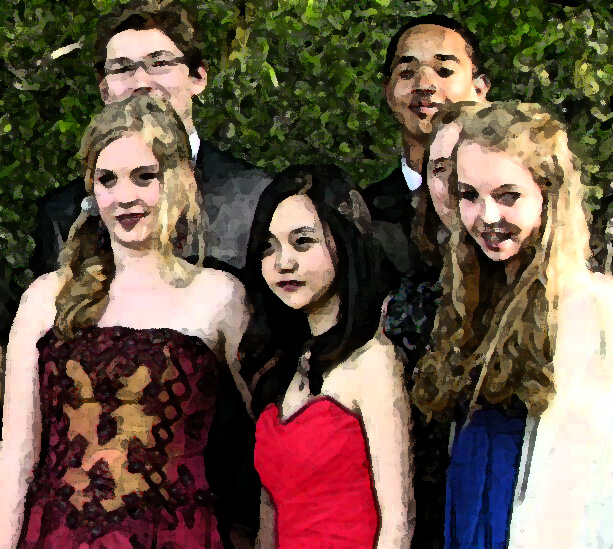
Photo by Emanuele Spies. CC by 2.0
Posted in Group psychology, Laughter and humor, Manipulation | Tagged , , , , , | 4 Comments

The unprincipled conformist

char1012_imagery

Illustration by S.L. Listman

The rebel with a cause is one of favorite heroic types in fiction. But the “foil” of the principled nonconformist, the unprincipled conformist, is also a common antagonist. What makes this character so villainous? Conformity requires that a person at least appear to follow a set of rules. So how can a conformist be unprincipled? A required similarity within a group can mask controlling force that is actually harmful to the people within the group.

The nature of this harm can express itself in a number of ways. One of the most common is the exclusion of people for insignificant reasons. In order to create the strong camaraderie a common enemy needs to be found. There are two reasons groups do this: one is the age old reason that wars exist, to take something of value from another person. Exclusion allows the group to gain. The second reason is to shift what the group doesn’t want onto the shunned people. Blame for any problems is shifted onto the scapegoats.

The difficulty with both of these actions is that in the end they destroy the group. Whether the exclusion is used as an excuse to take away wealth or credit or influence from the other person, or simply a social snub, it results in physical pain. This pain tends to cause the excluded people to avoid interacting with those people, even if they would prefer to conform in order to fit in. [1] This results in the group seeking out a fresh scapegoat, and this process continues until an apparently cohesive group crumbles from the inside out. The other “harm” caused by unprincipled conformity is the squelching of individuality, leading people to become rigid in their behavior.

How is the unprincipled conformist brought to a demise? By persuading this trickster’s followers that they have been following a leader that will use and destroy them. This job falls on the rebel with a cause. Often it is the stirring speech of revelation, not the physical knock-down drag out fight, that brings an end to the unprincipled conformist.

[1] Eisenberger, N. I.  (2012)  Broken hearts and broken bones: A neural perspective on the similarities between social and physical pain.  Current Directions in Psychological Science, 21, 42-47,


Posted in Creativity, Group psychology | Tagged , , | Leave a comment

Rebel with a cause

Lego_StarWars_Han_Solo_on_ice_planet_HothAs much as people may be willing to mimic the behavior and appearance of others in order to fit in, secretly they often envy those who show intentional dissent. According research  we admire the person who has the guts to do what we dare not do–challenge group norms–as long as the person is not challenging our own norms.

“Indeed, people may speak up and dissent from important group norms not because they want to be difficult and destructive, but because they care for the group and its future.” [1]

The heroes of novels are often principled rebels, not lacking in loyalty but willing to speak up against those with power for the benefit of the others. In the world of fiction, the hero often sways the fence-riding group to abandon the person doomed to be the villain by the use of stirring altruistic words. And, sometimes the hero engages in a knock-down, drag-out physical fight, too. But in real life? In a true uphill struggle by the minority to voice dissent and influence the majority, the rebel with a cause must be consistent. Consistency is not necessarily the hobgoblin of small minds.

Group dynamics affect the challenge of being a real-life rebel with a cause. Social groups tend to seeks consensus so that everybody can get a long. Even if this consensus is not rooted in reality, the fact that everybody else holds the same opinion provides enough validation for most people. They have committed themselves. They don’t really want to hear some one who questions their ideas. If you question the consensus, you run the risk of being excluded. If you back someone who is asking the difficult questions, the group may exclude you, too. [2]

Persistence on the part of the minority is their major weapon. The majority group starts with the assumption that the rebel is not correct but the persistence on his or her part creates a conundrum. ‘How can they be so sure and yet so wrong’? [3] If the rebel view is going to have any chance of gaining a following the supporters must remain consistent over time. If sticking to their guns is seen as attention seeking, or a rigid belief rather than consistency, it will fail.

Also the rebel with a cause does not have the luxury of both ‘winning friends’ and ‘influencing people.’ Rebels may influence others by remaining adamant in their position, but most people will not like them. And, the rebel hero must remain strong when punished by the status quo. An attempt to gain support through appeasement is typically seen as giving in. If the rebel gives in the chance to influence others goes down the drain. [3]

Basically, the uniform view of the majority is never as solid as it appears. Most people are conformist as they fear exclusion. They try to appear to adopt the majority position even if they privately disagree with it. But, timing is everything when trying to convert private dissenters into open rebels. The hero must speak up before members of the group have a chance to follow through with any action based on the mistaken belief of the majority. When people comply with group demands, and then someone criticizes the beliefs of the group, they do not climb on board behind this person. Rather they take the criticism personally and preemptively reject it.

So it is those fence-sitters still clinging tightly to their fence that are most willing to admire the person who dissents for principled reasons. When the rebel with a cause voices an opinion that they secretly hold, they might slide off the fence in his direction, with a sense of liberating relief that they have done the right thing [3].

“Lego StarWars Han Solo on ice planet Hoth” by Klapi – Own work. Licensed under CC BY-SA 4.0
[1] Monin, B.and and O’Connor, K. (2011) Reactions to Defiant Deviants-Deliverance or Defensiveness? In J. Jetten, and M.J. Hornsey,(eds) Rebels in Groups: Dissent, Deviance, Difference, and Defiance. 2011 Blackwell Publishing Ltd
[2] Levine, J.M. and Vernon L. Allen, V.L. (1968) Reactions to Attitudinal Deviancy, Report from the Per Group Pressures on Learning Project. Vernon L. Allen, Principal Investigator. Wisconsin Research and Development Center for Cognitive Learning, The University of Wisconsin
[3] Nemeth, C. J. & Jack A. Goncalo, J.A. (2011) Rogues and Heroes: Finding Value in Dissent.  In J. Jetten, and M.J. Hornsey,(eds) Rebels in Groups: Dissent, Deviance, Difference, and Defiance. 2011 Blackwell Publishing Ltd
Posted in Group psychology, Story structure, Writer's resource | Tagged , , , | Leave a comment

Technological component

BinaryData50Over the past few weeks I’ve been looking a psychological with an eye to creating realistic characters. Frequently I’ve been hearing a lot about how the millennial generation is different from other generations.  I really have not found any creditable research describing exactly what the difference is. Writers on this topic seem to be making it up based on what they think is logical for people who have grown up with computers and the internet.

Of course I have my own logic based on working with millennial age students and my own children who were born in the 90’s. Recently I was reviewing research I used for a literacy program developed as a consultant in 2005. What struck me as ironic was that one of the major points of the research was that this program required “a technological component.” However, the research paper was vague concerning the kind of  actual kind of technology needed or the results it was suppose to achieve. I showed this attempt to be cutting edge without specific information to my millennial age daughter.

Her response “Technological component? It could be a digital clock,  or one of those reading toys with a tiny computer inside.” The millennial generation often look with a jaded eye on the idea that technology by itself is a solution to any problem. They have grown up with instant Internet access and still see a world full of problems. Instead they want to know what specific technology will be used because they feel the pressure to know how to use it.

Of course millennials use electronic technology more than the previous generation, because it is around in greater abundance. But they are no more likely to adopt new technology as they get older than the past generations. In fact I have seen many millennials disgruntled with new versions of electronic products and software programs (or apps as they are now called).  It’s not just a matter of older generation not learning technology, younger people are getting tired of constant change also. They simply are already accustom to a set of technology that was developed later.

So I find the differences in generations is more a matter of environment heightened by superficial appearances  that people adopt because they want to belong to a group.  As a child I watched TV more than my parents did, who listened to radio more than their parents did, who probably read penny novels more than their parents did. Attention spans, persistence and people skills really do not change with generations, rather it is the unwritten rules on what is acceptable that changes.

Despite the major technology emphasis in classes, companies think students coming from college are less prepared for the workplace than in the past – in the sixties any degree was good enough to show you could learn on the job – because change in industry always outstrips change in education. There is a good reason for this; education is supposed to provide problem solving skills which is a far more classic and non-specific skill. If you want to see where education is headed, you can look to the workplace. Computer assisted instruction and learning simulators have were employed in the workplace when Roddenberry was writing the Star Trek scripts (no he didn’t make up the computer based schools on his own). The corporate world threw itself into e-learning because of the reduced expense of not having trainers on the road, only to find that their employees simply were not learning as well from e-learning. The pendulum is swing back to learning face to face.

So maybe the millennial generation will look at their own children and ask “Why do you actually want to be with your friends to talk to them?”

Image by W.Rebel (Own work) CC BY 3.0 via Wikimedia Commons


Posted in Education trends, Technology in education | Tagged , , | Leave a comment

What kind of deviant?

DSCN0668c1Authors are well aware that readers favor the rebel who follows a different drummer or stands defiant before the crowd. Social psychologists and sociologists have actually done  a good deal of research on groups’ reaction to this kind of person. The kind of person whom they describe as exhibiting deviant behavior.

Researchers have even categorized these deviants. The first group  are the passive deviants, who differ from the majority group due to forces not in their control. Whether they fail to follow the unwritten rules of society through ignorance, inability or a psychological compulsion. They are excluded socially. Sometimes it is simply the matter of an atypical intelligence, learned behaviors from another social class, or differences in appearance that causes society to exclude these people. In real life, many people tend to avoid passive deviants like the plague, almost as if they could catch whatever unavoidable factor causes these passive deviants to differ from the acceptable norm.

Of course, fiction is different than real life and these passive deviants form the ranks of the underdog heroes found in many stories. In real life the goal is often to help the passive deviant blend into the average population and be accepted by the group. In fiction this simple outcome is almost always unacceptable. Instead the underdog is expected to rise to lead their own group or overthrow and replace the leadership of the original rejecting group  – basically avenging themselves on the “in group.” Ironically in fiction the readers expects the passive deviant to exclude the others in the same manner as they were excluded by taking vengeance on members who found their differences objectionable. This actually gives a bit of insight into most people’s heavy dependence on being part of a group.

The second kind of deviants are intentional in their action. There are some that are considered harmless nuisances or eccentric. These defy convention for originalities’ sake or purposely flaunt group rules to promote themselves.  Others are considered criminals because of the harmful intent and result of their deviant actions.  However the lines between these types of deviations from society is not always clear. The intentional deviant that we cheer on in stories we read is the principled deviant, the person who speaks up against wrong doing, who rebels against the group when it treats others unfairly. However, as we look into this in more detail we find that in real life our relation to this principled kind of rebel is not related to their actual moral stance much as it is to our own behavior.

 Monin, B.and and O’Connor, K. (2011) Reactions to Defiant Deviants-Deliverance or Defensiveness? In J. Jetten, and M.J. Hornsey,(eds) Rebels in Groups: Dissent, Deviance, Difference, and Defiance. 2011 Blackwell Publishing Ltd.


Posted in Group psychology, Writer's resource | Tagged , , , , , , , | Leave a comment

When characters will not conform

Jeff 2007The social psychologist Solomon Asch  is famous for his experiments on  how peer pressure affects our perceptions in 1950s.  According to Asch if all those answering before the research participant selected the same incorrect answer approximately 76% of the people would choose that same obviously incorrect answer. [1] So if most people are in a group of ten or twelve people and all of the others say the sky is normally red, the average person will agree and somehow rationalize agreeing with a statement that they know to be false. Perhaps the question is about Mars, and not Earth. The sky is normally red on Mars, isn’t it?  This really has not changed since this 1950s, if anything differs it is the fact that less than 24% of the people tend to disagree when they know that the others are wrong.

But there is something else about conformity that Asch did not delve into. It is our cultural liking for rebels and mavericks. These people are often not in our immediate circle, which make them easier to tolerate because they are not directly disagreeing with us. However, this counter-cultural preference for the non-conformist shows that s perceptions really do not change based on peer pressure. People still know the sky is normally blue; they are just going along with everyone else in order to avoid ruffling feathers.  They buckle under knowing full well the right answer because they are reluctant to face possible negative reactions from the group.[2]

The majority of people admire the person who has the guts to do what they do not – challenge group norms.  That’s right. Conformist don’t seem to be as empathetic or as interesting a character in fiction as well as real life.  Apparently loyalty to a group at the price of individuality is the basis of fictional dystopia for most people.  Nemeth and Goncalo, psychologists from Berkeley and Cornell use the word “Orwellian” to describe a group with extreme emphasis on loyalty.  “These types of groups are more likely to be found in horror or science fiction movies than matching any kind of reality.”[3]

However, a problem arises with creating the non-conformist hero that most readers admire. Authors are not immune to the tendency to exclude maverick acquaintances who do not conform to their own “norms.” The source of people to draw from when modeling the non-conformist is often limited.  If this character is based on authors’ own desire to dissent, they will simply  write the same “unique” character repeatedly until this literary personality becomes predictable.

As much as any other group, those that record stories for the generations need to see the value of dissent in real life.  Sociologist Erikson saw deviants as part of a healthy society,  and curiously enough he quotes Aldous Huxley (author of Brave New World) to support this view.

 Now tidiness is undeniably good – but a good of which it is easily possible to have too much and at too high a price… The good life can only be lived in a society in which tidiness is preached and practised, but not too fanatically, and where efficiency is always haloed, as it were, by a tolerated margin of mess– even nourishing this society.[5]

Just as this quote notes that tidiness can be an unbearable burden when taken too far, the writer must balance the disagreeable traits of the non-conforming hero with value that they bring. A person who almost never imitates the actions of others is probably just too obnoxious to be likable. This balance has to be woven through out the story creating a type of inconsistent non-conformist. One who sometimes says the sky is normally red when they  know perfectly well that’s not true. However, being honest enough to admit faults is what keeps the character from losing the empathy of the reader. That is the very strength of the non-conforming hero.

[1] Asch, S. E. (1952). Effects of group pressure on the modification and distortion of judgments. In G. E. Swanson, T. M. Newcomb & E. L. Hartley (Eds.), Readings in social psychology. New York: NY Holt.
[2] Aronson, T. D.; Wilson, R. M.; Akert, E. (2010). Social Psychology (7 ed.). Pearson
[4] Nemeth, C. J. & Jack A. Goncalo, J.A. (2011) Rogues and Heroes: Finding Value in Dissent.  In J. Jetten, and M.J. Hornsey,(eds) Rebels in Groups: Dissent, Deviance, Difference, and Defiance. 2011 Blackwell Publishing Ltd
[5] Erikson, K.T. (1966). Wayward Puritans: A Study in the Sociology of Deviance. New York: John Wiley & Sons.


Posted in Group psychology, Literature, Writer's resource | Tagged , , , , , , , , , , , | 1 Comment

Writing like you talk

aside2When reading a professional author’s discussion thread, I noted that more than one person assumed the trick to creating a unique writer’s voice was “writing like you talk.”  There is some truth to this if you are a good verbal storyteller. But many good writers are do not excel at public speaking.

Recently I was discussing a book written by a prominent newscaster, mimicking his unique conversational mannerisms. One of the people made an interesting observation. He said, “You can really hear him speaking as you read it, and that really slows you down.” Now, I prefer reading to listening for the very reason that I can read about three times faster than I can listen. This led me to consider the complications of writing like you speak.

Most people tend to be more dramatic and less accurate when speaking. This allows them to be heard over competing voices. Frequent repetition is used … frequently. People also fill their speech with meaningless phrases, such as “when you think about things,” because they are actually thinking about things, such as what to say next. One of the biggest drawbacks to writing this way is increased word count for the amount of content. This may be at the root of my friend’s perception “that really slows you down” when reading a book written in this manner.

Use of  current catch phrases and regional interjections set the tone for the text, but often contribute little or nothing to the meaning. Don’t get me wrong; tone is necessary in writing. Much of how we interpret what people say is by listening to their tone of voice. Because there is no audible tone in writing it requires some unique phrases to achieve the same impact as vocal inflections.

A good verbal storyteller using lots of “colorful language” may be able to appeal to people in their region. Appealing to a larger crowd requires more. Write like you speak, with smatterings of colloquialisms, and you may be understood by your neighbor today. But remove the reader a few years, a few hundred miles, or a few rungs on the socioeconomic ladder, and suddenly it becomes hard work to read what you have written. If the content is not worth the effort, people stop reading.

Occasionally, I enjoy books by authors who write in the vernacular… in small doses. Mark Twain actually got his start as a lecturer, who made his living by talking. His novels were published as serial installments in magazines for a reason. Short passages in folksy language are interesting. However, I witnessed too many students dread the time they spent slogging through his imitation of Old English speech in The Prince and the Pauper. Even I eventually had to give up on his unabridged version of A Connecticut Yankee in King Arthur’s Court.

So when you decide to write like you speak, recall when you sat in a conversation as the other person chattered on assuming word choice made them sound interesting. Remember all the meandering thoughts, unfinished sentences and repetition. Now, edit your work ruthlessly until it flows. The content should be what drives it. People pay attention when you speak because that is polite. But you’ll never know when they simply stopped reading.


Posted in Style and voice, Writer's resource | Tagged , , , | 1 Comment

Characters and cohorts

group 2011 (1)In fiction most protagonists like most people are not complete loners. Interactions with their cohorts make up a good portion of novels, so creating these peers takes a bit of thought. What enables a real-life group to be innovative in business also makes for interesting interplay between the main character and their group.  A peek inside of what helps real work groups to collaborate and solve problems maybe the key to creating the cohort that complements the unforgettable protagonist.

With all the current emphasis on collaborative thinking and collective knowledge in the workplace, you might assume assembling a large group of properly motivated people could solve almost any problem. You don’t really believe this do you? The larger the group is, the less each person is inclined to contribute. According to Fortune Magazine 4 to 5 is the magic number. [1] Wharton School of Business  uses 5 to 6. Get beyond this and you will have social loafing, members who fail to contribute much or are kept from contributions due to the self-enforced conformity of large groups [2]. Most people will then tend to follow the loudest voice that supports the status quo. Of course maintaining status quo not only limits creativity. It also makes a boring plot line.

The ideal size of the team depends on its goal, but teams larger than eight people fail to function efficiently.  [2] In the same manner, a large number of well drawn auxiliary characters dilute attention to the struggles and triumphs of the main character. And they will confuse the readers to boot. Students studying literature keep lists of characters when reading epic novels to make enjoyment easier; not all readers are willing to do that.

In real situations, diverse groups are smarter and better at problem solving. This is particularly noticeable in the case of gender and ethnic diversity. Add females to a formerly all male group (and vice versa) and the collaborative IQ rises.[3] Ethnic differences make viewpoint differences more acceptable because, oddly enough, people become more upset when a view that conflicts with theirs is proposed by someone that looks and acts like them, rather than someone obviously different.[2]

This kind of attitude occurs in the fictional world also. Consider the difference between a foil and a doppelganger. Cervantes’ Don Quixote is tall, thin, and an impractical idealist, while his Sancho Panza, is short, fat and a realist. These differences in temperaments and appearance not only play the main character off of his side kick, but provide a range of resources so that they can assisting in helping each other get out of trouble.

However, the when the main character has an unnatural twin, a person who appears the same physically but is on the other side of the behavioral spectrum, the outcome is virtually bound to be tragic. It doesn’t matter whether the twin is an actual human, as in the Charles Dicken’s “Tale of Two Cities, a mythical doppelganger, as in Edgar Allen Poe’s “William Wilson,” or simply an illusion as in Fyodor Dotoevsky’s “The Double.” One (or sometimes both) of the identical appearing people are almost always doomed.

When you think about it perhaps it would help people doing research on successful work group successful to take a peek into successful main characters and their cohorts.

[1] Useem, Jerry.  “How to Build a Great Team” Fortune  Magazine, June 1, 2006 
[2] “Is Your Team Too Big? Too Small? What’s the Right Number?”Knowledge@Wharton. Jun 14, 2006


Posted in Creativity, Group psychology, Literature, Writer's resource | Tagged , , , , , | 1 Comment

When characters confuse

IMAGE0043a copyWhen Edgar Allen Poe published “Murders in the Rue Morgue” in 1841 the murder mystery was a relatively new genre. He wrote a few more of these increasingly popular detective stories before leaving behind his own mystery. In 1849 he was found wandering injured and delirious through the streets of Baltimore. The brilliant writer never regained his wits enough to explain what had happen to him. He died a few days later leaving behind a real unsolved mystery.

Current detectives have more techniques for identifying possible suspect but still lean heavily on the use of a psychological profile. You are probably familiar with a few of the terms they throw around, such as calling card, MO, and motive.  These are not just reserved for suspects in murder mysteries.  Fictional characters take on their own personalities when you remember to consider each of these features. Paying attention to these aspects  doesn’t make characters predictable (otherwise criminals would be easier to catch) but does make them less confusing.

The calling card is a quirky behavior, an eccentric ritual that goes beyond what is needed.  This  is also called the signature aspect in criminology because it comparatively unique. It provides an insight into motive and is derived from a deep seated psychological need.  (Major characters should also have unfulfilled psychological needs unless they are robots.) For example, a woman who had to grow up too fast in a distressing family situation may show a propensity for collecting stuffed teddy bears in an attempt to regain a lost childhood. Another from a similar background  may compensate by calling her own children on the phone, every day. Signature behavior develops uniquely for each person based on personality, motive and MO. It may increase or decrease but doesn’t really change.

MO or Modus operandi is Latin for method of operation. This is a character’s preferred way of interacting with others.  Consider two different teenage boys in their attempts to attract teenage girls. One may decide a show of physical strength, such as pelting a rival with a football, is the way to gain attention from the fairer sex. The other, who uses his wit may  point out the disproportional number of felons in the NFL after the pelting incident. Modus operandi is the preferred method that people use to reach a goal. It is not fixed, but based on learned behavior and changes over time as the character gains confidence through experience or descends into neurosis due to stress.  However, there has to be a reason, a point in time or an event that you can put your finger on, that causes the shift in MO.

Finally we come to motive. We may never understand why real people do what they do, but we expect to be able to detect motives in fiction. The reasons that drive characters to act may be initially hidden but should be revealed as the story progresses. A character’s motives can be transformed but this calls for an event with much more earth-shaking than that needed for developing a new MO. Just like the calling card, internal motivation tends to remain constant, unless the character goes through trauma or brain surgery.   The calling card can provide a window into the character’s motivation if you are subtle about connecting the two. Readers often enjoy uncovering this on their own. After all a major point of creating the story is for the reader’s enjoyment.

Posted in Creativity, Writer's resource | Tagged , , , , | 1 Comment

When characters collide


Face_Off copy
Consider the possible basic conflicts in fiction:  man against environment, man against man, man against society, and man against self.  In most plots the conflicts are between people.  Even in Robinson Caruso and Castaway, tales of man surviving in isolation, other people are part of the conflict. The fact that the protagonist  learned to survive  on his own didn’t bring either story to an end. When people arrived on Robinson’s Caruso’s island, they weren’t friendly. The enemy had to be defeated. In Castaway the  biggest conflict occurred when the main character returned to civilization only to realize that the love of his life had married someone else. Contact with people only brought new conflicts.

What causes the conflict between fictional characters is often over simplified. Typically, character A and character B want the same thing, but they don’t want to share. This love triangle plot is played over and over again with competition not necessarily for the affection of a person but for a coveted prize, a position of power, or a piece of land handed down by the family. However, there needs to be another conflict, one of personality which keeps the two characters from doing the smart thing and compromising to work out this difficulty.

Personality conflicts are played out in real life frequently.  One person is emotional, but sensitive and the other logical, but cold. One person is quick to take offense when another offers criticism, but the critique is really meant to help.  A subtle war starts because one person perceives that another is getting the special privileges, which very well may be true because people who treat others equitably are very rare. So, a collision of characters can often be drawn from simply watching people around you.

In fiction authors often play heavy favorites with characters, creating heroes with admirable qualities and villains that are evil simply because they are.  However, intriguing antagonists have real personalities that cause them to want to block the hero from reaching the goal.

Creating memorable conflict between characters requires an understanding of modus operandi or MO.  MOs don’t just belong to criminals. They belong to everyone. These are the methods characters use to get what they want.  If two clashing characters want the same thing, how they go about obtaining it separates them.  This gives clues into internal motivations so authors do not have to blatantly describe characters as “good” or “bad.” Modeling characters on real personality conflicts results in heroes and villains whose life like immediacy draws the reader’s interest. The conflict in which neither one is the shining knight or the dragon is much more compelling.

Posted in Creativity, Literary devices, Writer's resource | Tagged , , , , , , , | 1 Comment