
Feeling and knowing

ink1007 sunsetAlmost all articles on brain based learning will emphasize the importance of emotions in learning. Emotions are supposed to direct our attention and aid our memory. Learning accompanied by emotional impact lasts far longer than a lecture that goes in one ear and out the other. How exactly do emotions affect our ability to learn?

Our emotional state (often referred to as affect) may motivate us to learn, but emotions are not information stored in the same way as cognitive learning. Cognition involves cortical processing from what we learn of the outside world through our senses. It is harder pinpoint precisely where emotions come from.

There are theories that emotions develop as a method of protection, an instant unconscious warning of danger based on past experience. But the instantaneous impulse of flight or fight do not serve us in the modern world very well. We often lash out in anger in response to a danger that that is not yet detected. As we grow older most people learn to suppress displays of fear while they figure out the source of danger. Basically we “mull over” or rehearse the event repeatedly until the sensory input is encoded into the part of our memory that responds with emotion. 

Because we remember emotional content better, there have been many attempts to use this relationship to increase learning. But, there are draw backs. When mulling over information that causes stress rather than listening to neutral facts, retention goes down. Also, people tend to suppress the memory of events causing unpleasant emotions. Therefore, being presented with a reminder of such an event may interfere with our ability to retrieve a memory. How do we know if an emotional reference will result in the suppression of an unpleasant memory? Basically we don’t. As wonderful as it sounds to be able to increase learning through emotional impact, the realization that this requires emotional manipulation that may backfire puts a bit of a damper on creating “emotional memories” to enhance learning.

Illustration by S.L. Listman
Panksepp, J. The Affective Brain and Core Consciousness How Does Neural Activity Generate Emotional Feelings? In M. Lewis & J. M. Haviland-Jones (Eds.), Handbook of emotions (3rd ed., pp. 742-756). New York: Guilford Press.
Christianson, S. The Handbook of Emotion and Memory: Research and Theory. Psychology Press.
Levy, B.  & Anderson, M. (2002). Inhibitory processes and the control of memory retrieval.  Trends in Cognitive Sciences. 6(7), 299-305.

.

Posted in Education trends | Tagged , | 1 Comment

Neat little boxes

Dec 026 c copyNot all research on how the brain functions comes to the same conclusions. In fact one of the major problems with applying brain-based theories in actual instruction is that the findings are frequently contradictory. The cellular structure of the brain is complex and changes as we learn. But the tendency of the human mind is often to simplify information into easily identified compartments. In fact pattern finding is measured as a kind of intelligence. It is one of those intellectual skills that students practice to ace their College Board exams. The brain is complex, the brain seeks patterns. Are these two ends of a spectrum or parallel characteristics?

Considered prejudice, the concept of using a few superficial things about a group of people to make a large number of preconceived conclusions. The very fact that most people are unconsciously prejudice shows how much we like to sort data into neat little boxes. This is basically an attempt to simplify the complexity of humanity into a few easy patterns. Researchers have shown that people who are not comfortable with ambiguity are more prone to clump humans into prejudicial patterns. These people are quick decision makers who have a higher need for cognitive closure. They want to find the right answer by boiling down masses of data down to their essence.

So how do you teach people to accept ambiguity? You don’t. What you do is introduce them to people in a group that they have negative preconceived concepts about. If they form friendships with a few of these people then there will be less negative prejudice, but there will still be prejudice.

The need for an authoritarian figure, or willingness to submit to authority has also been linked to greater prejudice, specifically racial prejudice. But few would promote the teaching of rebelling against authority as the antidote to this.  So we try to examine the human brain to find out about prejudice and discover it seems to fulfill a basic human need for cognitive closure. We know what causes the problem, but have no answer.

And that is the conundrum of implementing brain based learning.

Side Effects of Multiculturalism: The Interaction Effect of a Multicultural Ideology and Authoritarianism on Prejudice and Diversity Beliefs. Pers Soc Psychol Bull March 1, 2013 39305-320
Adorno, T.W., Frenkel-Brunswik, E., Levinson, D.J., & Sanford, R.N. (1950). The Authoritarian Personality. New York: Harper

.

Posted in Education trends, Group psychology | Tagged , | Leave a comment

Learning from inside out

London__map2

The instructor in my high school English class was rather dry. She would drone on about difference between past and subjunctive verbs, and participles and gerunds. However, she was a well-read and well-traveled person. On the side wall she had tacked up a poster of the London subway system, brought back as a souvenir. It had exotic named stations like Piccadilly Circus and Knights Bridge that seemed far more interesting than dissecting English grammar. So, when my eyes started to glaze over, I would stare at the poster and try to absorb the feeling of what it would be like to travel in London.

The real difficulty with applying education on the latest brain research is knowing exactly how to manipulate the environment outside the student in order to affect what occurs on the inside. Proponents of brain-based learning have done scant studies on what kind of manipulation actually works. Instead they hone in on a few facts about how the brain works and stretch conclusions as far as possible to redesign education. One study I read recently honestly admitted “After a very selective summary of what is known from brain research about how the brain learns, implications were drawn concerning the influence this new knowledge may have…” (1) So we are supposed change the classroom environment based on mere implications and hope it works?

Think about some of the conclusions reiterated in brain based learning schemes… such as brains are unique. In fact some research has found so that what we consider an “average brain” of normal intelligence without any learning disabilities actually exists in less than 20% percent of the population.(2) But how exactly do we implement education in large classrooms if being different is the norm? No one is ready to scrap public education and let everybody get their own tutor. Educators are encouraged to differentiate, a word which basically means students will learn the same objectives by doing different activities. That is not nearly as easy as they make it sound.

Another finding shows how a large portion of learning is done unconsciously. We gather new information when we are not trying and we do not realize it. We pick up peripheral sights and sounds all of the time and tuck these away in our brains. That presents a real challenge as far as developing strategies for brain based learning. If the students do not realize when they are learning how easy will it be for someone on the outside to determine when this unconscious act of learning is occurring?

Finally, we come to the research showing that that brains learn more in sensory rich environments. So educators are encouraged to redecorate the rooms frequently, but they better make sure that these decorations actually reinforce what they want students to learn. Surroundings that are too interesting can distract students from listening to the instructor. I recall the English class with a map of London, including pictures of all the well-known tourist sites. I left knowing more about how to vacation in London than how to apply the rules of English grammar.

(1) http://www.designshare.com/Research/BrainBasedLearn98.htm
(2) https://feaweb.org/brain-based-learning-strategies
Posted in Education trends | Tagged , , , , | 1 Comment

Learning in the eye of the beholder

Picture 057During a post graduate course in learning design, one of the students attempted to present instruction on the solar system without the use of any visuals. After the professor gave a curt lecture on importance of multi-sensory instruction, she asked the student to at least draw the solar system on the board.  Seeing the embarrassed student cringe and apologize for complete lack of artistic ability, I agreed to illustrate the planets.

Astronomy is not one of my strengths, and the college classroom did not have the latest in drawing materials. In fact it was a rather archaic one with real slate blackboard. Grasping a quartet of pastel chalk, I began to illustrate Mercury as dusty yellow, Venus as a swirl of colors, and the earth in pastel blue and green. The red planet, Mars, I rendered in pink and then began working on the gas giants. I realized any drawing of the solar system to scale would be tiny dots of planets on an immense blackboard. But my vastly exaggerated planet sizes and vastly diminished distances still provided relative information to reinforce the instruction.

Hearing words and seeing images simultaneously increases our ability to learn not because people prefer one over the other, but because we increase our comprehension when we use multiple senses.

It is not distracting to receive visual and auditory stimulus at the same time, if one reinforces the other. A theory called dual coding attempts to explain this phenomenon as resulting from using both hemispheres of the brain, the left for language and the right for visuals, to store information. Evidently storing new data in multiple area of the brain lessen cognitive overload in over-activated areas.[1]

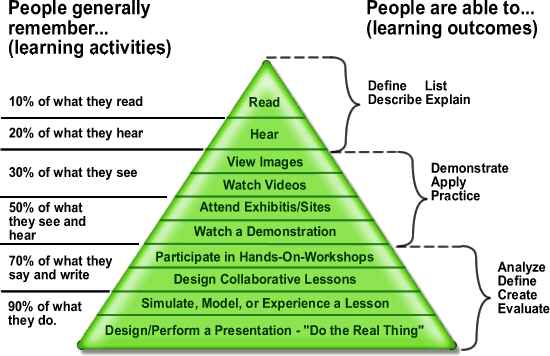
You are probably familiar with Edgar Dale’s Cone of Learning which illustrates how much we learn.

Edgar_Dale's_cone_of_learning

Creative Commons Attribution-Share Alike 3.0 Unported

Please note that this data has not been scientifically tested and is apparently inaccurate.

If you want to test it for yourself, try watching an unfamiliar video that has a narrator without the sound, and then listening to another similar video without seeing the video. Most of the time you will be able to perceive more of what has occurred if you listen to the sound only. People actually learn more from what they hear because less visual information is presented in most instruction.

According to dual encoding theory people will recall a lower percentage of what they have heard due to cognitive overload. They will remember a higher percentage of visual information, because there is less of it to remember.[1] Here is another test to try. Present a rapid string of illustration at the same speed that we move from sentence to sentence. People’s eyes will soon glaze over from overload.

Let’s return to my experience with illustrating the planets based on verbal input. I was actually able to remember more of the instruction than the other students. If you think about it logically people really do not learn by doing. Without hearing or seeing instruction they have no clue of what to do. However, they remember more by performing actions based on what they have been taught. The act of converting one output into another output uses even more areas of the brain, and evidently the more you use, the better you remember.

[1] https://www.sciencebasedmedicine.org/brain-based-learning-myth-versus-reality-testing-learning-styles-and-dual-coding/

.

Posted in Education trends | Tagged , , | 1 Comment

Tinkering with the mind of man

055 monitor brainThe idea of the left brain being logical while the right is creative has been disproved in studies which show that during creative activity people are more likely use both half of their brains. According to Dr. Jeff Anderson, director of the fMRI Neurosurgical Mapping Service at the University of Utah, “It is not the case that the left hemisphere is associated with logic or reasoning more than the right… Also creativity is no more processed in the right hemisphere than the left.”[1]

But when it comes to our outlook is does seem like the left side of the brain supports optimistic thinking while the right brain supports pessimistic ideas. More specifically physiological activity in the left-hemisphere tends to increase self-esteem and the assumption of a good outcome. While the right side of the brain supports the parasympathetic nervous system. This system kicks into high gear when we sense danger and controls the flight or fight response. A right brain viewpoint will tend to focus on possible dangers and consider how to avoid them.  Experiments which are aimed at manipulating people’s perception of whether or not they cannot control a situation demonstrate a difference in activity on each side of the brain. There are greater physiological changes in the left half of the brain when people are led to believe that they can control a negative situation, while the right half has a greater neurophysiological response if people are told they are powerless to enforce a change.[2]

However the left-hand and right-hand sides of the brain do not work in isolation, nor would we want them to. The constant flow of information between the two sides input what seems to us to be a unified experience to us. This allows us to avoid risky behaviors due to an optimistic sense of invincibility, while not succumbing to gloom in the face of negative events.

While all of this may make up interesting conversation at a convention of neurologists, the truth is understanding particular brain functions doesn’t really help us alter the way people think. It is simply too dangerous and costly to be performing brain surgery just to tinker with a person’s level of optimism. However, the idea keeps appearing that our increasing knowledge of how the brain works will allows us to make great strides in promoting mental health and learning. One of the recent findings about our brains in how much they differ between each person. Having what is considered an abnormality or learning disability is basically normal. Also, as we learn the brain changes and adapts in ways that we still do not comprehend. How much will all the new things we have learned about the brain enable us to improve ourselves? Stick with me for a few weeks while I look into brain-based learning.

___________________________

[1] Wanjek, Christopher. Left Brain vs. Right: It’s a Myth, Research Finds (accessed Feb 17, 2014)
[2] Hecht, David. The Neural Basis of Optimism and Pessimism. Experimental Neurobiology. 2013 September; 22(3): 173–199. Published online 2013 September 30
Posted in Education trends, Manipulation, Mental health, Optimism and Pessimism | Tagged | Leave a comment

Less optimistic and happier?

DSCN5879a

In order to research the difference optimism, it must be defined in a measurable manner. One of the ways that some researchers measure it is by explanatory style. For them optimism is based on how much credit you take for success, and how much you blame failure on external events.[1] According to Cathy McFarland and Michael Ross, people with higher self-esteem, which often accompanies optimism, tend to use self-serving attribution. In other words if they fail, it was because the task was too hard. If they succeed it was because of their own talent, intelligence, and hard work. This pair of researchers from the University of Waterloo did a study to see how much this self-serving attribution affected moods. Indeed, the people who were led to believe that success or failure was based on themselves were happier when they succeeded and more glum when they failed. Those that attributed success or failure to the difficulty of the task did not have such mood swings.[2]

So optimism, as measured by how you explain successes and failures, should go hand in hand with happiness. Well maybe this is true for a short experiment, but not when optimism is measured over a lifetime. A study of optimism in German adults from 18 to 60+ found that the younger adults had the sunniest outlooks and expected their life to improve the most. Middle age adults were a bit more realistic, and older adults predicted the greatest decline in their satisfaction with life.[3] However, a study from the University of Chicago that looked at depth at who was happiest in America found that older people were. [4]

Now possibly the difference between living in Germany and America could affect the outcome of this research. However, both studies looked at huge samples of the population, groups over 1000 in size. Each study was based on the answers to a few questions, a simple rating of happiness or prediction of future satisfaction with life. So now the researchers are busy trying to explain why increasing in age results in both a more pessimistic outlook and increased happiness. Some ideas are that as people age they gain better social integration skills, they have learned to be content with who they are or perhaps their memories just gloss over past pains. So is the true cause of happiness high self-esteem or forgetfulness? Perhaps the secret to being happy really is to expect less.

[1] Peterson, Christopher; Seligman, Martin E. P. Vaillant, George E. Pessimistic Explanatory Style Is a Risk Factor for Physical Illness: A Thirty-Five-Year Longitudinal Study, Journal of Personality and Social Psychology, 1988, Vol. 55, No. 1,23-27
[2] McFarland, Cathy; Ross, Michael. Impact of causal attributions on affective reactions to success and failure. Journal of Personality and Social Psychology, Vol 43(5), Nov 1982, 937-946.
[3] Lang, Frieder R. Weiss, David. Gerstorf, Denis. Wagner, Gert G. Forecasting Life Satisfaction Across Adulthood: Benefits of Seeing a Dark Future? Psychology and Aging © 2013 American Psychological Association 2013, Vol. 28, No. 1, 249 –26
[4] http://news.uchicago.edu/article/2008/04/16/age-comes-happiness-university-chicago-study-shows#sthash.vsWQpdwp.dpuf
Posted in Uncategorized | Tagged , | Leave a comment

Does pessimism shorten or lengthen your life?


576px-Woman_in_Old-Age_Home_-_Mariana,_Minas_Gerais_-_Brazil (1)

Frequently I have read anecdotal accounts of people who were sure that they were going to beat a life threatening disease (usually cancer) against the odds and managed to do so. Often they would give credit to their optimistic attitude that kept them fighting. There is not much thorough research that looks at long term effects of optimism and pessimism on health. However, there was one notable study that followed 99 men from age 25 to 60. Each man’s optimism was rated based on the way they explained bad events. If they thought that the cause of bad events were unstable, specific to the individual events and external to them rather than a result of their action, they were judged as optimists. Those who held the other view – the cause of bad events was stable, global and related to themselves – were labeled pessimists. Of course like most studies on this subject they drew from a pool of subjects that would tend to have a larger number of optimists who assumed they had better than average prospects, namely students at a prestigious private college. In this case it was Harvard [1]

These researchers (Peterson, Seligman and Vaillant) found that a pessimistic attitude predicted poorer health from ages 45 through 60. They were unable to pinpoint the specific cause for this. Some suggested reasons were lower immune system or less support from other people. Evidently pessimists are not as popular among their peers, or perhaps they just don’t want to rely on other people as much. The pessimists definitely made more frequent visits to the doctor. However, as these men reached their fifties the correlation between poorer health and pessimism began to fade. The study did not follow them beyond their sixties, but one wonders if this trend would continue.

Another study on health, longevity and outlook on life was conducted by Frieder R. Lang, of the University of Erlangen-Nuremberg in Germany. According to his research people who have low expectations for the future are more likely to live longer. His study was only ten years long and consisted of a much larger and diverse population, 40,000 people from ages 18 to 96. Each group were asked questions to predict how satisfying life would be in five years. Then, five years later they were asked the question again and again at the end of ten years (if they survived that long). For the oldest group, 65 and above, over 40% predicted life would be less satisfying than they actually found it five years later. This group had fewer disabilities than those that thought their life would be better than it turned out to be. Of course, just like the study on the health of Harvard men, the researchers had had only guesses as to why this occurred.

“Pessimism about the future may encourage people to live more carefully, taking health and safety precautions.”[2]

However, I have my own ideas. This second study did not measure optimism or pessimism as much as it measured how well people could predict their future satisfaction with life. It may not just be an unfulfilled pessimistic forecast that results in healthier, longer lives. The fact that these aging people found themselves healthier than their peers may have led them to become more satisfied. In the same way those who suffered more disabilities would abandon an earlier optimistic attitude and be less happy with their lives. Most likely the decline in health had more of an effect on attitude than attitude did on health.

 [1] Peterson, Christopher; Seligman, Martin E. P. Vaillant, George E. Pessimistic Explanatory Style Is a Risk Factor for Physical Illness: A Thirty-Five-Year Longitudinal Study, Journal of Personality and Social Psychology, 1988, Vol. 55, No. 1,23-27
[2] Lang, Frieder R. Weiss, David. Gerstorf, Denis. Wagner, Gert G. Forecasting Life Satisfaction Across Adulthood: Benefits of Seeing a Dark Future? Psychology and Aging © 2013 American Psychological Association 2013, Vol. 28, No. 1, 249 –26

.

Posted in Optimism and Pessimism | Tagged , , , | 2 Comments

How well do you know yourself?

Acon 2011 (1)b

High self awareness may not be a pleasant characteristic to have. There are other names given to this trait, such as private self-consciousness. Stephen Franzoi of the University of California at Davis has studied the effects of private self-consciousness and found that people scoring high in this measure know themselves better. They are more likely to self-disclose their problems in periods of distress, but tend to do so in a low key manner that will not push social acquaintances away, because it is their problem, not their associate’s. However, these people are also more likely to be depressed.

Research conducted at the University of Waterloo in Canada shed some light on the efforts currently made to improve self-esteem. Surprisingly Lead researcher Joanne Wood found that giving positive pep talks to oneself only raised the mood of those people who already thought well of themselves. This technique actually backfired for those with low self-esteem. One additional thing that I might mention about the University of Waterloo research is that the subjects were reminded to think how loveable they were by hearing a bell ring every 15 seconds. Hearing a noise to consistently reminding me to change my thoughts reminds me  the egalitarian dystopia in Kurt Vonnegut wrote about in Harrison Bergeron more than anything else. Harrison was subjected to a periodic noise to interrupt his thoughts to prevent his superior intelligence from making him different from other people.

A series of studies on how people shift between optimistic and pessimistic outlooks by Hazlett and Molden has concluded that people may choose the outlook that has the best motivational value for them. People that are concerned with promoting their advancement not only tend towards optimistic forecasting, they do better at tasks when they adopting an optimistic outlook. People that work towards the twin goals of safety and security, emphasize preventing bad events from happening. Conversely they perform better when adopting a pessimistic outlook. This research does not support the “logical” argument that people who are pessimists are prone to give up and stop trying. Rather it appears that normally optimistic people who adopt a pessimistic view, start to lag in persistence. A pessimistic person, on the other hand, works harder to achieve a goal they think they may not reach.

If optimism and pessimism really are dispositional traits, we should be wary of teaching people to change the way of thinking they have adopted because it actually works better for them.

Hazlett, Abigail and Molden, Daniel C. Northwestern University. Aaron M. Sackett, University of St. Thomas Social Cognition: Vol. 29, No. 1, pp. 74-96. 2011
Derlaga, Valerian J , and Berg, John H. eds. Self-Disclosure: Theory, Research, and Therapy
Slavin, Robert (2009) Educational Psychology, p. 117 ISBN 0-205-59200-7

.

Posted in Mental health, Optimism and Pessimism | Tagged , , | Leave a comment

The problem with positive pep talks

Eggs_Expressions_Happy_Sad1After centuries of  philosophers, and in more recent times psychologists, coming up their own set of personality factors a symposium in the 1980s settled on what are called the “big five” which are commonly found in  most summaries of personality traits. Four of the traits were supposed to be positive: Openness to experience, conscientiousness, extroversion and agreeableness. The last one, neuroticism, was tied to unpleasant emotions and anxiety.

The four positive traits have not remained as the ideal psychological state. For one thing a person high in openness to experiences seeks novelty and variety which are avoided by the conscientious person who prefers  planning and dependability. Even agreeableness if overdone can result in spinelessness.

Finally, we have come to accept the fact that less energetic and outgoing behavior of an introvert is not a sign of poor mental health, and removed it from the Diagnostic Standard Manual used by mental health professionals. Telling introverts to blurt out everything that comes to their mind and never retreat to solitude does not work because it does not fit their psychological needs. In the same manner it is exhausting for an extrovert to spend hours silently concentrating on work.

However, neuroticsm still has it’s bad reputation. It is often closely linked with a pessimistic life view that is on the look out for the next unpleasant event. So the tendency has been to encourage the “glass half empty” people to pep themselves up with positive self talk. If optimism and pessimism are really parts of a persons disposition, this kind of advice might not be useful at all.

A study from the  University of Waterloo in Canada found that repeating positive affirmations made people who already had low-esteem feel worse about themselves. The group was divided into two, with the control half writing down whatever crossed their mind for 4 minutes. The other half were instructed to do the same thing with the addition of thinking a positive though about themselves each time a bell was rung.  After 4 minutes both groups answered a battery of questions about their mood and self-esteem. People with high self esteem exhibited a more positive mood if they were in the group giving themselves affirming themselves every time the bell rang. But those with low self-esteem were in a better mood if they were allowed to write without the intrusion of the self pep talk.

According to Joanne Wood, the  Lead researcher and professor of psychology at the University of Waterloo:

It appears that positive self-statements, despite their widespread endorsement, may backfire for the very people who need them the most.

But have we ever considered that the people with low-esteem are leery of the illusion of positive self-feed back? Not only do they not need it, they do not want it. They may function better in an environment in which a less than optimal view of one self is accepted.

Joanne V. Wood, Ph.D, Should we re-think positive thinking? Giving ourselves pep talks may backfire.Published in Regarding Self-Regard. March 20, 2009


Posted in Mental health, Optimism and Pessimism, Psychology | Leave a comment

The origins of optimism

Optimism and pessimism are not two distinct styles but rather ends of a continuum. At the optimistic end people expect only good events to happen to them. They concentrate on stimuli that indicates a rosy outlook and ignore warning signs of unpleasant possibilities. At the pessimistic end people expect bad events to happen to them and become preoccupied with signs that something is going wrong.  Recently we have been told the further one is on the optimistic side, without reaching the oblivious dysfunctional state of being unable to see any pitfalls, the better life is.  Look at the all the benefits that some psychological researchers claim to have found for people who are higher on the optimism scale; they are purportedly happier, healthier and make more money.

However, careful examination of these claims show that social support[1], health, higher income[2] and optimism are really a cluster of characteristics that are frequently found together. This means that optimism could be the result of a popularity, good health and a good paying job, rather than the cause. Or there could be something else that contributes to all of these.

Research that suggests that optimism originates from having a supportive family with a higher than average economic standing[3]. Long term studies from the department of psychology at the University of Helsinki in Finland have shown that parental styles do have a measurable effect on the long term attitudes of children including their level of optimism. The mother’s own satisfaction with life, child rearing attitudes and opinions about the child’s temperament had very strong correlation with the daughter’s self-esteem which is tied to an optimistic outlook. The mother’s attitudes did not have as much effect on their sons.

However, when it came to the influence of the family’s socio-economic status (SES), the child’s gender did not seem to cause a difference. The lower the family SES, the more likely their children were to grow up to be pessimists. Even when adults coming from a  background of poverty and lack of opportunity moved up in education and occupational status from their family of origin, their optimism did not increase as much as a person who had these benefits growing up.

Think about this logically. A child doesn’t have any influence in choosing their gender, their parent’s attitudes or their parent’s income and social status. So if a person’s environment is more likely to influence their level of optimism than their attitudes are,  what is the purpose of promoting optimism as a benefit?

The answer? It benefits those doing the promoting. People keep reading books on how to be optimistic, assuming they will find the key to happiness, or at least to gaining wealth and opportunities. However, these books ignore the research that shows many of the characteristics of an optimist are developed during childhood.  And the books do not explain how to go back in time and change the way one grew up.

Rare is the individual who is content with his or her life. Most of us are seeking something better, so we listen to people who have found something that sounds like it may work, and we buy their books. When we don’t find a better life using their proposed method, we search for something else. The production of self-help books seems to be endless, probably because most are not helping.

[1] House, J. S., Landis, K. R., & Umberson, D. (1988). Social relationships and health. Science, 241, 540−545.
[2] Lorant, V., Deliège, D., Eaton,W., Robert, A., Philippot, P., & Ansseau,M. (2003). Socioeconomic inequalities in depression: A meta-analysis. American Journal of Epidemiology, 157, 98−112.
[3] Heinonen, K., Räikkönen, K., & Keltikangas-Järvinen, L. (2005). Dispositional optimism: development over 21 years from the perspectives of perceived temperament and mothering. Personality and Individual Differences, 38, 425−435.
Posted in Creativity, Mental health, Optimism and Pessimism | Tagged , | 1 Comment