Competitive disadvantage for creative women

510px-Defense.gov_photo_essay_080814-A-8804H-006 Every time I hear someone ask how to intrinsically motivate students, I have to laugh inside. The very definition of intrinsic means to come from inside of a person, not from an outside source, such as a teacher, instructor, trainer or anyone else employed in the field of getting people to learn. But maybe I should tell them that they need not worry about intrinsic motivation. Although it is touted as a way to improve learning, when it comes to improving one’s level of recognition in a field – even recognition for creative accomplishments – extrinsic motivation seems to trump strictly internal goals every time.

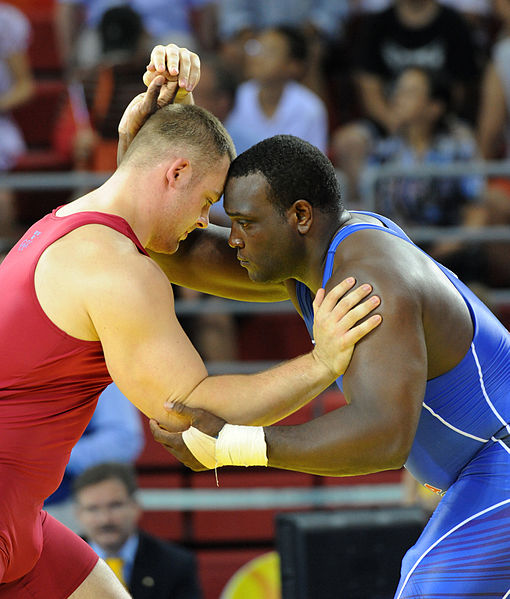
Consider the root of competitiveness.  People work harder to do something not just to excel in their own sight, but to be recognized by the public as better than someone else.  The Olympic medalist who bemoans winning silver may have spent months of solitary training, but the crushed expression at coming in second reveals the high level of extrinsic motivation involved.

Men seem to compete more readily than women. Evidently the male characteristic of trying harder if someone else is paying attention starts young. It is noticeable early in grade school (Gneezy 2002).  Not only do the males make more effort when competing, they are more willing to take the risks. Why? Because they typically predict that they will perform better than they actually do. (Niederle & Versterlund 2005).

Many societies have placed a premium on competition. Even creative individuals  in the arts and sciences must compete for resources with which to do their work.  These resources have been habitually controlled by men (Simonton 1994). The decision to award these resources in often based on competition, and with creativity of ideas being a particularly subjective judgment, resources are often awarded to the most competitive people.  People who promote themselves as being the best win – not necessarily the people who are the best (Gneezy 2002).

It becomes obvious how this tendency carries over into the creative fields. F. Barron’s (1972) study of young artists at the San Francisco Art Institute and at the Rhode Island School of Design yielded similar observations. When the students were asked if they thought their work was “particularly unique or good” 40% of the men and 17% of the women agreed. These statistics were basically reversed when he asked the flipped side of this, with 40% of the women and 14% of the men feeling that that their work was inferior to others at the institute. Interestingly, these were not real indications of quality. Overall the woman’s work was as high a quality as the men’s. Barron attributed this disparity to a difference in self image.

However, this self-image may be due to social conditioning, not innate differences between men and women. In the few matrilineal cultures in which women control the resources, they behave in a similar competitive manner to men of other cultures. (Gneezy & List 2013). It has often been noted that women can also be competitive. However, they tend to limit this to competition against other women, which is done in a more covert and less openly aggressive manner. To make an impact on the world with their creativity would require a different style of competitiveness. So what exactly occurs when women try this?

Photo: 2012 London Games. Defense.gov_photo_essay_080814-A-8804H-006.jpg/Public domain.


Barron, F. (1972) Artists in the Making. New York: Seminar Press
Gneezy, U. (2002) Gender and Competition, Do Competitive Environments Favor Men More Than Women? Capital Ideas, Vol. 4 No. 2 | Fall 2002
Gneezy, U. and List, J. (2013) Where Women Are More Competitive Than Men, Time
Niederle M., and Lise Versterlund, L. (2005) “Do Women Shy Away from Competition? Do Men Compete too Much?” NBER Working Paper Series, National Bureau of Economic Research , 1050 Massachusetts Avenue, Cambridge, MA 02138
Simonton, D. K. (1994). Greatness: Who makes history and why. New York: Guilford Press.
Posted in Creativity | Tagged , , , , , , , , | Leave a comment

Is there a hidden price in creativity for women?

Berlin12 116No matter how many different studies  are performed using different measurements in testing creativity for males and females there seems to be a consistent result. There is no difference.  Kogan (1974) found that when creativity test scores for students were compared girls had a slight advantage, so it is improbable that innate gender differences in creativity could explain why creative accomplishment of men heavily outweigh those of women. So what causes this imbalance?

  • Is it how society perceives men and women in creative fields?
  • Is it the perception that creative women have of themselves?

Of course perception is a delicate matter. Do we view ourselves as other’s see us, or do other’s see us as we view ourselves? Cause and effect are difficult to detangle.

Amabile  (1982) tested creativity hypotheses using products, not test, as measurement. Her “grading” technique was consensual assessment. Basically experts in the field of art, poetry and fiction judged the products, most of them agreeing on which were the best. The judges looked at products, but did not have information about the people creating them. Basically they found no difference in creativity between men and women. But while gender did not make a difference monetary reward did. In a later study (Amabile et al, 1986) she found that artists, who sometimes worked for commissions, were told they were producing for pay, they tended to make products that were less original.

Other researches did similar studies on how rewards affected creativity in students and noted that these results varied, based on the gender of the student. Baer (1998) had eighth grade girls and boys writing poetry simply for themselves and for the possible of a reward. The negative impact of the reward on originality was largely confined to the girls. Conti, Collins, and Picariello (2001) also discovered that that female subjects were less creative in competitive situations than male subjects. Finally Koestner, Zuckerman & Koestner (1989) research how specific and general praise affected the performance of college students.  using college students as subjects. Their conclusion? “Women tended to display more intrinsic motivation in the no-praise condition than in the two praise conditions, whereas men showed the reverse pattern.”

In each of these situations it would seem that the females do not lack creativity, but are de-motivated by the possibility of being recognized for it in competitive situations. Is there a price to be paid for this recognition that does not exist for males?

When Frank Barron interviewed artists at the San Francisco Art Institute and at the Rhode Island School of Design he found that women view their work with more detachment and less passion. Yet “when asked whether they would still paint if they had no results or success, only half the men said they would continue to paint, but all of the women did.” (Piirto, 200o) So although the dedication to art seemed weaker, the persistence was actually stronger.

The conclusion reached by Ruth & Birren (1985) is that women “appear more interested in the creative process itself than in its end-product. Women sometimes have difficulties in externalizing their inner creative processes or have a lower need of achievement in creative endeavors.” Is it simply a  matter of men putting more effort into gaining fame for their creative work because this extrinsic motivator drives them? Or do women sense a price to be paid if they continue producing more creatively and compete with men? As mentioned earlier, detangling cause and effect of perception is difficult, so I will continue to try, but may not be able to answer this question.

AMABILE, T. M. (1982). Social psychology of creativity: A consensual assessment technique. Journal of Personality and Social Psychology, 43, 997-1013.
AMABILE, T. M . Hennessey  B.A. & Grossman  B. S.(1986) Social Influences on Creativity: The Effects of Contracted-for Reward. Journal of Personality and Social Psychology, 50, 14-23
BAER, J. (1998). Gender differences in the effects of extrinsic motivation on creativity. Journal of Creative Behavior, 32, 18-37.
CONTI, R., COLLINS, M., & PICARIELLO, M. (2001). The impact of competition on intrinsic motivation and creativity: Considering gender, gender segregation, and gender-role identity. Personality and Individual Differences, 31, 1273-1289.
KOESTNER, R., ZUCKERMAN, M., & KOESTNER, J. (1987). Praise ,involvement, and intrinsic motivation. Journal of Personality and Social Psychology, 53, 383-390.
KOGAN, N. (1974). Creativity and sex differences. Journal of Creative Behavior, 8, 1-14.
PIIRTO, J. (2000) Why are there so few? (Creative women: Visual artists, mathematicians, scientists, musicians), Davidson Institute for Talent Development.
RUTH, J.-E., & BIRREN, J. E. (1985). Creativity in adulthood and old age: Relations to intelligence, sex and mode of testing. International Journal of Behavioral Development, 8, 99-109.


Posted in Creativity | Tagged , , , , , , | Leave a comment

Making the choice

rocker aThis past Sunday was Mother’s Day in the United States. A holiday inspired by Anna Jarvis, an educator, editor and business woman who never married or became a mother herself. Instead Jarvis campaigned to honor her own mother, a socially active woman who had encouraged her to attended college.  Motherhood is an honored status in our society and one of the main reasons cited for the lack of creative women in the arts and sciences.

For women there looms an issue that men do not seem to face – the choice between a successful career and a family. Nowhere is this more evident than in fields of creative endeavor. Gilligan (1982) proposed that women often define themselves by relationships and their ability to care for others. There has been an unspoken rule in society that women are to put others first. Gilligan pointed out that conflict arises first in high school, where it is more acceptable for girls to be highly creative and then reappears again after college. [1]

Reis (1998) has found more recently that young gifted women do not believe they are going to face the barriers that previous generations of women encountered. However, they naively thought they could  begin a career, and then stop to marry and have children without any negative consequence to their career advancement. The creative women from their 20’s to 40’s in age that Reis studied realized that they had a finite amount of energy. If they worked on developing their own talents, those they loved would be affected in a negative way. Finding time to do their own work always resulted in compromise. [2]

According to Piirto (2000) “Few if any gender differences are found in creativity until after college, when women must decide how they will manage being mothers, wives, and creators. The double bind hits hard, and this gender difference cuts across all fields and domains. The men creators never seem to wonder how they will manage raising a family and having a career. The women creators always do. That is why many who reached prominence were childless and even lived alone, without a mate.”[3] …like Anna Jarvis did.

Anna Jarvis poured a huge amount of time and effort into her crusade, she even resigned her position as an editor. In 1914, Mother’s Day became a national holiday, and within a few years Jarvis became disillusioned at the commercialization of this day, and was openly critical of the floral and greeting card industries. There is always that possibility of pouring one’s whole life into an effort only to be disappointed. Maybe that is something that many creative women, who continue to struggle make time to care for a family and their own work, have always realized.

[1] Gilligan, C. (1982). In a different voice: Psychological theory and women’s development. Cambridge, MA: Harvard University Press.
[2] Reis, S. M. (1998). Work left undone: Compromises and challenges of talented females. Mansfield Center, CT: Creative Learning Press.
[3] Piirto, J. (2000) Why are there so few? (Creative women: Visual artists, mathematicians, scientists, musicians), Davidson Institute for Talent Development.
Posted in Creativity | Tagged , | Leave a comment

Creative wiring

Tape_cubby_roseWhen it comes to creativity, evidently women’s appearance is important, far more than it should be. You will the large percent of  singers, actors, dancers that are women. Their numbers continue to grow because their career is typically shorter than for males. It begins declining in their mid-thirties because the bias against age is greater for women than men. It doesn’t take much thought to realize this is due to the premium placed on women’s appearance. According to a number of studies on creativity, this third decade is the peak time for creative production. But, moving from singer to songwriter, dancer to choreographer and actor to director becomes much more difficult for women than men. Also, many men continue careers in performance, and never make the switch into producing.

That is only one tiny fraction of the answer to the question “Why as there so few well-known creative females?” There are far fewer well known women writers, artists, and composers.

First, let’s look at the claim that there are differences between the minds of men and women. Read almost any lay person level discussion of the mind they will make all sorts of assertions about differences in male and female brains that really do not exist. There is some evidence that the average woman is slightly better at language processing and average men are slightly better at spatial and numerical processing. But any examination of the brain, through scans or testing, does not reveal the gender of the person.

Interestingly enough, the main creative field in which women are almost equally as well known as men is creative writing.  Helson’s study of the psychology of creative writers and mathematicians found that “creative male writers were more like creative women women writers…than they were like creative male mathematicians.” But although prolific, woman do not dominate the field of writing, despite slight advantage at processing language. They also tend to not be as highly regarded in art, and almost non-existent in music composition.

Getzels and Czikszentmihalyi  administered a battery of tests to female and males studying at the Art Institute of Chicago. They found that the females had much higher spatial ability than the average female. Their scores in spatial perception were close to the males students, who had a slightly higher spatial ability. When it came to personality assessments,  both groups were unconventional, imaginative and independent. In fact, the similarity went beyond that. The female artists tended to show more masculine values than their female peers in college, while the male artists showed more effeminate personalities traits than other male college students. This finding caused  these researches to conclude that “The psychology of creative men is a feminine psychology by comparison with less creative men; the psychology of creative women is a masculine psychology by comparison, with less creative women.”

In Priito’s studies of gifted females and male teenagers in music performance and composition, there was no significant difference between the personalities of the two groups. There is greater similarity between the mental processes and personalities of  men and  women in creative fields, than there is between creative person and the average Joe or Jane.

Photo by S.L. Listman
Piirto, J. (2000) Why are there so few? (Creative women: Visual artists, mathematicians, scientists, musicians), Davidson Institute for Talent Development
Posted in Creativity | Tagged , , , , | 3 Comments

To make or to show?

DSCN0562c2DSCN0656c

People often split creativity between the arts and sciences, placing painters, writers, composers, dancers and actors on one side, and biologist, chemists, mathematicians, psychologist and physicists on the other. There is another dichotomy apparent to anyone attempting  innovation–the split of designing and performing.

It is easier to see this split in the arts; the visual artist, composer, and writer are obviously designing works of art that they construct. The actor, musician, dancers are all performing, right? But there is an overlap. Conceptual visual artists will imagine original ideas, but the resulting tangible piece may not strike people as a great work of art. It is the explanation of the idea–the performance–that carries the conceptual artist into the creative limelight. I recall seeing one create portraits on a floor covered with wax paper by pouring chocolate syrup. Watching him in the act of creating was the intriguing part.

This also occurs in the sciences. Notable theorist, such as Albert Einstein, are known for their explanations of theories–abstract ideas that are not really observed or proven through experiments. They promote the theory through a series of logical arguments, and the ability to present is as important as the ability to produce proof or construct a sophisticated invention. Others through constant experimentation (or sometimes accidents as in the case of Louis Pasteur’s anthrax vaccine) produce new practical inventions.

Creative people often work on both sides of the split. Directors and actors who also write, musicians who play an instrument and compose. Inventors who initiate original ideas or who through their persistence and ability to gain backing produce another’s novel invention. Artist and scientists piggyback on the past to the point that it is difficult to determine who originated the “original” idea for which one person receives the credit.

After all  “there is nothing new under the sun.”

Photos By K.N. Listman


Posted in Creativity | Tagged , , , | 2 Comments

Is creativity in men and women different?


Telemachus_and_Mentor_crop

Yearn to be recognized for creative achievement? Over forty? You may be too late – unless you are female.  Creative production in a variety of fields – mathematics, medicine,  physics, psychology – increased until age 30 -39 and then hit a decline according to H. Lehman.[1]  D. K. Simonton  found the same to be true among composers and musicians and referred to it as the “swan song phenomenon.”  Later works by noted composers were considered less original even though they were often more popular with the audiences.[2] However, these studies used predominantly male populations for data.

Geoffrey Miller found that the peak age of creative output for most writers, painters and musicians was in their thirties and forties. However, Miller took his studies of  bit further due to interest in culture rather than creativity. Most of the earlier findings were based on populations that were primarily or exclusively male. Miller determined that female authors produced more work later. His research showed them to be slightly more productive in their fifties.[3]

Sally Reis has pointed out that the male concept of the creative process has been accepted as the standard. However, this standard may only apply to male creators. She found that creative women are frequently perfectionists. They attempt to expend maximum energy at all times. More women try to do everything and do it well.[4] This is in contrast to the more focused aim at specific achievement pursued by most males. Reis’ study of creative female mathematicians found that there was almost no difference between the genders on measures of intelligence and cognition. They tended to show “rebellious independence, introversion, and a rejection of outside influences.” However, females in mathematical  research activity were highly flexible and original, and less likely to accept outside influence than male peers. During interviews women explained that they often felt that they had no choice. Their drive to contribute was strong as their belief in their ability to do so. Some of them simply said, “Something inside of me had to come out.”[5]

[1] Lehman, H. (1953) Age and Achievement, Princeton: Princeton University Press.
[2] Simonton, D. K. (1989). The swan-song phenomenon: Last-work effects for 172 classical composers. Psychology and Aging,4,42-47
[3] Eds. Garibaldi, P. Joaquim Oliveira Martins, J.O., van Ours, J. The Grand View on Age and Productivity  in Ageing, Health, and Productivity: The Economics of Increased Life Expectancy. Oxford University Press. pg 155
[4] Reis, S. M.(1998). Work left undone. Mansfield Center, CT: Creative Learning Press.
[5] Reis, S. M.(2002) Toward a Theory of Creativity in Diverse Creative Women,  Creativity Research Journal, University of Connecticut.
Posted in Creativity | Tagged , , , , , , , | 1 Comment

Learning through social networking media?

068 laptopIn the past with students glued to their phones rather than paying attention in class, teachers wondered if they could teach better using a social network. Social media may be useful, but the belief that everyone is using it sometimes lead to further exclusion.  MySpace (yes, it still exists) Snapchat, Tumblr, Reddit, DeviantArt, Pinterest even LinkedIn are chosen by some students rather than Facebook and Twitter, because of the different offerings and levels of complexity. The recent switch to distance learning for students has revealed the weakness of attempts to learn completely on-line.

Mimi Ito traced what teenagers and young adults did on social networking sites. Most of it was everyday social transactions, sharing entertaining moments, and self publicity. A few used sites to explore and gain new knowledge. She also noted that teenagers feel weird having adults on the social networking sites.[1]

Students need instruction on how to avoid pitfalls of using social media. It is the world where success is measured quantitatively, number of likes and hits – with actual impact remaining unknown. A easy and harmful way to to increase notoriety is by spreading lies and rumors. Teachers need to explain the consequences of this. There have been students who entered the  court system due to this kind of harassment. Students don’t seem to get away with the false rumor tactics that politicians pull. 

It’s not particularly wise to have students complete assignments on social networking sites, unless they are set up for education. Instead, they need to know how to use the sites. Students needing resources must determine which kind of sites best fit their goals. With the use of conferencing software, classes can even have “show and tell” times when describe what they have learned.  However, controlling the content shown to the virtual classroom, so that it is appropriate, requires monitoring that is often more subtle than in an actual classroom. Violations are harder to perceive and cannot be instantly reprimanded.

Social networking, even on-line, is still a social activity. This requires skills in relating to others and an ethical sense of behavior. With so much of life shifting to this mode,  students need help in practicing virtual relationship skills–setting expectations and limits, giving encouragement and watching out for others when on-line.

[1] Ito, Mizuko. Hanging Out, Messing Arounc and Geeking out: Kids Living and Learning with New Media, MIT Press.
Posted in Education trends, Technology in education | Tagged , | 1 Comment

Don’t like criticism? You might feel the same way about creativity.

647px-BitterkaelderSoed_edited-1

Illustration Ravnen 1890, Public Domain

Alex Osborn, known for founding the Creative Problem-Solving Institute, set up a structure for group creative brainstorming. One rule to free people from creative inhibitions forbid criticism and judgment during initial brainstorming. [1]

There is no need to guess why. People tend to champion their own ideas at the expense of better ideas. It only takes a small minority set on “defending their turf” to have a detrimental effect.

Ask educators the way to encourage creativity and they will tell you students need an environment full of stimuli. They will also say the classroom should have an open, accepting atmosphere, free from criticism to build up self-esteem. Ask people noted for work in creative fields, and they will agree with the need for a stimulating environment, but not with the lack of criticism.

While interviewing college art and educations majors about factors leading to creativity for my own research, both groups placed willingness to take risks high on their lists. The art majors said being around creative people was the most important factor. The education majors gave high self-esteem first place, but this did not match the results of students in creative fields. Self-esteem wasn’t even mentioned by the art majors. They preferred honest critiques of their work. Evidently, building self-esteem does not build creative thinking.

Teachers often have difficulty with highly creative students for same reason corporate workers find creative colleagues difficult. They tend to level criticism at others more frequently [2]. But evidently creative people are not as hurt by criticism, either. According to research both innovative students and employees take the anxiety resulting from a negative evaluation of their work and convert it into a drive to be even more unique. [3]

Research conducted in both the United States and France, examined the result of brainstorming groups when one was told not to criticize while the other was encouraged to debate ideas. Those allowed to debate generally came up with superior ideas. The key was to encourage debate and even criticism, without allowing anyone to monopolize the session.

“Brainstorming techniques have specifically admonished people ‘not to criticize’ their own and others’ ideas, a tenet that has gone unexamined. In contrast, there is research showing that dissent, debate and competing views have positive value, stimulating divergent and creative thought.” [4]

[1] Osborn, Alex. F. (1953) Applied imagination: Principles and procedures of creative thinking
[2] Torrance, E. Paul. ‎(1963) The Creative Personality And The Ideal Pupil. Teachers College Record, 65, 220-226
[3] Johns Hopkins University news release, August 21, 2012, Don’t Get Mad, Get Creative: Social Rejection Can Fuel Imagination, JHU Carey Researcher Finds
[4] Nemeth, Charlan J. Personnaz, Bernard. Personnaz, Marie. Goncalo, Jack A. (2004) The liberating role of conflict in group creativity: A study in two countries. European Journal of Social Psychology,Volume 34, Issue 4, pages 365–374,
Posted in Creativity | Tagged , , , , , | 2 Comments

The curse of creativity

DSCN6251C.jpgIt just isn’t fair. One person gets to be born with an enviable imagination, the ability to come up with new, innovative ideas, or create artistic masterpieces and the next person does not. Many cringe at the idea that creativity could be an innate and inheritable trait …. including those that have this trait.
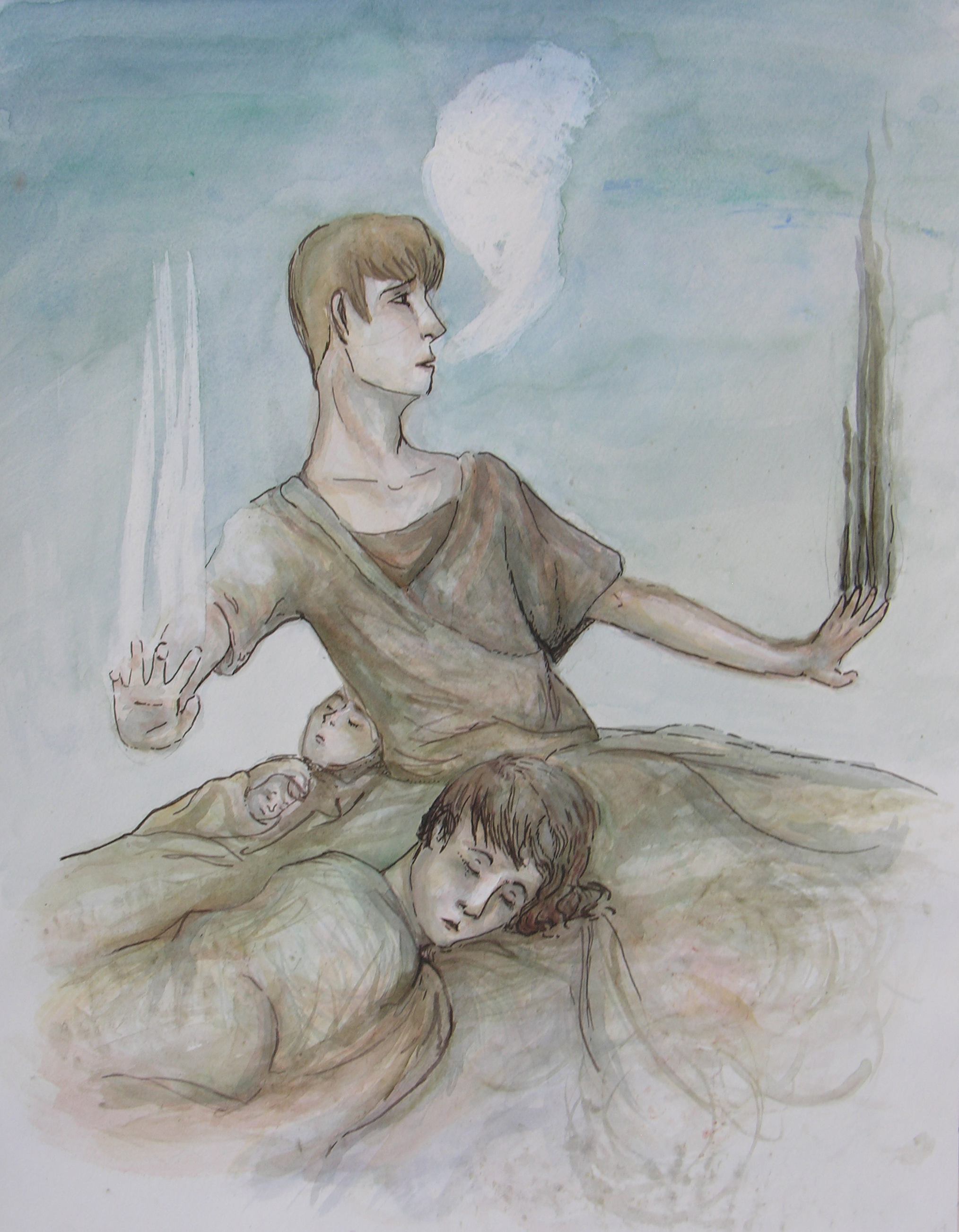
Creative people often feel driven to be different, to strive for the original idea and take it as far as possible despite the deprivation and pain that results. They fear that inspiration may abandon them and leave them stranded, or the world may decide that the masterpiece into which they have pour blood, sweat and tears is useless and ugly. They may not see their ability as being  a fortunate circumstance. In fact, most of the evidence for innate creativity is based on the negatives associated with this trait.

First on the list of negatives is the similarity of creative thinking to schizophrenic thinking. Researchers find increasing evidence for the genetic basis for schizophrenia, as they search through family trees of schizophrenics.  There appears to be a larger than average number of people in creative fields in these family trees. In the same manner, examining the families of famous creative people reveal more members exhibiting types of psychopathology than found in an average population.  Abnormal thinking includes:

  • Delusional thinking, which is similar to using divergent associations
  • Over-inclusive thinking, or paying attention to seemingly irrelevant details
  • Uncontrolled flexibility, evidenced by jumping from idea to idea [1]

Do those sound a lot like creative traits? The difference is that the creative person has a stronger ability to make judgments to determine when this kind of behavior will be acceptable, a characteristic controlled by the pre-frontal cortex. [2]

The second evidence for innate creativity is associated with a problem that many writer’s bemoan–the unpredictability of inspiration. For those most known for creative output, the peak tends to come at the beginning of their career. Then, creativity tends to fluctuate, going up and down, but usually not reaching the earlier height. If creativity were a learned behavior it should improve. However, the ability to come up with a creative product seems to “a chaotic sequence of hits and misses.” [3]

Finally, no one seems to be able to explain why some people keep after their pursuit of creativity when it is heavily discouraged. Reams of articles come out on how to encourage creativity in education and the workplace, but it appears some manage to keep a unique perspective without encouragement. Business have an increasing desire for creative products. But this desire for these products and is in opposition to their treatment of most creative people. Those that produce creative ideas are generally disliked.[4] Why would a creative person continue coming up with the kind of ideas that cause social rejection if it was only something they learned to do–not something they did intuitively? Apparently social rejection increases imaginative thinking–at least  in those that are already nonconforming types. According to a study from Johns Hopkins:

“Rejection confirms for independent people what they already feel about themselves, that they’re not like others. For such people, that distinction is a positive one leading them to greater creativity.”[5]

[1] Kuszewski, A. (2009) The Genetics of Creativity: A Serendipitous Assemblage of Madness, http://www.grupometodo.org
[2] Jung-Beeman, M., Bowden, E., Haberman, J., Frymiare, J., Arambel-Liu, S., Greenblatt, R., Reber, P., Kounios, J. (2004). Neural activity when people solve problems with insight. PLoS Biol 2(4): e97
[3] Feist, G.J. (1998) A meta-analysis of personality in scientific and artistic creativity, Personality and Social Psychology Review, 2, 290-309
[4] Olien,J (2013) Inside the Box, People Don’t Actually Like Creativity.
[5] Johns Hopkins University news release, August 21, 2012, Don’t Get Mad, Get Creative: Social Rejection Can Fuel Imagination, JHU Carey Researcher Finds


Posted in Creativity | Tagged , , , , , , | 1 Comment

How is creativity killed?

chronic waste c2If teaching students to be creative is one of the highest goals of education, we have a problem. The United States as a nation is becoming less creative. Unfortunately, the scores on are getting lower on the Torrance Test of Creative Thinking. Initially after this test gained wide-spread acceptance in schools, scores rose. This is a normal result known as the Flynn effect, which also occurs on IQ tests. In fact, IQ test have to be normed repeatedly or else the general population scores slowly increase.

The scores for creativity increased in a fairly linear manner until the 1990’s. Then, the slump started. The biggest decrease in is the skill of elaboration–the ability to expand and add details to a creative concept.[1]

What caused this decline?  Increasing electronic communication has been blamed. According to Larry Rosen, a psychology professor at California State University , the constant checking of phone texts and social media provides a connection without requiring the innovation necessary for face to face interaction. The student who sees a “like” gets a dopamine boost that reduces anxiety. However, the constant review of social media stats decreases creativity. Rosen noted that mobile phone usage soared at the same time that the Torrance Tests of Creative Thinking scores fell  in 1998, and this is no coincidence. [2]

Even early in his work, Torrance (1963) found reasons that creativity might be discouraged. Adults who come up with original ideas are characteristically absorbed in their work, and do not take the time or effort to be polite. They often refuse to take no for an answer, and level criticism at others. Creative children have the same traits, which can be viewed as “obnoxious” by teachers. Torrance warned educators that they needed to deal with these negative aspects of students’ personalities without discouraging  creativity.[3] In later studies Torrance (1980) uncovered the fact that some teachers said they were rewarding creativity when they were actually punishing it.[4] Part of the decline may be the due to the students’ attempts to get along with others.

Westby and Dawson (1995) proposed that creativity is being discouraged by educators who do not actually recognize it. When they tested college students to find out which characteristics they thought correlated with creativity and non-creativity, their answers matched the psychologists’ findings about 95% of the time. However, when a group of teachers in grade school were asked about the same traits, the correlation was about 50%. They thought students who were not creative if they were:

  •   emotional
  •   impulsive
  •   non-conformists
  •   making up rules as they went along
  •   trying to do the impossible
  •   not fond of working with others when making new things

But all of these traits correlate with higher levels of creative thinking. Still, many teachers claimed they liked creative students, but they warped the definition to match students that were easier to control in class. [5]

A few years ago, I witnessed e a teacher sharing a collection of poems her students had written. She wanted advice on making them into a book. This teacher’s favorite poem was a set of stanzas with perfect spelling and rigid rhymes. The words fell pretty much as expected. A college professor pointed out a different and compelling piece in which the young poet described her own struggles and inability to meet expectations. However, this teacher failed to see the quality of this other poem. She was not fond of the student that wrote it.

In the end, we have to be able to learn to recognize authentic creativity, even if we do not like what we see in the person who produced the work.

Art by S.L. Listman

[1] Bronson, Po, and Merryman, Ashley (2010) The Creativity Crisis, Newsweek.
[2] Joel Stein, Millennials: The Me Me Me Generation
[3] Myers, R.E. and Torrance, E.P. (1961) Can teachers encourage creative thinking? Educational Leadership 19, 156-159
[4] Torrance, E.Paul ‎(1963) The Creative Personality And The Ideal Pupil. Teachers College Record, 65, 220-226
[5] Westby, Erik.L. and Dawson,V.L. (1995) Creativity: Asset or Burden in the Classroom? Creativity Research Journal.  Vol 8, No 1, 1-10
Posted in Creativity | Tagged , , , , , , | 1 Comment