Destined for optimism?

01 enthused

There has been an academic debate going on between psychologists since Shelly Taylor published Positive Illusions asserting that the normal mentally healthy person holds on to optimistic illusions. Are most humans not realistic in their view of themselves and the their future? According to psychologists Shelly Taylor and Jonathon Brown:

 “One dilemma that immediately arises is that, as noted earlier, many formal definitions of mental health incorporate accurate self-perceptions as one criterion. In establishing criteria for mental health, then, we must subtract this particular one.”[1]

There has been some pushback to asserting that a realistic view of one’s self is not a basis of mental health. Critics have contended that this research showing that the normal person perceives themselves as better than average in ability and future outlook was a result of using an elite population, namely students in prestigious private universities, to conduct research. [2]

However, others such as neuroscientist Tali Sharot, concur with Shelly and Brown. Sharot has summarized research on this topic in her easy to read books (such as The Science of Optimism – Why We’re Hard –Wired for Hope) aimed at the general public. In her attempt to answer the question why the majority of humans have a built in tendency to be more optimistic than realistic, Sharot claim that optimism is adaptive. In others words, a rosy view of the world makes it easier for a human to survive and reproduce. Much of her theory is based on research showing that people that believe they can overcome a life threatening illness against the odds, such as cancer, are more likely to do so. [3]

Does unrealistic optimism really provide an advantage, or is it simply a popular idea to sell books? Let’s look at the major advantage optimism is supposed to provide. According to Sharot, low expectations are not a good idea because those with great hopes for the future will keep trying despite setbacks due to the belief that they will be successful, while pessimists will simply give up.

A study by Charles S. Carver et al also asserted that:

 “…People who are confident about eventual success continue trying, even when the going is hard. People who are doubtful try to escape the adversity by wishful thinking, they are drawn into temporary distractions that don’t help solve the problem, and they sometimes even stop trying.[4]

It sounds logical, but you must remember that the reason Taylor saw optimism as an illusion is that the majority of people have far less control over events than really exists. They predict outcomes better than actually occur. Personally, I would also like to know how to distinguish the difference between unrealistic optimism and wishful thinking? The two terms seem very similar in my mind.

Carver’s research indicated that although optimism was considered a personality trait, it sometimes was not very stable. In a study that measured the optimism of students in law school to determine this would affect success in their careers (as measured by how much money they made) researchers found that:

 “the change in that study was mainly in the optimistic direction and was predicted by increases in social resource.”

In other words as former students climbed up the socio-economic ladder, they became more optimistic. So again optimism is shown as increasing in a study done among an elite group, students in law school.

However according to Sharot it is all really based on point of view.

 “Research shows that whatever the outcome, whether we succeed or we fail, people with high expectations tend to feel better. At the end of the day, how we feel when we get dumped or win an award depends mostly on how we interpret the event.”[5]

So is it simply a matter that optimists are happier with their circumstances? Or is it more closely related to the socio-economic standing which would fit the profile of most students in elite universities and law schools. We really need to measure if optimism rises and falls in cycles that mirror economic growth? If research on optimism continues to be done mainly on populations that are likely to succeed because they already have an advantage we will never know.

[1] Taylor, S. E. & Brown, J. D. (1988). Illusion and well-being: A social psychological perspective on mental health. , American Psychological Association, Psychological Bulletin, 103, 193—210.
[2] Colvin C.R., Block J. Do positive illusions foster mental health? An examination of the Taylor and Brown formulation. Psychology Bulletin. 1994 Jul;116 (1):3-20.
[3] Sharot, T., The Science of Optimism – Why We’re Hard –Wired for Hope
[4] Carver, Charles S., Michael F. Scheier and Suzanne C. Segerstrom. 2010. “Optimism.” Clinical Psychology Review 30:879-89.
[5] Sharot, T. The Science of Optimism – Why We’re Hard –Wired for Hope
Posted in Education trends, Mental health, Optimism and Pessimism | Tagged , , , , , | Leave a comment

You can dream it, but you will probably never do it.

Мечты_Стеллы_МарисHow many times have you heard “if you can dream it, you can do it?” Well evidently if you can dream it you consider yourself happier, even if you never get around to doing it. And you are also similar to the majority of people who continue to believe things will get better despite never accomplishing their dreams.

Psychologists and researchers have been intrigued at how people continue to hold on to unrealistic views of their future. According to psychologists Shelly Taylor and Jonathon Brown positive illusions are fairly common in normal thought and fall into three categories:

  • People see themselves in an unrealistically positive manner as shown by the fact that the majority of people assume that they are “above average” in many areas
  • People assume that they have more control over environmental events than they actually do
  • People see the future as turning out better than data indicates it will

Taylor and Brown’s research indicated that established criteria for judging mental health included contentment; caring for others and its corollary, caring about others; ability to do productive and creative work; openness to new people; and receptiveness to new ideas. Most crucially they noted that a person’s mental health is judged on exhibiting a positive attitude concerning oneself, also known as having high self-esteem.

Self-esteem typically comes from how an individual believes other people view him or herself. This means our current view of mental health is based a curious conundrum. People tend to believe others view them highly, when in reality others view them as less able than themselves. As this contradiction becomes evident, people spread the high appraisals to those within their immediate group.

Taylor and Brown also found that research showed that people see their friends in a more positive light than the average person. In fact close friends are given more credit for success and less blame for failure than those outside one’s group. This means the average individual assumes that his or her immediate acquaintances are better than average, just like he or she is. Now we come to our second conundrum. This bias seems to be the opposite of openness to new people and very similar to the idea of prejudice against those outside of one’s group.

It is ironic that an unrealistically positive attitude about oneself which results in a sense of group superiority has been deemed “healthy” in the twentieth century. However, the ability to sustain these optimistic illusions is generally considered an indication of good mental health. Previously psychologists have asserted that a realistic self-assessment was necessary for this, but that would leave much of the world’s population being deemed as lacking in mental health. So the illusion remains and we are content to keep dreaming, without doing, just like almost everyone else.

Photo: “Мечты Стеллы Марис” by Stella Maris – https://500px.com/photo/86751947/in-dreams-by-stella-maris. Licensed under CC BY-SA 3.0 via Wikimedia Commons
Taylor, S. E. & Brown, J. D. (1988). Illusion and well-being: A social psychological perspective on mental health. , American Psychological Association, Psychological Bulletin, 103, 193—210.
Taylor, S. E. & Brown, J. D. (1994). Positive Illusions and Well-Being Revisited Separating Fact from Fiction, Psychological Bulletin, American Psychological Association, Vol. 116, No. 1, 21-27
Posted in Optimism and Pessimism, Psychology, Self confidence | Tagged , , , , , | Leave a comment

The prejudice against pessimism

Kiruna_church_2009_15_Öfvermod  Ülbus

You would think that having an accurate view of yourself, your situation and others around you would contribute to mental health. Well-adjusted humans are supposed to see the world realistically, and believing illusions is considered a hallmark of mental illness. But it is simply not that way. People tend to filter information in a positive light, and society rewards this. Evidently believing illusion makes humans happier. So the average view of reality is actually overly optimistic.

Our manner of gathering data is not at all based on logical and unbiased observation. We gather a piece here and there and fill in the blanks with our own self-serving prejudices. As humans, we interpret what we see to be advantageous to ourselves. This viewpoint colors almost everything we observe. We tend to live our lives viewing the world around us and ourselves with an enduring pattern of bias.

We know we all make mistakes, right? But we view our own errors as small as inconsequential, while we tend to view our successes as more spectacular than they really are. This is reflected in personality tests in which people judge themselves to have far more positive traits than negative. It seems that you really do not have to teach children to have positive self-esteem, as most people rapidly take to that tactic. Also people tend to forget incidents where they exhibited negative behavior. Therefore the question “What is the biggest mistake you ever made?” is not so difficult to answer because it embarrasses us. It stumps the typical person because their memories tend to forget that mistake.

In psychological experiment in which people must predict whether or not they will fail or succeed in a task, they err on the side of assuming success. And there is that pervasive tendency for the majority of people to respond to surveys indicating they see themselves as happier, smarter, and more able or well-adjusted than the average human. Of course it is not logically possible for most people to be better than others. So why do we cling to this illogical view? Why do we label those who have more balanced in self-perceptions as low in self-esteem, or moderately depressed?

What drives our prejudice against pessimism?  Is it simply a fad of our times or has it always existed? The second may be true as research shows most people prefer not to see themselves or their future in its true light.

Alicke, M. D. (1985). Global self-evaluation as determined by the desirability and controllability of trait adjectives. Journal of Personality and Social Psychology, 49, 1621-1630.
Campbell, J. D. (1986). Similarity and uniqueness: The effects of attribute type, relevance, and individual differences in self-esteem and depression. Journal of Personality and Social Psychology, 50, 281- 294.
Fiske, S. T., & Taylor, S. E. (1984). Social cognition. Reading, MA: Addison-Wesley.
Nisbett, R. E., & Ross, L. (1980). Human inference: Strategies and shortcomings of social judgment. Englewood Cliffs, NJ: Prentice Hall.
Watson, D., & Clark, L. A. (1984). Negative affectivity: The disposition to experience aversive emotional states. Psychological Bulletin, 96, 465-490.
Posted in Group psychology, Leadership, Manipulation, Persuasion | Leave a comment

Faking funny

Feb 071 laughter Everybody loves the sound of laughter don’t they? The muffled giggle, the high pitch twitter, the polished chuckle, the wheezing chortle, and the deep belly laugh can all be taken differently depending on who is uttering the sound. Real involuntary laughter is often contagious in groups, one person catches on to a joke and others join in with rounds of laughter that rise and fall. But faked laughter is more common in everyday life. It typically serves a type of social interaction and can be used to smooth over differences, appease a person perceived as more important, to draw attention to oneself or increase group cohesion by aiming guffaws of scoffs at an outsider.

A common use of the manufactured laughter, which tends to be slower and more nasal in tone, is to bond with other people. However, faked laughter is only appealing if we actually like the person doing it. I heard a guy comment once that a particular group of girls were not attractive enough to be giggling so much. He understood their artificial laughter as a kind of flirtation, and was uncomfortable with it because he did not find them appealing.

According to studies conducted by UCLA associate professor Greg Bryant, most people can only distinguish faked laughter about two/thirds of the time. Detection is based on the “breathiness” of the laugh, which is composed of the vocalized sound, “ha, ha, ha” and rapid breathing. The slower the laugh is the more we hear the vocalization and the more controlled the breaths seem; both are cues for detecting faked mirth.

And there is a third kind of laughter – the insidious, haunting kind of laughter. What makes it different from the other two? It hints of insincerity because the breathing is clearly controlled, unlike the gasping of real laughter, and it is often marked by pitch that trails downward. However, the situation does affect our opinion. A genuine deep belly laugh at what the rest of us consider revolting or grotesque, still seems very twisted.

Bryant’s studies are based on idea that many animals use laughter to indicate playfulness similar to a real human laugh. Most people are familiar with the hysterical sounds made by chimpanzees. But what do they find so outrageously funny? Usually nothing. Their laugh is used to ease social situations. Did you realize that dogs, also have a way of chuckling? You may not be able to perceive it because it is much more like wheezing than human laughter. However you do not have to worry that your dog is poking fun of you. Dogs use chuckling to appease others, just like people do.

http://newsroom.ucla.edu/releases/ucla-s-laughter-guy-dissects-features-of-counterfeit-chortling

Posted in Group psychology, Laughter and humor, Persuasion | Tagged , , | Leave a comment

No one wants to laugh alone

Foto de verdadeiro samigos by Vinims

Foto de verdadeiro samigos by Vinims

 Just beyond the door of my office a photographer was setting up a lights. He was also chatting with everyone who passed by. Finally he got down to the business of spreading out the tripods that held the lights. Then, I heard a clunk and soft crunch followed by a giggle from the resident of the office next to mine that keep on going. Even though I didn’t see, I didn’t have to wonder what was so humorous. The photographer told the story to every upper level manager that came to pose for their business portrait.

“I was setting up the lights quickly, and didn’t bother to move the boxes they came out of. At one point I over extended myself and landed on the box. I didn’t think anyone saw and then I heard the laughter that keep coming.” The photographer told the story chuckling at himself much of the time.

I understood the purpose of his self-effacing humor. He wanted the harried executives to relax and look more pleasant, and his humorous little story helped. If he had actually hurt himself the woman in the next office wouldn’t have laughed so much. What is interesting is how we spontaneously laugh at someone else looking very foolish in a manner that tends to actually bring us closer together. Chuckling serves as a social glue and we often laugh at something that is not really funny at all.  As researcher Sophie Scott begun to study expressions of emotions and in particular laughter she found that the person who typically does most of the laughing during a conversation is also the person that does most of the talking. It appears being mirthful is a way of trying to maintain social relationships.

Most of us are familiar with fake laughs – chuckles and giggles interspersed in conversation when nothing funny is said. Scott studied not only the difference in sound of these forced laughs but also the difference in the way that the brain responds to this kind of laughter versus the authentic kind. Interestingly response to different kinds of laughter is based more on the relationship with the person than whether the laughter is faked or real. If we dislike a person, their frequent faked laughter will strike a note of discord.

Most important in Scott’s research on the social aspects of humor is that people prefer comedy when in groups, in fact the larger the group, the more people tend to laugh. When my daughter was younger, we started watching “America’s Funniest Videos” – an almost endless parade of short video clips showing people slipping, sliding, missing a step, or whatever would cause a fall. Sometimes these were punctuated by trying out ridiculous ideas, such as the preschool teacher who tried to hang a piñata on an emergency sprinkler head and ended up showering the eagerly awaiting little ones. However as she got to be a teenager when it was no longer cool to hang out with parents, she still wanted keep up this ritual. Laughing is just not as enjoyable if you are not laughing with someone else.

David Robson, Why do we laugh inappropriately? BBC Future 23 March 2015

Posted in Group psychology, Laughter and humor | Leave a comment

A proper repartee

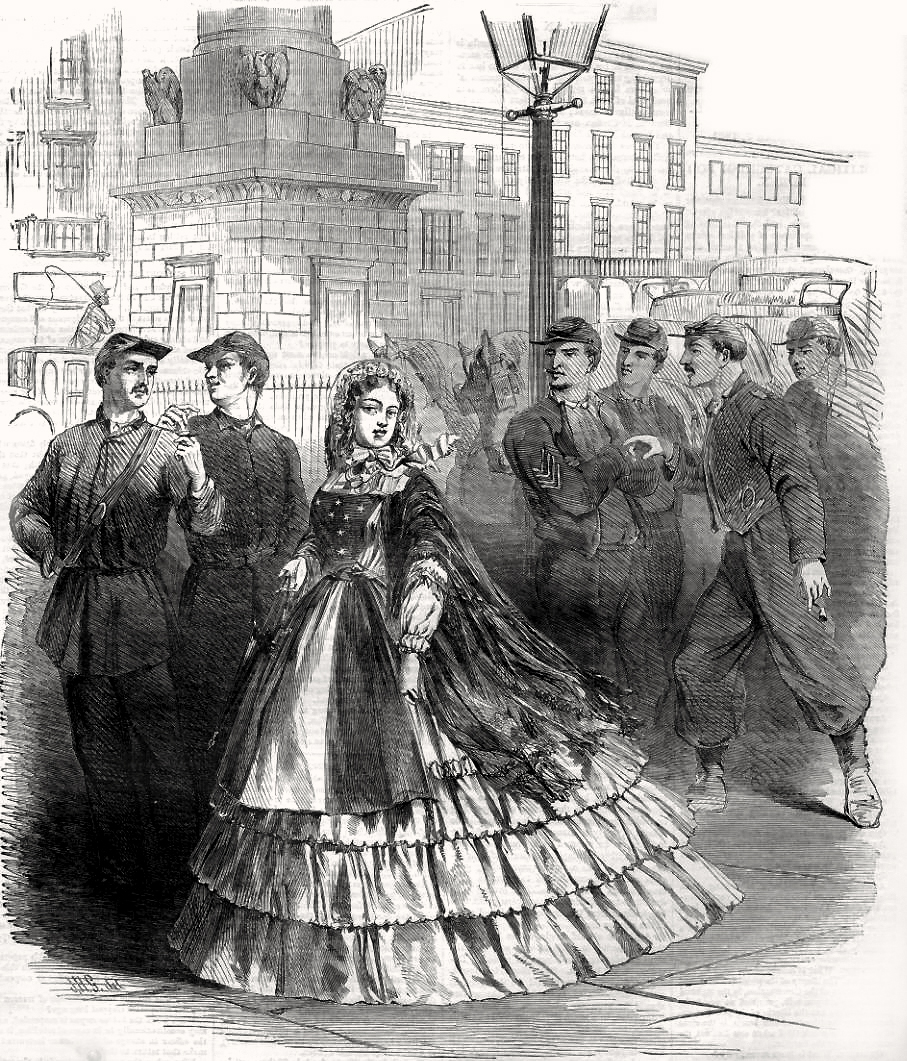
Southern-belle-civil-warThe group of women sat around a table, discussing their mother’s instructions on being a “Southern Lady.” In their storytelling manner they competed with each to relate the most outlandish piece of advice.

“I never could understand that bit about making sure I had on clean underwear before going on a car trip in case I was in an accident,” one drawled.

“Me neither,” agreed a second woman with a honeyed giggle. “If I were in a car crash and bleeding, I doubt anyone would be worried about how clean my underwear was.”

The first woman continued. “Still, she would remind me every time we got in the car. Sometimes she simply would insist that I go back in the house and put on another pair, but I would have none of that.”

“My mother would insist that I put on clean underwear, too,” a third woman chimed in. “I simply refuse to do it.”

“Intentionally wearing dirty underwear–what a great way to stand up to your mothers.” I commented straight faced.

At first they looked confused, and finally the third woman shot me a dirty look. That is difficulty with using sarcasm as humor. It is a biting way of saying what I really don’t mean to say. It brings attention to a lack of logic in a backward manner. Unlike satire, a type of buffoonery expressed when the subject of ridicule is not there, sarcasm almost always requires the presence of the person caught in the mistake to make sense. The inflection of a sarcastic comment is subtle. It is not accompanied with “Let me tell you about…” or the guffaws that often mark brazen attempts at humor. Without these cues some people  are unsure how to respond.

Psychologist Penny Pexman from University of Calgary confirmed in her study that people are more likely to use sarcasm with their friends than strangers. She also found that children as young as five can be adept at picking up the real meaning behind facetious comments. They evidently learn it from their parents. But, then research has also have uncovered significant regional differences. A whopping 20% more Northerners in the U.S found sarcasm funnier than people from the South did.[1] So I suppose I shouldn’t look too harshly on the trio of “Southern” women not knowing the appropriate way to respond to sarcasm–they need to reply with an even wittier barb.

[1] Richard Chin, “The Science of Sarcasm? Yeah, Right” Smithsonian.com, November 14, 2011
Posted in Creativity, Laughter and humor | Tagged , , , , , | 1 Comment

But am I funny?

A-fest12 022 cThere are advantages to being considered humorous, even if you do not want to spend your life in front of an audience as a comedian. People who communicate with humor are often perceive as being more socially attractive and more competent communicators. They also tend to be less lonely. Students feel that teachers who appropriately use humor are more in touch with them, and workers view bosses who crack a few jokes as having a great immediacy.

However, before you gather your collection of puns and one-liners remember that believing you are funny doesn’t necessarily make you so to others.  There is a skill involved here. Traits that are found in people who are considered humorous include: adaptability in communication, desire to make a positive impressions, orientation towards feeling/emotions, and being able to see the irony in a situation. So how do you know if you are funny? The Humor Orientation Scale has been developed by a pair of West Virginia University researchers so you can rate your Humor Orientation or HO. But there is a caveat, your peers must also think you are funny, so recruit a couple of acquaintance that will honestly rate you according to this scale.

Humor is not just the content of what you say, but also the manner of delivery. People who have high HO scores are perceived as being funnier than those with low HO scores, even when delivering the same jokes. However there are other dimensions to what is considered funny. For example, in a class room instructors who had the ability to get a group to laugh were considered more humorous by students also had high HO scores. The students with low HO scores simply did not see them as being as funny. But maybe they have stiffer requirements for humor, because instructors with low HO scores were not considered funny by either group of students.

A study from Baldwin Wallace University has linked decoding ability and humor orientation. Decoding ability involves three parts: conversational sensitivity, nonverbal sensitivity, and receiver apprehension. The more sensitive the person was to both verbal and non-verbal cues the higher the person’s humor orientation tended to be. However, sometimes sensitivity results in apprehension which led to a negative correlation to being perceived as funny.

Content of humor, however does still matter. Verbally aggressive people tend to use humor at the expense of others. Targeting others for laughs doesn’t necessarily cause a lower perception of their humorous ability but it caused their “likeability” or rating for social attractiveness to plummet according to research.

Finally, understanding the language and culture of your audience is crucial for being funny. On time I sat listening to an educational speaker who often managed to get a chuckle out of others bemoan the time he was presenting in China. “I was using the same jokes and puns that always get a laugh, but the just people sat their deadpan,” he complained. “So I asked the translator if she was translating me word for word or restating the meaning in her own words. She admitted she was restating the meaning. That’s why it wasn’t funny.”

I was taken back that he failed to comprehend that jokes and puns don’t translate well. These kinds of humor rely on words sounding similar in a particular language. I tried to explain that if she had translated his speech word for word it still wouldn’t have been funny and the Chinese audience might have thought his presentation was a bit nonsensical. However, he continued to whine about how the translator ruined his humor, which got eventually got a chuckle out of me.

Booth-Butterfield, S., & Booth-Butterfield, M. (1991). Individual differences in the communication of humorous messages. Southern Communication Journal, 56, 205–218.
Merolla, Andy J. Decoding Ability and Humor Production, Communication Quarterly 05/2006; 54(2):175-189.
Wanzer, M., Booth-Butterfield, M., & Booth-Butterfield, S. (1995). The funny people: A source-orientation to the communication of humor. Communication Quarterly, 43, 142–154.
Wanzer, M. B., Booth-Butterfield, M., & Booth-Butterfield, S. (1996). Are funny people more popular: The relationship of humor orientation, loneliness, and social attraction. Communication Quarterly, 44, 42–52.
Posted in Education trends, Laughter and humor | Tagged , , , | Leave a comment

Laughter and learning

359px-shy_guy_imagicity_5A

Photo by Dan McGarry “Shy Guy” CC BY-SA 3.0 

Imagine two different college classes: in one the instructors is always logical and serious; and in the other the instructor throws in frequent jokes only tangentially related the subject. In which class do students learn more? According to research it depends the students. In one study, Melissa Bekelja Wanzer found that humor found offensive or directed at students interfered with learning. In another study, Mark Shatz, and Frank LoSchiavo discovered that when a professor made self-deprecating jokes and included subject-related cartoons in on-line classes, students said that they enjoyed the class more.

But that research doesn’t tell us in which class the students learned more. The problem is that most studies on how humor affects learning end up with mixed results. Wasner found that when professors use a dry sense of humor when instructing, the students perceived them as better communicators. (In the same manner doctors who occasionally spoke in a witty manner were viewed more favorably by their patients.) However, if instructors repeatedly put themselves down, some students viewed them as less competent. There is no escape from the differences in what students perceived as funny. What one person thinks is sufficient enough to arouse a chuckle may go over the head of another student. What brings up a belly laugh in one, may be considered overdone slapstick by another.

John Hopkins University professor, Ron Berk, PhD, uses humorous skits to promote learning in his biostatistics class. His goal is to help students with different learning styles see how statistics work and encourage divergent learning that is applicable in real life. But humor’s role in relieving stress is what makes it valuable in his estimation. “It helps relieve fear and reduce anxiety…prior to or during an exam, humorous directions or test items may relieve students’ tension and help them perform better.”

So remember to keep your best, most relevant joke to tell just before that killer exam.


Shatz,, Mark and LoSchiavo , Frank, Teaching of Psychology, Vol. 32, No. 4, pages 246-248, 2005
Stambor, Zak. How laughing leads to learning. Monitor , Vol 37, No. 6, June 2006
Wasner, Melissa. “Use of Humor in the Classroom” In Our Teaching Behavior, Communication Education, 48—62
Posted in Creativity, Education trends, Laughter and humor | Tagged , , , | 1 Comment

No laughing matter

StateLibQld_2_177635_Serious_faced_group_of_school_children_The support shown for the people killed in the attack on Charlie Hebdo’s office appeared wide spread throughout the news. Candle light vigils, crowds proclaiming “Je suis Charlie.” It would almost seem like a great show of solidarity. But of course if this satirical journal truly had such widespread support the attack would have never happened. Satire draws selected people and current events in an absurd perspective. People are more likely to pay attention to satirical lampooning than a serious discussion of flaws. The political humor makes people feel superior, as long as their group is not the ones being lampooned. But most people made to look absurd feel more wounded when they are mocked than when they are openly critiqued.

Charlie Hebdo had a particularly irreligious brand of mockery. They been sued jointly by Islamic organizations – the Grand Mosque, the Muslim World League, and the Union of French Islamic Organizations – but not as often as they had been sued by the Catholic Church. However, this journal tended to avoid anti-Semitism. Cartoons with anti-Jewish sentiment had appeared frequently in Nazi Germany while the holocaust was going on. So this subject was no longer a laughing matter.

Which brings us to the power that satire actually has. Satirical works, whether they are cartoons and articles, or full blown books and movies, deride some person, group or belief. The idea is to shame the target so that the object of the attack seems ridiculous or grotesque.  Satire has the power to cause disregard or even hatred for the target. There is no requirement for the satirical work to be true – in fact it almost never is – but it must only be funny to a large enough group. If satire wakes the public to a great wrong, offering a backhanded viewpoint that would right that wrong, such as in Daniel Defoe’s Modest Proposal, it has a strength that simply preaching against the problem does not have. But satire’s power to be destructive is just as potent. There is little way to combat the ideas expressed by satire, other than by government suppression, which seems unthinkable to those who so proudly cling to freedom of speech.

As I was watched CNN with their constant coverage after the attack on Charlie Hebdo, I heard a man interviewed in France compare it to the September 11 attack on World Trade Center in New York. I winced. He couldn’t possibly believe these two events were similar in scope. The masses of people who died in the twin towers did nothing to provoke the attack. I could have mocked him; making him look ignorant. But satire doesn’t work that way. It is an offensive game; you must strike first. Speak back in a serious manner and you are seen as humorless. Squash it with any sort of power and it is seen as an affront.  Once satire has been attacked it takes on an aura of respectability. The best thing to do is simply not to laugh.


Posted in Uncategorized | Tagged , , , , , | Leave a comment

He laughs, she laughs


Once I heard a bit of advice spoken by one adolescent boy to another. “Do you want to know if a girl likes you? Tell a really stupid joke, the stupider the better. If she laughs, she likes you.” It has been obvious for eons that laughter has a sexual side. I am not referring to sex as the subject of humor, but the differences in the way that people of different genders perceive what is funny and how they respond with laughter.

Allan Reiss and colleagues of Stanford University studied the response of male and female brains when reading comics. To a large degree they used similar parts of the brain–the part that makes sense of semantics and juxtaposition of ideas. The difference is brain function between genders existed but barely. It was not possible to tell who was male or female by viewing the response results. The part of brain that deals with executive processing were activated more in the women’s’ brains than the men’s. The reward center in the female brain was also more active when they found a comic funny.  But this increased activity was minimal.

Let’s return to our first example. If an adolescent boy told a really stupid joke, a typical female laughing in response would be an indication of approval. His male peers would be more likely to respond with a kind of laughter known as scoffing, to show him how stupid the joke really was. Boys, and even men, commonly use humor as a kind of competitive social tactic. We ignore the way males poke fun at other males. However, when adolescent girls laugh at other girls in a ridiculing manner, they are considered “mean girls,” the kind of cliquish queen bees who use cruel humor to maintain their superiority over others.

Women’s humor is expected to be socially supportive, whether they are laughing at a man’s not so funny joke, or laughing with their female friends about a common situation. According to Don Nilsen, a linguistics professor at Arizona State University, a woman who employs the typically aggressive or competitive male sense of humor will find both men and women critical of her.

So what about men who laugh in the way that society prescribes for women, in an appeasing manner that shows support? Men do laugh that way often–in front of their bosses. Humor is not affected as much by the way genders perceive what is funny–their brain function have very minute differences according to the Stanford study–as it is by role society has assigned them. Most people will laugh at humor based what their society sees fit for their gender and their status.

A. Reiss, MD, the Howard C. Robbins Professor of Psychiatry and Behavioral Sciences and director of the Center for Interdisciplinary Brain Sciences Research. Dean Mobbs, Nov. 7 online issue of the Proceedings of the National Academy of Sciences.
W. Lawson, “Humor’s Sexual Side” Psychology Today, article 200508, published on September 1, 2005 – last reviewed on December 20, 2012


Posted in Group psychology, Laughter and humor | Tagged , , | 1 Comment