Too bad to be true

17 smog 023cSir Thomas More, a scholar, lawyer and statesman published a novel in 1516 describing a perfect civilization. According to the book, this too real to be true society existed on an imaginary island that he dubbed Utopia.  Of course, More was not the first to attempt to do this; he was heavily influenced by Plato‘s Republic, written over 18 centuries earlier. The utopian novel is an ancient idea.

The word More coined was used a few hundred years later by John Stuart Mill to create another new term, dystopia, a society too bad to be true. Dystopian literature is by no means new either. There are ancient texts that describe a society which is deeply flawed, and yet citizens continue to serve the powers that be, unaware of their enslavement.

The creator of modern works in this vein is often credited to the Russian author Yevgenv Zamyatin. He created a future world of complete human conformity in his novel We.  However, Jack London published Iron Heel over a decade earlier. London’s book described the rise of unscrupulous big business in an economic dystopia.

Dystopian novels almost always take place in a future society based on false ideals resulting in oppression. The particular flaw the society varies widely, based on what the author perceived as the existing threat to humanity. They often detail how humans are required to live in an enforced conformity to support theses skewed ideals, which  masquerade as the path to utopia. The environment that people inhabit is frequently artificial as well, highly urbanized with wild or natural areas restricted to the perimeter. The hero is typically awakened to the hidden controller of the flawed society by another character, an individualist that often does not survive. For the protagonist there is no going back. Once enlightened, the only options are escape, bringing down the society, or death.

Except in the case of one of the most famous dystopian novels 1984, which ended in a type of brainwashing. George Orwell feared the rise of authoritarian governments under the guise of protection of the common people. He depicted how this situation would result in a small oligarchy reaping all the benefits at the expense of the working class in Animal Farm, an allegory that is uniquely without an individual protagonist as well as his more frightening novel, 1984.

In Brave New World, the worship of technology allows the upper classes to experience lives devoted to pleasure and possessions at the sacrifice of the genetically engineered lower classes. Aldous Huxley introduces an upper caste man raised in the savage regions into his dystopian world to show the hopelessness of being free to live selfishly but forbidden to feel any kind of moral qualms.

Sometimes the human desire to erase the memory of any unpleasantness or pain is what leads to the twisting of a civilization into a dystopia. Such is the case in Ray Bradbury’s book burning society in Fahrenheit 451, and the deceptively innocent looking community in The Giver by Lois Lowry.

Of course, there is currently the flood of newer dystopian novels on the market. But, as the popularity of this genre rises many have forgotten the original use of it as a warning, and not simply a high adventure account of the overthrow of an evil government.

Posted in Literature, Writer's resource | Tagged , , , , , , , | 1 Comment

Glare of the limelight

Dscn0139crop

While watching a recent bone crunching pro-football game on TV, I saw a player dive into a fracas and come up the fumbled football. He took off for his goal, running for the sidelines to avoid being pummel by a pile of opposing players.  With the TV camera in close I could see his grin as his teammates gave him congratulatory fists to the his helmet. It looked like his head was being knocked around inside his helmet.

“Doesn’t that hurt him?” I asked.

“Players frequently do things to their own players that would result in a penalty if they did  it to an opponent,” was the response of a more sage sports aficionado.

If you read many of the current sports books you will find there is a much darker side to sports than the painful  celebratory punching that occurs between team members. The same sports aficionado advised me that “There is probably a greater percentage of felons who have worn an NFL uniform than the percentage of felons in the general public.”

So I decided to look back at classis sports novels to trace the “cultural development” of this bad reputation, only to find that there is a paucity of sports novels written before 1950. One of the most well-known, The Natural by Bernard Malamud, loosely based the life of Eddie Waitkus, was published in 1952. The novel has a darker, more realistic ending than the popular movie. The baseball prodigy, who loses his best years is a more reckless character that doesn’t succeed in his comeback and fails to win the big game for the pennant.

Occasionally there are more light hearted views of the sporting life such as George Plimpton’s Paper Lion, a real account story of how he gained access into the Detroit Lions’ training camp practices despite obvious ineptitude as a athlete.  But other than the scrubbed clean sports books for preteens and younger, many of the current “true stories” in sports describe a litany of gambling, dirty dealing and drugs that make the opponents seem like the least of the player’s worries.

Even in Friday Night Lights, H.G. Bissinger’s candid coverage of one dramatic season for the Permian High School Panthers,  there are painful revelations about high school football. The town gathers ritualistically to cheer on its athletes, who lose much in their gamble to become a stars, and are discarded as soon as they are no longer useful.  Sports have been around since ancient times, but their imprint on anything resembling literature has been fairly weak until recently. I suppose the heroes of the playing field have replaced the heroes of battle. And you are probably well aware of all the novels about the darker side of war.

← Back

Thank you for your response. ✨

Posted in Literature, Writer's resource | Tagged , , , , , | 1 Comment

The distant lands of home

Biltmore (77)aIn grade school I would skim the readers for something intriguing, passing over stories of everyday American life and fun science facts for narratives about other countries. As  junior high student I soaked up Jules Verne adventures in distant places such as the famed  Around the World in Eighty Days, 20,000 Leagues under the Sea and the lesser known Michael Strogoff: Courier of the Czar.  As an adult I discovered he chafed under the formulaic requirements imposed on him for writing these shallow adventure novels. But they were the right stories to get me hooked on reading at that time. (Maybe, if these same requirements were followed by some of today’s YA novelist their works would actually improve).

Often in secondary education, we foist the best works of classic authors on students when they are not ready for the abstract thinking required to appreciate it. There is another option to turning off students or only giving them modern authors to read. It is introducing them to the more accessible, popular early works from which classic writers went on to build their reputation.

Many American authors start their career by describing their travels, and returned to novels set in their own backyard later. These works are largely autobiographical with little or no symbolism and deep meaning to uncover – just a record of their own real life. Three of the most famous started off writing on long passages on the sea:

  • Herman Melville of Moby Dick fame, first wrote largely autobiographical works such as Redburn and White-Jacket to describe his adventures as a sailor.

  • Mark Twain wrote Innocents Abroad, a humorous view the naiveté of Americans on a cruise to the Middle East and Life on the Mississippi to describe his own days as a river man.

  • Jack London wrote the purely adventurous John Barleycorn before completing The Call of the Wild and Sea-Wolf on which his fame rests.

Sometimes, however, travelogues are the work of a mature writer, John Steinbeck, widely known as for his stories of the Great Depression also chronicled his 1960 trip across the country in Travels with Charley: In Search of America. Steinbeck doesn’t simply describe the new scenery, he reflects on his own life, and the flood of changes that had washed over the country that he knew as a much younger man. But this nostalgia is a more recent one that students may be able to connect to.

One of the more current travel novel for adolescents is Into the Wild by John Krakauer. The journalist traces the path of a self-disenfranchised wealthy young college grad as he attempts to reinvent himself in a quest to live a life free of society’s trappings. Despite initial success, Chris McCandles’ follows the lure to go farther into the wild, which up ends up being deadly. Not particularly optimistic – but real.

Into the Wild also discusses Chris McCandles’ connection with transcendentalist philosophy. Most teenagers become bewildered trying to pin down the defining elements of this intellectual revolt against traditional religion. A quick look into the life of Ralph Waldo Emerson and Henry David Thoreau (or any other member of the Transcendental Club) can help to enrich this book. However, students will discover that although the Transcendentalists idolized nature and decried the negative influence of society in their writing, they never managed to live off of nature separate from society. And learning to see the difference in what is said and done is a good introduction to abstract thinking.

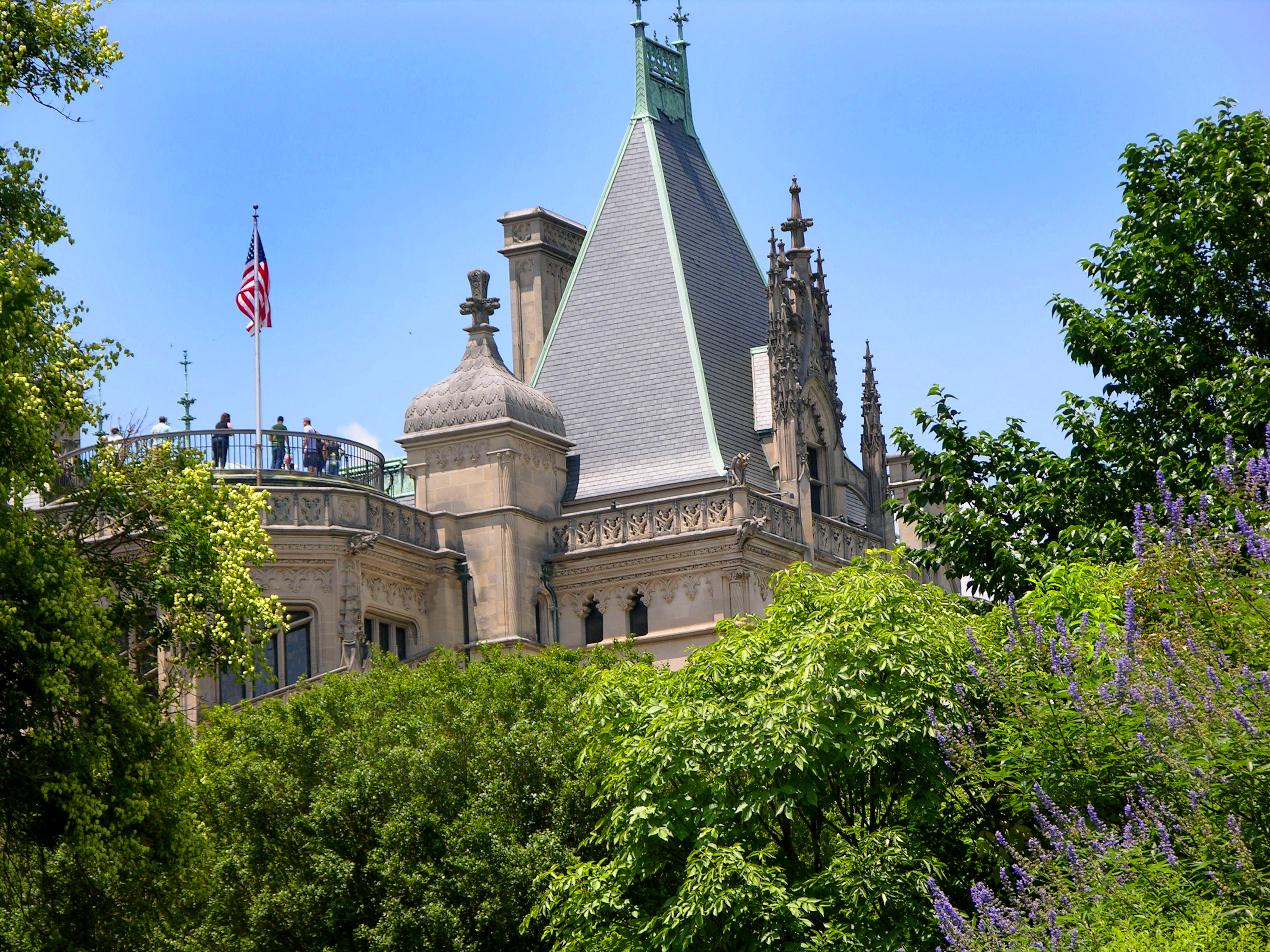
Photo of Biltmore Estate in Asheville, NC

Posted in Literature, Writer's resource | Tagged , , , , , , , , , | 1 Comment

Ten top reasons not to read classic literature

grimm's grave w10 – There are so many choices of books to read now, why bother with less relevant writing from the past. There is also a lot more to learn in the fields of history, science and math so while we’re at it, why don’t we just pare them down to the important events of the last fifty years, too.
9 – Most of the people who wrote this literature stuff are long dead. This is also another good reason to eliminate the all the history we now have to study now.

8 – The people who wrote classic literature, do not really know what our life is like. Of course, the most influential people alive now–political leaders, business moguls, movie stars–probably don’t know any more about the way we live.

7 – We want to read about what matters to us now. However, if we read only what is current we tend to think everyone’s writing is tied to the fads of their time.  What do you mean by claiming that some past authors actually captured the nature of humans across the ages?

6 – Classic literature is just too difficult for most people. Of course, if you ever tried to hit a curve ball, pass a football to a surrounded quarterback, throw a basketball through a hoop twenty feet away, or skate without falling down and failed, you should had realized that these things are just too difficult and given up on them, too.

5 – Movies are much more enjoyable. It’s true, if you start reading and find that movies are simplified, action driven versions which leave out much of what’s interesting in a book, you won’t enjoy watching movies as much.

4 – Reading takes too much time. It’s ironic but people can read about three times faster than they can listen. So if a TV series like Survivor was transcribed (dialog and description of action) to be read, you would spend one third of the time reading it that you would spend watching it, but it also might seem less interesting without the scheming intonation of their voices.

3 – They take too long to say things and nothing much seems to happen. Sort of sounds like a season of Whales Wars. Some old classics can be wordy. Remember they were serialized and should not be read in one sitting, but in stages like a TV series is viewed.

2 – The publishers need the money now that people can self-publish on the internet. Let’s make the students go out and buy copies of recent best-sellers to keep the publishing industry solvent.

1 – After reading enough paranormal teenage romance and dystopian gladiator stories, everyone will be so tired of the same stock characters and plots that they’ll actually want to write their own books.

(Yes, it’s satire)

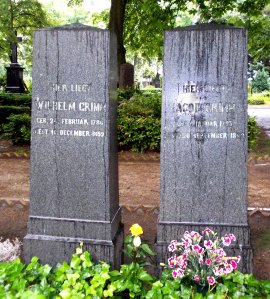
Photo of Grimm’s brothers graves by S.L. Listman

Posted in Literature | Tagged , , , , , , | 1 Comment

How to play the words well

Meister des Codex_Manesse (Grundstockmaler)Do a little bit of research on the internet and you will soon come up with vast lists of literary devices in addition to the ones that I have discussed. But it is too overwhelming to start employing them all. Mastering literary devices is like playing an instrument – you must practice to improve your performance and work on only a few songs at a time.

So how do you practice?  First, start with your own writing. Check to see which devices you are already using. For convenience I usually sort usually categorize them according to the following:

I have seen students with an interest in writing use a device without any idea that it was a defined concept. One elementary aged student began the narrative of her first overnight camping trip telling how she grasped the pretty red fruit of the prickly pear and howled in pain. After a rather rambling list of events, she ended the account with another camper teaching her how to prepare the spiny fruit to eat. When asked how she decided to organize her story she said “I started and ended with the prickly pear ‘cause I know how to camp now.” Creating the envelope as a plot device to show her progress made sense to her.

Then, take a few things that you’ve written that seem bland and tasteless. It helps to have works from more than one genre, such as a narrative, a essay, a persuasive presentation, or poetry. Look at two to three types of devices that grab your attention. Incorporate a couple of each into the existing writing. Return to the list, find some more devices that you have not tried and do the same again. And then repeat again.

As you continue to layer on literary devices to a single piece of writing you will find it reaches a saturation point. After which it becomes something you must slog through, rather than an interesting composition.  Learning how to handle and apply literary devices with the right touch is part of the process if you want to learn how to play the words well.

Art work  Codex Manesse (public domain)

← Back

Thank you for your response. ✨

Posted in Literary devices, Teaching writing skills, Writer's resource | Tagged , , | Leave a comment

Wilde words

407px-Oscar_Wilde_3g07095u-adjust

Sometime in the eighties I noticed a shift in the focus of television sitcoms–the humorous situation was gradually being replaced by humorous banter. Witty retorts were more important than amusing events. In fact, often the events would be minimal. The entire plot may have been based solely on the character’s illusions, often nothing happened but clever conversations. Sometime the events in comedies actually struck a painful nerve. But, the audiences continued to laugh as the actors cut each other down a notch with witty retorts.

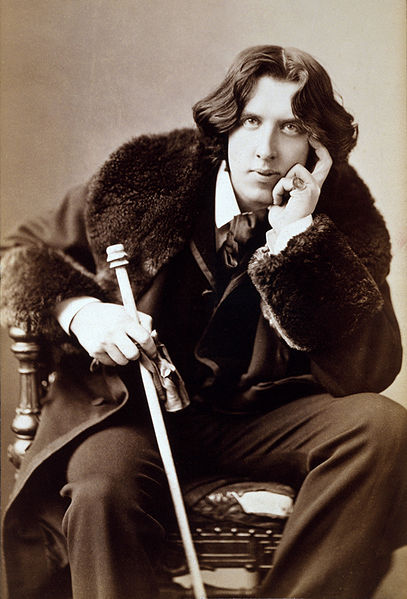
This is not the first time that ‘witty’ words have been prized over plot. Oscar Wilde, a 19th century Irish writer and poet wrote many poems, essays, short stories and plays. However, other than the fame achieved through his one novel The Picture of Dorian Gray, and his hit play, The Importance of Being Ernest, Wilde is mainly known for his epigrams, wry observations about life. An example of his wit is found in an article in the New York Tribune.

And, after all, what is a fashion? From the artistic point of view, it is usually a form of ugliness so intolerable that we have to alter it every six months.

Epigrams are short, clever statements (or poems) that have been recorded ever since Ancient Greece. Each culture has its own kind of humor but there are some basic devices:

Paradox–like Wilde’s quip about fashion it states an apparent contradiction or incongruity that on second glance may actually be true. Wilde is also quoted as saying the following concerning one of his critics in The New-York Herald:

If it took Labouchere three columns to prove that I was forgotten, then there is no difference between fame and obscurity.

Litote –a rhetoric device that uses a negative to discretely mention something that is not particularly pleasant without being too critical. As Oscar Wilde would write in “The Birthday of the Infanta”

He is really not so ugly after all, provided, of course, that one shuts one’s eyes, and does not look at him.

Euphemism–a softened ways of describing what we fear, such as death, or discuss inappropriate matters to like sex and violence. Similar to litote, a euphemism underplays the impact and the words true meaning. Oscar Wilde created his own in The Nihilist:

Experience, the name men give to their mistakes

Satire–is type of parody which ridicules the follies of society by seeming to imitate real events, but not quite. Satire can also be leveled against work of art and fiction and especially other writers. Familiarity with Shakespeare’s monologue from As You Like It makes the satirical restatement by Oscar Wilde more cutting:

 The world is a stage, but the play is badly cast

In each case there is an irony, a play on words where ordinary wisdom is twisted into a new meaning in a way that seems humorous–at least on the surface. But the underlying meaning may end up being as bitter as Oscar Wilde’s own end.

Photo by Napoleon Sarony [Public domain]

Posted in Literary devices, Literature, Writer's resource | Tagged , , , , , , , , | 2 Comments

The merits of fictional characters

Macron02

Having seen discussion boards in which people spend time arguing about the merits of fictional characters, I would assume that a number of readers prefer these imaginary people to real ones. Fictional characters may be braver, more beautiful, or have greater ingenuity than real people so it is easier to become attached to them. But the real advantage is they don’t talk back and readers can imagine them however they desire. But, the same is not true for the people who create the stories. I can attest to a number of times that authors have related incidents in which characters they have created refuse to behave in the manner that the author envisions.

Characters live in the author’s heads, sometimes ignore their directives and even argue with them as the author tries to capture them with words. These finite words are the only way that reading audience may become acquainted with the character. There is the easy way to do this. Tell the audience directly that main character is a tall, muscular, fearless, and impatient man that speaks four different languages, has a preference for blonds and BMWs, and a severe allergy to peanuts. Then, there is the better way–write the narrative in a manner so the reader can observe the character, follow what he does, see how he reacts, hear what others say about him, and even listen to what he thinks about these other characters.

The next challenge is embellishing all the other less important characters, which is necessary unless you are writing a new version of Robinson Caruso. You cannot create them all with the same detailed development reserved for the main characters unless you want to drive your readers up a wall. Simply naming each character is confusing. We only want to spend the mental energy to keep track of the names of a few major characters and their sidekicks. Each minor character who is seen repeated times should still have a bit of individuality, like a quirk in behavior or a physical trait to make them distinguishable from the others.

So here are some usable shortcuts to creating characters:

Archetype–the embodiment of a collective set of characteristics for universal types of humans. Archetypes include the mentor, a wise old man or woman willing to share their wisdom with the hero, or the trickster, a lively characters whose loyal is always suspect.  Archetypes must be fleshed out with details to make them unique and different from other characters who are the same archetype, otherwise they are simply a stereo type.

Doppleganger–a character who looks identical to a main character. The doppleganger, can be an empathetic companion or an evil twin. Technically the doppleganger is an archetype, but their traits may be the same or opposite of their spitting image. They don’t have the boundaries of other archetypes.

Foil–a character who is pretty much the opposite of another, usually the protagonist. For example, a clumsy, shy foil would make your protagonist seem suave and cosmopolitan.

Semi-Round character–a partially developed character that has a contradictory trait or two to keep them from being flat and boring, such as an actor with stage fright.

Stock characters–a stereotype already created by the culture who behaves in an expected manner, such as the dumb blond or the ruthless drug dealer. Use the flat characters for those without enough importance to be named. They may appear once or twice and then they are gone from the story and often from the reader’s memory.

Creating complex characters for the protagonist, the antagonist and their cohorts is usually both more difficult and more satisfying for writer and the reader. Of course, some readers would rather simply be told what each character is like and they actually enjoy major characters who are stereotypes. Flat main characters are predictable and do not requiring any close observation or deep thought while reading. As a writer you have to decide who you are writing for and if you can live with your decision.

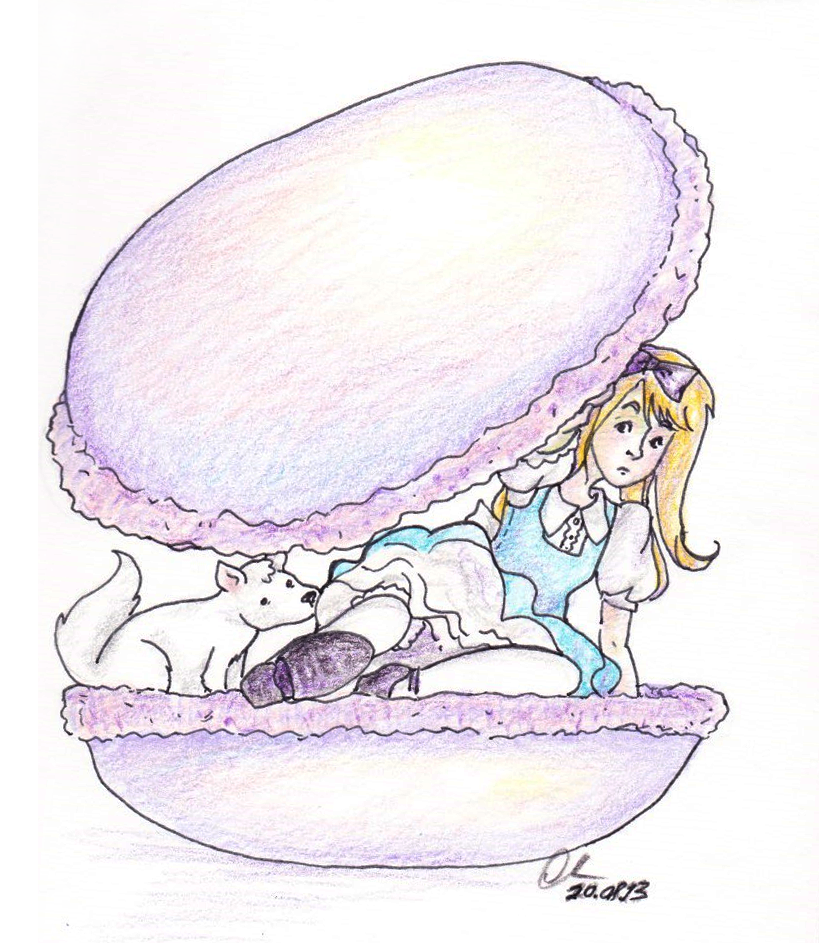
Artwork – Macaron by S.L. Listman


← Back

Thank you for your response. ✨

Posted in Literary devices, Story structure, Writer's resource | Tagged , , , , , , , , | 2 Comments

More than what you see

IMG_4708 imagery2The term ‘imagery’ brings to mind, of course, images–verbal pictures that allow us to peer into the world which an author has dreamed up.  Imagery sometimes implies page after page of descriptive detail–in which case you might risk having the readers fall asleep and start dreaming up their own worlds.  But, a story without enough visual detail leaves the characters moving in an unsubstantial shadow land.

Imagery should includes more than what you see in your mind’s eye. It also needs to bring to life the sounds, smells, tastes, and textures of the world you have created. One of the appealing aspects of writing is that you do not have to stick with the conventional. Music can be  ultramarine blue or a person’s scent can be rough and sand papery. Using these metaphors which cross the senses is  called synesthesia, a term referring to a neurological condition in which senses in one pathway involuntarily leads to another. A person with synesthesia may see the number 5 and sense the smell of cinnamon.

How do you include imagery without overloading the reader with unnecessary detail? Beyond the senses, imagery should reflect the interior mood of the characters. The characters are not omniscient and do not pay attention to everything. They regard what they find worthwhile out of love, fear, ambition, or other desires. The writers has to get inside the characters head to see, smell and hear the world as they do. The sound of rain may be the dance of water sprites, or the dull thudding of depression, depending on your character.

This should not be so difficult. Right? After all you created the character. However,  it feels a bit like self-induced schizophrenia to be considering how each of many characters perceive the world around them.  The other challenge is that imagery cannot be subtle or its significance is lost on the reader. There is no easy short cut to descriptive passages that draw in the reader. The best advice is to practice. Create imagery and cut it down unmercifully, like a prospector washing tons of gravel until only the glinting grains of gold remain.


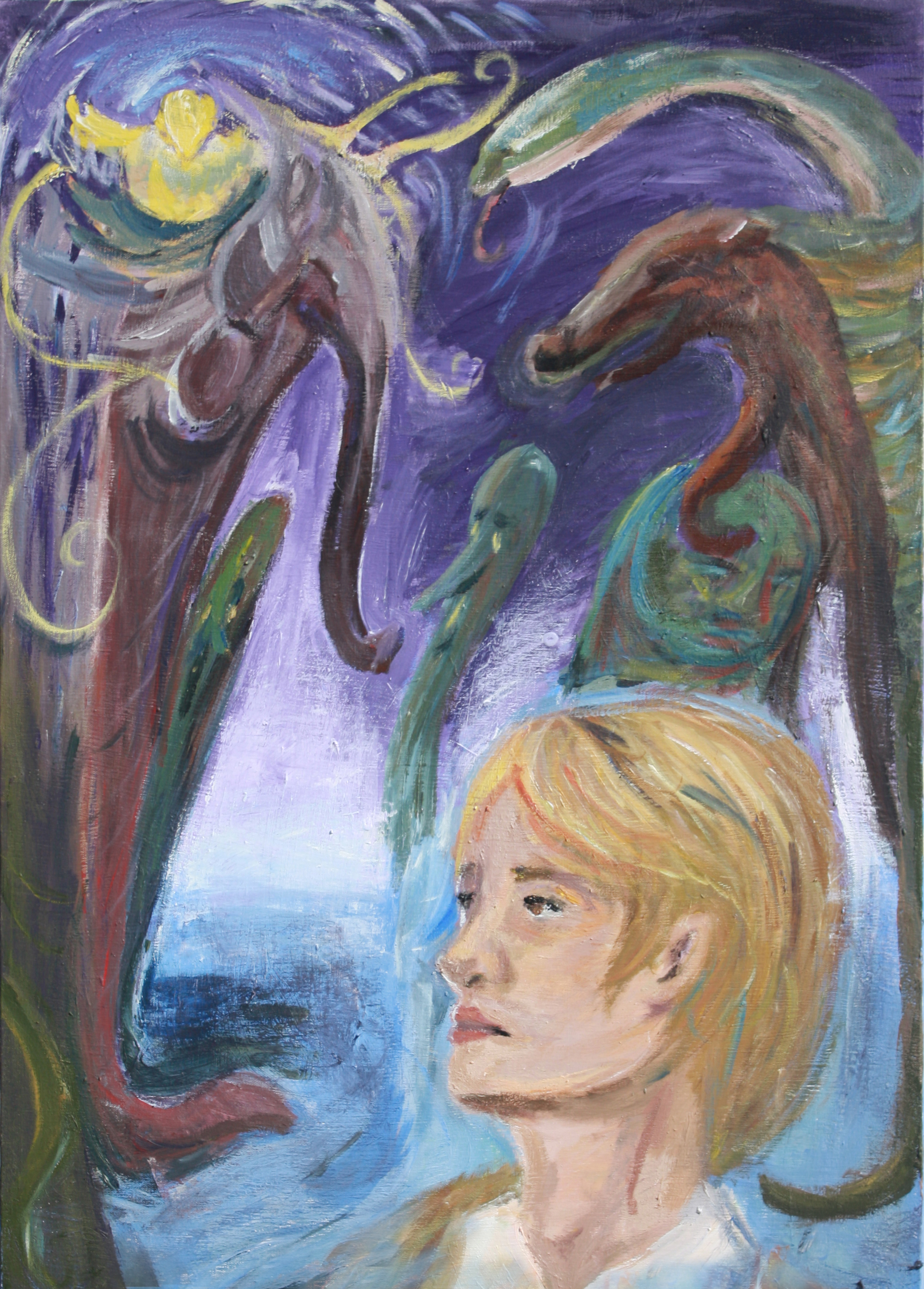
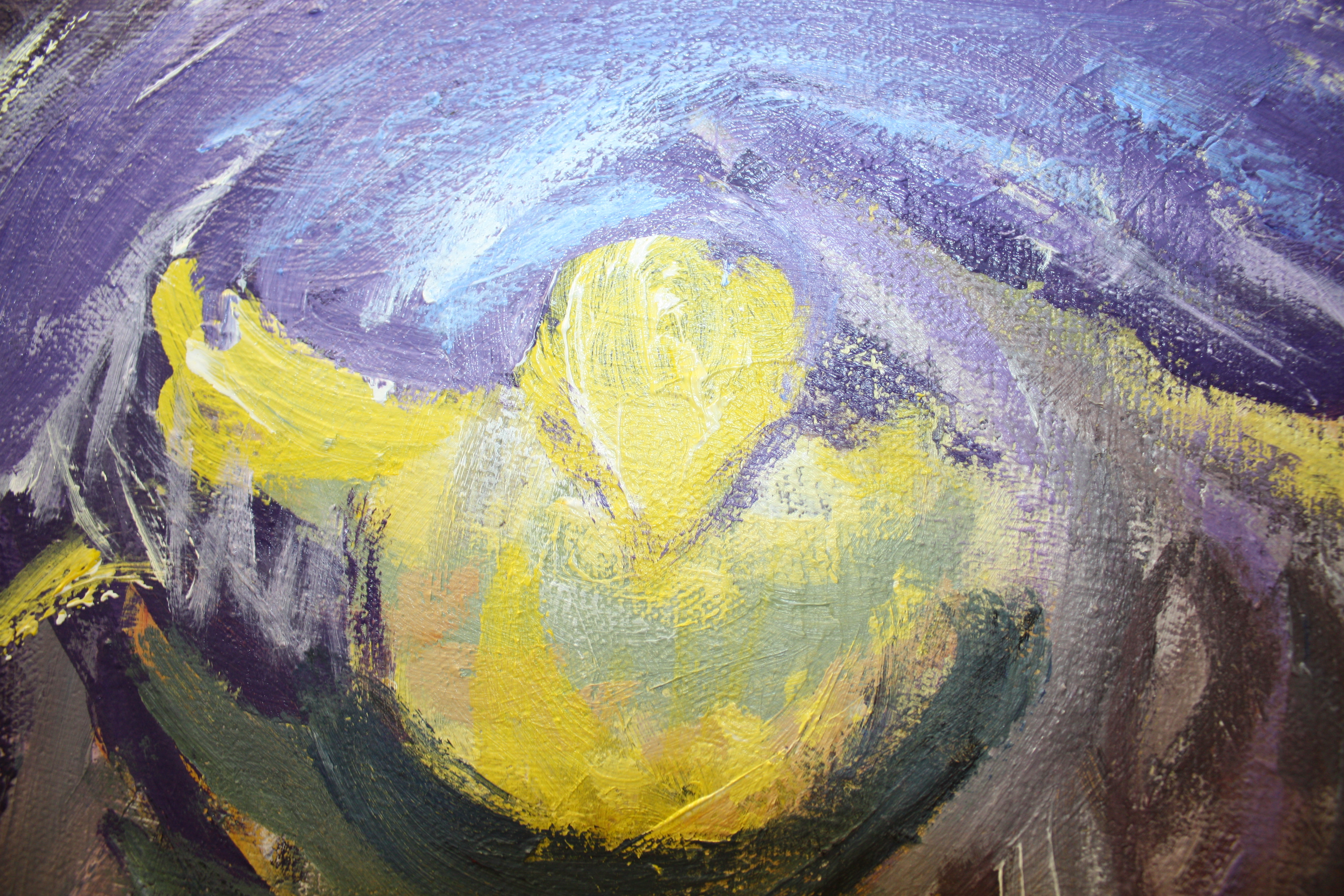
Artwork – detail from The Shadows that Follow Me by S.L. Listman

Posted in Literary devices, Style and voice, Writer's resource | Tagged , , , , , | 2 Comments

Playing musical words

stephs (4)One of the quickest ways to make your writing voice stand out from the crowd is to master the use of literary devices. Some devices are just fancy names for specific types of diction and syntax.

For example, anastrophe is a type of hyperbaton in which the position of a single word is changed from the normal syntax for emphasis. In case that definition doesn’t make sense,  you can just remember that anastrophe is what makes the speech of Yoda in Star Wars so distinctive.

However, there are many more literary devices that have potential. These involve selecting words for their actual sounds, as the sloshing, crackling, twinkling onomatopoeia words. I fondly think of these as the ‘musical’ literary devices. Longer words, with many syllables ending in vowels, like onomatopoeia, sound elegant, while short consonant bound ones, such as slang, carry a cocky connotation. I’ve witnessed people discussing whether it is more important to be intelligent or smart. To me that is a moot point, as both words mean the same thing. However, people base shades of meaning on types of sound. (This is important to remember when naming characters.)

You can consciously change your writing voice by selecting words that alliterate, or begin with the same sound. Be aware of overusing alliteration in a mnemonic manner such as persuasive writers and speakers are fond of doing. Every point you make does not have to begin with the same letter. Instead look at Robert Frost’s poem Birches which uses words beginning with “b” in a playful manner for his celebration of the simple joys of youth.

Consonance, or repeating a consonant at places other than at the beginning of words, as in “barn,” “turn” and “consternation” has a similar poetic effect. Assonance refers to the intentional repetition of vowel sounds, like the long “o” in Edgar Allan Poe’s Eldorado. English does not have a huge number of vowel sounds so that readers may not be swayed much by the effect of assonance. However, combine assonance with ending consonance and you have the ever popular sound of rhyming words. Again, don’t go overboard with this device.

The pleasantness or harshness of word when read aloud has a subtle impact on mood even when they are read silently. The word cacophony contains one element that makes a word harsh–the repetition of the “k” sound. Repeating other voiced consonant, such as “d,” hard “g” and “z,” also create a guttural sound. Euphony–the beautiful sounding effect–is created by using words full of unvoiced consonants such as the soft “s,” “l,” “j,” and the “f” sound, which is found in the middle of euphony.

Does getting down to the sound of letters really affect the way people perceive your writing? Have you heard of the Bouba/kiki effect? The sound of letters affects the way people perceive shapes (https://en.wikipedia.org/wiki/Bouba/kiki_effect). We probably all realize this is also occurring in writing, even if no one has managed to construct an experiment to prove it yet. So, keep on playing with musical words to embellish your tone of voice.

Posted in Literary devices, Style and voice, Writer's resource | Tagged , , , , , , , , | 2 Comments

Deciding on a direction

TX_dallas b

“Say what you are going to say, say it, and finally say what you have said.” I don’t know how many times I’ve heard this rule for organizing the written word repeated in the educational realm. But rules are meant to be broken. Following this rule consistently will end up putting your readers to sleep. So many formulas to create structure in writing breed boredom instead. Good writing requires movement towards a goal, without being completely predictable.

There are multiple types of graphic organizers to assist the writer in brainstorming: such as branching, bridging, and bubbling. However, consider exactly how the reader would comprehend a composition if you wrote it with one central idea and all the related sub-ideas jutting out in different directions? This would be like constantly returning to home between every leg of a road trip. There is no way to get away from the fact that reading is a linear activity. When you examine all the types of organizational schemes for writing they fit into one of two categories: time-based narrative (sequential) or subject-based (non-sequential). Organizing your thoughts as words actually requires a progression towards an end using one or both of these.

Fiction, biography, history, and the unbelievable true story are predominantly sequential. But flashbacks, flash forwards, clusters of events and parallel accounts all break into the march of time so the narrative doesn’t always move forward. There is a larger, overshadowing orderliness based on the theme.  Being conscious of this helps you know when to insert a time bending device, such as flashback, because it assists the reader in understanding the next step forward to reaching the goal.

Non-sequential writing may move from topic to topic based on location, people or some other criteria, such as a biological tree. However, the overarching movement is normally from a topic of less importance to one of greater impact. Subject-based writing may still contain many chronological narratives. In fact rarely do you find a book or article that is exclusively composed of sequential narrative or discussion of topics. Most writing is a blend.

Finally there is the matter of digression–the comment only barely relevant to your article, story or book. Many authors divert from their goal to expresses a pet peeve, or to praise a tangent idea. When is it okay to digress? There is no hard and fast rule. If there were, you would only be breaking it to keep your writing interesting. You must decide if the digression adds to the color of the story, gives insights to your view of the world or simply makes the piece incoherent. As with other characteristics of voice, organization requires judgment, and that is why it reflects your uniqueness.

← Back

Thank you for your response. ✨

Posted in Story structure, Style and voice, Writer's resource | Tagged , , , , , , | 2 Comments